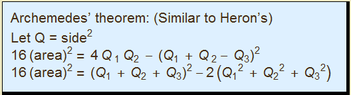
Let the sides be $a,b, c$ and $a \le b\le c$
now there are 2 cases
$a = 2$ or all are odd
if A is area then $A^2 = \dfrac{( a+b-c)(a+b+c)(a-b+c)(b+c-a)}{4}$if all are odd then all 4 terms on the numerator of RHS are odd then $A^2$ cannot be integer so A cannot be whole number
case 2:
for $a= 2$ and $b = 2$ or $a= 2$ and $b != 2$
$a = 2\, b =2 \, => c = 2\, or\, 3$
$a =2\, b = 2\, c = 2 => A^2 = \dfrac{6*2^3}{4} = 12$ so A is not integer
$a =2\ , b= 2\, c = 3 => A^2 = \dfrac{7 * 1 * 3 * 3}{4}=\dfrac{3^2*7}{2^2}$ so A is not integerif $b\ne 2$ then $b= c$ because if $c \gt b$ then $c\ge b+2$ or $a+b\le c$
so we get $A^2 = \dfrac{(2+2b)* (2b-2)* b^2}{4}= \dfrac{b^2(b^2-1)}{4}$ cannot be a perfect squareso no solution