Can I Handle Tenenbaum/Pollard's ODE Book After Calc III?

  • Context: Undergrad 
  • Thread starter Thread starter sponsoredwalk
  • Start date Start date
  • Tags Tags
    Book Ode
Click For Summary
SUMMARY

Students transitioning from Calculus III to Ordinary Differential Equations (ODE) should consider the book "Ordinary Differential Equations" by Tenenbaum and Pollard as a supplementary resource, but it may not be sufficient as a standalone text. The discussion highlights that a solid understanding of calculus is essential, and many recommend "Differential Equations with Boundary-Value Problems" by Dennis G. Zill & Michael R. Cullen (6th edition) for its clarity and organization. The complexity of ODE is emphasized, with many students finding it significantly more challenging than previous calculus courses. A thorough and complete textbook is necessary for mastering ODE concepts.

PREREQUISITES
  • Solid understanding of Calculus III concepts
  • Familiarity with Ordinary Differential Equations (ODE)
  • Experience with self-study techniques
  • Knowledge of boundary-value problems
NEXT STEPS
  • Research "Differential Equations with Boundary-Value Problems" by Dennis G. Zill & Michael R. Cullen
  • Explore the "Ordinary Differential Equations" by Tenenbaum and Pollard for supplementary learning
  • Study the differences between ODE and PDE to understand their unique challenges
  • Investigate additional resources or solution manuals for ODE textbooks
USEFUL FOR

Students of mathematics and physics, particularly those transitioning from calculus to differential equations, as well as self-learners seeking comprehensive resources for mastering ODE concepts.

sponsoredwalk
Messages
531
Reaction score
5
Hi, I'm nearly finished with calc III ala Thomas Calculus. I'm really just clearing up any stray concepts and was thinking of getting the Dover book Ordinary Differential Equations by Tenenbaum/Pollard. I'm wondering would the book be a giant leap?
https://www.amazon.com/dp/0486649407/?tag=pfamazon01-20
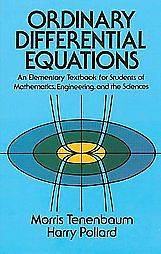
1a_8.JPG


The books looks, to me, easy enough if you have a rock solid understanding of calculus but I'd like a few second opinions on that. I'm currently studying physics and I think this book would aid me in getting more advanced texts.

The main question is, would I be able to handle this book based on the knowledge books like Thomas Calculus & University Physics (Young) impart?
 
Last edited by a moderator:
Physics news on Phys.org
I have been a self studier on Cal III and now PDE. But I did take the class in ODE. I have quite a few other books on ODE and I find:

Differential Equations with Boundary-Value Problems by Dennis G. Zill & Michael R. Cullen 6th edition the best...Without a doubt.

This book for one is easier to understand. It is well organized. It does have a solution manual but the student edition is not very good. You have to get hold of the instructor's manual. I am still using it as reference for my PDE study because part of it is even better than my Asmar PDE book.

It is going to cost more than the one you questioned, but cheaper is usually not better. I am a self studier and I buy so many books on the subjects I study. I usually have at least 5 books on each of the topic I study. I found expensive books are not necessary good, but the cheap ones are usually not complete. It is only good for maybe reference, never good for studying the subject. I can't help be a sucker for the price, I have a pile of those to show for! I yet to find one of those cheaper books useful for studying the subject. For reference and quick lookup, they might ok. It is almost like they serve as enhancement if you are taking a class or companion of a real textbook, not a stand alone book.

The other one I found useful is the one by Boyce. But this one is harder and is not as well organized and is not complete. But this one have more detail derivation if you really want to dig into it.

BTW, ODE is very very different from the first three Cal class. It really took me a while to bend my mind over! So you really need a complete book. I though the same way after my vector calculus study. I thought ODE was just an after thought! I was surprised, total suprised. I got the first in the class, but I spent sooooooo much time on this subject! I don't even find PDE is that hard compare to the ODE! It was the shocking factor that it was so different for me. So be prepare to dig in and have fun! believe me, I am not the only one that feel this way, Other students in the class said so too. They all said they spent so much time on this subject compare to the other classes.
 
Last edited:

Similar threads

  • · Replies 7 ·
Replies
7
Views
4K
Replies
3
Views
2K
Replies
22
Views
17K
  • · Replies 55 ·
2
Replies
55
Views
12K
Replies
3
Views
11K
  • · Replies 11 ·
Replies
11
Views
5K
  • · Replies 10 ·
Replies
10
Views
11K
  • · Replies 4 ·
Replies
4
Views
2K
  • · Replies 9 ·
Replies
9
Views
5K
  • · Replies 7 ·
Replies
7
Views
4K