Can PDF values be equal to zero at some given points?

Join the discussion
Ask a follow-up here, or get your own question answered by working scientists, mathematicians and engineers — people, not an autocomplete.
Real named experts · corrections over time · the nuance an AI answer skips
4 replies · 4K views
Schwann
Messages
7
Reaction score
4
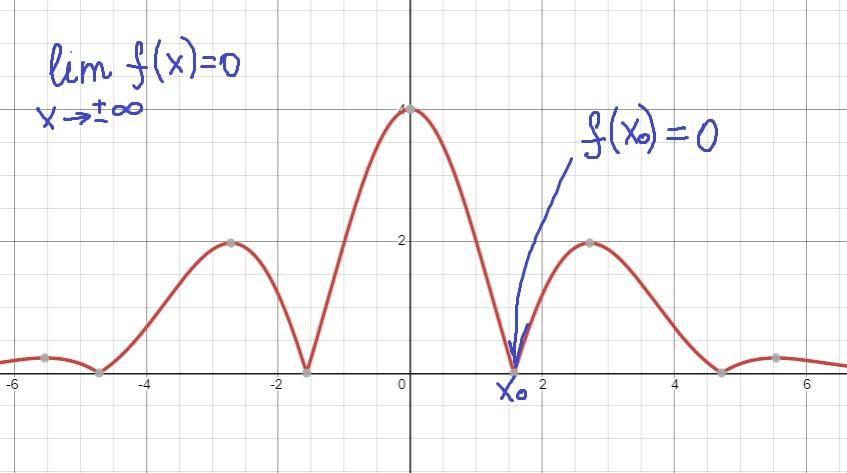
Suppose we have a function which looks like this:
probability.jpg

It seems like it meets criteria of probability density functions: this function is asymptotic to zero as x approaches infinity and also it is not negative. My question is: if at some points this function reaches zero (as I have shown above), does that mean that in cannot be PDF?
 
Physics news on Phys.org
An example of a well-known absolute continuous distribution with density function that is zero on a set of infinite measure is the gamma-distribution and the exponential distribution (which is a special case of the former).
 
  • Like
Likes   Reactions: Schwann
Schwann said:
Suppose we have a function which looks like this:
View attachment 252880
It seems like it meets criteria of probability density functions: this function is asymptotic to zero as x approaches infinity and also it is not negative. My question is: if at some points this function reaches zero (as I have shown above), does that mean that in cannot be PDF?

If you have a Borel-measurable map ##f:\mathbb{R}\to [0,\infty[## such that ##\int_\mathbb{R} f =1 ##, then we get a measure

$$\mu(A) =\int_A f d\lambda, A \in \mathcal{B}(\mathbb{R})$$

and this is a probability distribution. One can even show that there is a probability space on which there exists a random variable with this distribution. More formally, there exists a probability space ##(\Omega, \mathcal{F},\mathbb{P})## and a random variable ##X: (\Omega, \mathcal{F})\to (\mathbb{R},\mathcal{B}(\mathbb{R}))## such that ##\mu=\mathbb{P}_X##.

So to anwer your question: such a function is certainly a density function of some random variable on some probability space.

Last remark: a density function ##f## need not be unique, but it is unique almost everywhere.
 
Last edited by a moderator:
  • Like
Likes   Reactions: Schwann and sysprog