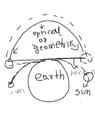
Can somebody explain what is happening here? (sunlight refracting in Earth's atmosphere)

  • Thread starter Thread starter tellmesomething
  • Start date Start date
Click For Summary

Homework Help Overview

The discussion revolves around the phenomenon of sunlight refracting in Earth's atmosphere, particularly focusing on the visual perception of the sun during sunrise and sunset. Participants explore the differences between the observed virtual image of the sun and its geometric position relative to the horizon.

Discussion Character

  • Exploratory, Conceptual clarification, Assumption checking

Approaches and Questions Raised

  • Participants examine the definitions of optical length and geometric length in relation to the visibility of the sun at different times of the day. Questions are raised about the timing of when the sun is seen versus its actual position, and whether the time intervals for sunrise and sunset are equal.

Discussion Status

The conversation is ongoing, with participants sharing insights and clarifying points about the visibility of the sun at sunrise and sunset. Some guidance has been offered regarding the interpretation of diagrams and the implications of refraction, but no consensus has been reached on all aspects of the problem.

Contextual Notes

There are references to diagrams that illustrate the sun's position and its perceived image, which may not be universally understood by all participants. Additionally, the discussion touches on the complexity of visual perception versus geometric alignment, indicating that assumptions about these concepts are being questioned.

tellmesomething
Messages
449
Reaction score
59
Homework Statement
A light from the sun enters the atmosphere, it refracts due to the small difference between the speed of lights in air and vaccum. The optical length of the day is defined as the time interval between the instant when the top of the sun is just visibly observed above the horizon to the instant at which the top of the sun disappears below the horizon. The geometric length of the day is defined as the time interval bewteen the instant when a geometric straight line drawn from the observer to the top of the sun just clears the horizon to the instant at which this line just dips below the horizon?
Relevant Equations
None
I honestly do not understand which one is referring to which one, the optical length states that the time interval between the instant when the top of the sun is just "visibly observed" above the horizon to the instant at which the top of the sun just disappears below the horizon. The sun that is "observed" Is the virtual image as seen in the diagram.

1000006687.webp
But geometric length is defined as the time interval between the instant when a geometric line is drawn from the observer to the top of the sun just clears the horizon to the instant at which this line dips below the horizon. If you see it like this it must mean the "actual sun"' when it comes up the horizon and not the virtual image so doesn't it make both the time intervals equal?

The answer given is A

1000006692.webp
 

Attachments

  • 1000006688.webp
    1000006688.webp
    39.8 KB · Views: 28
Physics news on Phys.org
For simplicity, consider yourself on the equator.

At sunrise, can you see the upper edge of the sun before it is geometrically lined up with the horizon and you?

At sunset, the upper edge of the sun is what was the lower edge of the sun at sunrise,

At sunset, can you see the upper edge of the sun after it is geometrically lined up with the horizon and you?
 
  • Informative
Likes   Reactions: tellmesomething
Your diagram seems to show the sun going around clockwise relative to the Earth, so I guess we are looking down on the N pole, with W on the right and E on the left.
The upper image of the sun on the right shows where you would see it set if no refraction, and the lower right where it is when you do see it set. Which is later?
 
Steve4Physics said:
For simplicity, consider yourself on the equator.

At sunrise, can you see the upper edge of the sun before it is geometrically lined up with the horizon and you?

At sunset, the upper edge of the sun is what was the lower edge of the sun at sunrise,

At sunset, can you see the upper edge of the sun after it is geometrically lined up with the horizon and you?
Yes I can stil see the upper edge after it is geometrically lined up with the horizon. So like the day starts earlier and ends later for us observers? Hence the time interval is longer?
 

haruspex said:
Your diagram seems to show the sun going around clockwise relative to the Earth, so I guess we are looking down on the N pole, with W on the right and E on the left.
The upper image of the sun on the right shows where you would see it set if no refraction, and the lower right where it is when you do see it set. Which is later?
The upper image of the sun on the right
 
tellmesomething said:
Yes I can stil see the upper edge after it is geometrically lined up with the horizon. So like the day starts earlier and ends later for us observers? Hence the time interval is longer?
Yes, spot-on.
Well, almost spot-on! See post #7.
 
Last edited:
  • Like
Likes   Reactions: tellmesomething
@tellmesomething, just noticed an issue with what you wrote (sorry - I should have read it more carefully).

tellmesomething said:
Yes I can stil see the upper edge after it is geometrically lined up with the horizon.
That's only true at sunset.

At sunrise, you can see the upper edge before it is geometrically lined up with the horizon.

tellmesomething said:
So like the day starts earlier and ends later for us observers? Hence the time interval is longer?
Yes.
 
  • Like
Likes   Reactions: tellmesomething
tellmesomething said:
The upper image of the sun on the right
In your diagram the sun is going clockwise, so it is descending on the right. In which position is it later, upper right or lower right?
 
  • Like
Likes   Reactions: tellmesomething
haruspex said:
In your diagram the sun is going clockwise, so it is descending on the right. In which position is it later, upper right or lower right?
The sun is physically on the lower right but we see it on the upper right right during sunset...its virtual image is what we see and in our pov it stays for longer..
 
  • #10
Steve4Physics said:
@tellmesomething, just noticed an issue with what you wrote (sorry - I should have read it more carefully).


That's only true at sunset.

At sunrise, you can see the upper edge before it is geometrically lined up with the horizon.


Yes
Yes, since you specifically asked in post #2 about sunset so that's what I replied to..
Steve4Physics said:
At sunset, can you see the upper edge of the sun after it is geometrically lined up with the horizon and you?
 
  • #11
tellmesomething said:
The sun is physically on the lower right but we see it on the upper right right during sunset...its virtual image is what we see and in our pov it stays for longer..
Right.
 
  • Like
Likes   Reactions: tellmesomething
  • #12
tellmesomething said:
Yes, since you specifically asked in post #2 about sunset so that's what I replied to..
In Post #2 I asked two separate questions - one specifically about sunrise and one specifically about sunset. Sorry to be picky.
 
  • Like
Likes   Reactions: tellmesomething
  • #13
Steve4Physics said:
In Post #2 I asked two separate questions - one specifically about sunrise and one specifically about sunset. Sorry to be picky.
Oh i missed that sorry just noticed. Anyways thankyou for helping me understand it. ☺
 
  • Like
Likes   Reactions: Steve4Physics

Similar threads

  • · Replies 4 ·
Replies
4
Views
2K
  • · Replies 8 ·
Replies
8
Views
3K
  • · Replies 12 ·
Replies
12
Views
6K
  • · Replies 10 ·
Replies
10
Views
16K
  • · Replies 8 ·
Replies
8
Views
6K
Replies
7
Views
8K
  • · Replies 4 ·
Replies
4
Views
2K
  • · Replies 26 ·
Replies
26
Views
3K
  • · Replies 13 ·
Replies
13
Views
3K
  • · Replies 5 ·
Replies
5
Views
25K