Science Advisor
Homework Helper
Education Advisor
- 7,864
- 1,605
- TL;DR
- Does the given example of commutative diagram use conventional notation?
I'm used to seeing commutative diagrams where the vertices are mathematical objects and the edges (arrows) are mappings between them. Can the diagram ( from the interesting article https://people.reed.edu/~jerry/332/25jordan.pdf ) in the attached photo be interpreted that way?
In the article:
##k[x]## is the ring of polynomials over a field k.
##V## is a vector space.
##T## is a linear transformation on ##V##
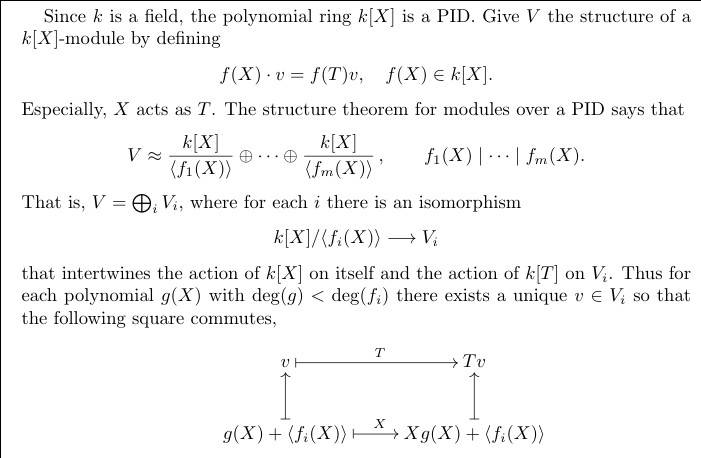
I understand ##T## and ##X## as maps, but do the vertical arrows go from a map to the argument of a map?
In the article:
##k[x]## is the ring of polynomials over a field k.
##V## is a vector space.
##T## is a linear transformation on ##V##
I understand ##T## and ##X## as maps, but do the vertical arrows go from a map to the argument of a map?