MHB Can we Use Partial Derivatives to Verify the Solution of PDE with Derivatives?

  • Thread starter Thread starter mathmari
  • Start date Start date
  • Tags Tags
    Derivatives Pde
Click For Summary
The discussion centers on verifying the solution of a partial differential equation (PDE) using partial derivatives. The proposed solution involves a double integral, and participants discuss the application of Leibniz's integral rule to differentiate the integral with respect to time and space. There is a focus on calculating the derivatives of a function defined within the integral, leading to expressions for second derivatives. Participants express uncertainty about the correctness of their derivatives and the implications of boundary conditions, particularly regarding the behavior of the function at specific limits. The conversation concludes with a suggestion to adjust the limits of integration to better align with the problem's requirements.
mathmari
Gold Member
MHB
Messages
4,984
Reaction score
7
Hey! :o

I want to verify that $$w(x,t)=\frac{1}{2c}\int_0^t\int_{c(t-\tau)-x}^{x+c(t-\tau)}f(y,\tau)dyd\tau$$ is the solution of the problem $$w_{tt}=c^2w_{xx}+f(x,t) , \ \ x>0, t>0 \\ w(x,0)=w_t(x,0)=0, \ \ x>0 \\ w(0,t)=0 , \ \ t\geq 0$$ For that we have to take the partial derivatives of $w$. But how can we do that in this case for example as for $t$ where we have at both integrals the $t$ ? Could you give me a hint? (Wondering)
 
Physics news on Phys.org
mathmari said:
Hey! :o

I want to verify that $$w(x,t)=\frac{1}{2c}\int_0^t\int_{c(t-\tau)-x}^{x+c(t-\tau)}f(y,\tau)dyd\tau$$ is the solution of the problem $$w_{tt}=c^2w_{xx}+f(x,t) , \ \ x>0, t>0 \\ w(x,0)=w_t(x,0)=0, \ \ x>0 \\ w(0,t)=0 , \ \ t\geq 0$$ For that we have to take the partial derivatives of $w$. But how can we do that in this case for example as for $t$ where we have at both integrals the $t$ ? Could you give me a hint? (Wondering)

Hey mathmari! (Wave)

How about defining $g(x,t,\tau) = \int_{c(t-\tau)-x}^{x+c(t-\tau)}f(y,\tau)dy$, and then differentiating one integral at a time using Leibniz's integral rule? (Wondering)
 
I like Serena said:
How about defining $g(x,t,\tau) = \int_{c(t-\tau)-x}^{x+c(t-\tau)}f(y,\tau)dy$, and then differentiating one integral at a time using Leibniz's integral rule? (Wondering)

We have the following partial derivatives, or not?
\begin{align*}w_{t}&=\frac{\partial}{\partial{t}}\left [\frac{1}{2c}\int_0^tg(x,t,\tau )d\tau\right ]=\frac{1}{2c}g(x,t,t)+\frac{1}{2c}\int_0^tg_t(x,t,\tau )d\tau\\ & =\frac{1}{2c}\int_{-x}^xf(y,\tau)dy+\frac{1}{2c}\int_0^tg_t(x,t,\tau )d\tau\end{align*}
\begin{align*}w_{tt}&=\frac{1}{2c}\int_{-x}^xf_t(y,\tau)dy+\frac{1}{2c}\frac{\partial}{\partial{t}}\int_0^tg_t(x,t,\tau )d\tau\\ & =\frac{1}{2c}\int_{-x}^xf_t(y,\tau)dy+\frac{1}{2c}g_t(x,t,t)+\frac{1}{2c}\int_0^tg_{tt}(x,t,\tau )d\tau\end{align*}

\begin{align*}&w_x=\frac{\partial}{\partial{x}}\left [\frac{1}{2c}\int_0^tg(x,t,\tau )d\tau\right ]=\frac{1}{2c}\int_0^tg_x(x,t,\tau )d\tau \\ &w_{xx}=\frac{\partial}{\partial{x}}\left [\frac{1}{2c}\int_0^tg_x(x,t,\tau )d\tau\right ]=\frac{1}{2c}\int_0^tg_{xx}(x,t,\tau )d\tau \end{align*}

Is everythig correct so far? Now we have to calculate the derivaties of $g$, right?
 
I think it should be $f(y,t)$ and $f_t(y,t)$, shouldn't it?
Otherwise I believe it's all correct. (Happy)
 
I like Serena said:
I think it should be $f(y,t)$ and $f_t(y,t)$, shouldn't it?
Otherwise I believe it's all correct. (Happy)

Ah ok! We have the following partial derivatives of $g$, or not?
\begin{align*}g_t&=\frac{\partial}{\partial{t}}\int_{c(t-\tau)-x}^{x+c(t-\tau)}f(y,\tau )dy\\ & =c\cdot f(x+c(t-\tau),\tau)-c\cdot f(c(t-\tau)-x, \tau)+\int_{c(t-\tau)-x}^{x+c(t-\tau)}f_t(y,\tau )dy\end{align*}

\begin{align*}g_{tt}&=c\cdot f_x(x+c(t-\tau),\tau)\cdot \frac{d}{dt}[x+c(t-\tau)]-c\cdot f_x(c(t-\tau)-x, \tau)\cdot \frac{d}{dt}[c(t-\tau)-x]+\frac{\partial}{\partial{t}}\int_{c(t-\tau)-x}^{x+c(t-\tau)}f_t(y,\tau )dy\\ & =c^2\cdot f_x(x+c(t-\tau),\tau)-c^2\cdot f_x(c(t-\tau)-x, \tau)+f_t(x+c(t-\tau),\tau )\cdot c-f(c(t-\tau)-x, \tau)\cdot c+\int_{c(t-\tau)-x}^{x+c(t-\tau)}f_t(y,\tau)dy\end{align*}

\begin{align*}g_x&=\frac{\partial}{\partial{x}}\int_{c(t-\tau)-x}^{x+c(t-\tau)}f(y,\tau )dy\\ & = f(x+c(t-\tau),\tau)-(-1)\cdot f(c(t-\tau)-x, \tau)+\int_{c(t-\tau)-x}^{x+c(t-\tau)}f_x(y,\tau )dy\\ & = f(x+c(t-\tau),\tau)+ f(c(t-\tau)-x, \tau)+\int_{c(t-\tau)-x}^{x+c(t-\tau)}f_x(y,\tau )dy\end{align*}

\begin{align*}g_{xx}&= f_x(x+c(t-\tau),\tau)+ f_x(c(t-\tau)-x, \tau)\cdot (-1)+\frac{\partial}{\partial{t}}\int_{c(t-\tau)-x}^{x+c(t-\tau)}f_x(y,\tau )dy\\ & = f_x(x+c(t-\tau),\tau)- f_x(c(t-\tau)-x, \tau)+f_x(x+c(t-\tau),\tau )-f_x(c(t-\tau)-x, \tau)+\int_{c(t-\tau)-x}^{x+c(t-\tau)}f_{xx}(y,\tau )dy \\ & = 2f_x(x+c(t-\tau),\tau)- 2f_x(c(t-\tau)-x, \tau)+\int_{c(t-\tau)-x}^{x+c(t-\tau)}f_{xx}(y,\tau )dy\end{align*}

(Wondering)
 
Last edited by a moderator:
I must have some mistakes...because if these derivative were correct, we would get

\begin{align*}w_{xx}&=\frac{1}{2c}\int_0^tg_{xx}(x,t,\tau)d\tau\\ & =\frac{1}{2c}\int_0^t\left [2f_x(x+c(t-\tau),\tau)- 2f_x(c(t-\tau)-x, \tau)+\int_{c(t-\tau)-x}^{x+c(t-\tau)}f_{xx}(y,\tau )dy\right ]d\tau\end{align*}

\begin{align*}w_{tt}&=\frac{1}{2c}\int_{-x}^xf_t(y,t)dy+\frac{1}{2c}g_t(x,t,t)+\frac{1}{2c}\int_0^tg_{tt}(x,t,\tau )d\tau \\ & = \frac{1}{2c}\int_{-x}^xf_t(y,t)dy+\frac{1}{2c}\left [c\cdot f(x,t)-c\cdot f(-x, t)+\int_{-x}^{x}f_t(y,t )dy\right ]+\frac{1}{2c}\int_0^t\left [c^2\cdot f_x(x+c(t-\tau),\tau)-c^2\cdot f_x(c(t-\tau)-x, \tau)+f_t(x+c(t-\tau),\tau )\cdot c-f(c(t-\tau)-x, \tau)\cdot c+\int_{c(t-\tau)-x}^{x+c(t-\tau)}f_t(y,\tau)dy\right ]d\tau \\ & = \frac{1}{c}\int_{-x}^xf_t(y,t)dy+\frac{f(x,t)-f(-x,t)}{2}+\frac{1}{2c}\int_0^t\left [c^2\cdot f_x(x+c(t-\tau),\tau)-c^2\cdot f_x(c(t-\tau)-x, \tau)+f_t(x+c(t-\tau),\tau )\cdot c-f(c(t-\tau)-x, \tau)\cdot c+\int_{c(t-\tau)-x}^{x+c(t-\tau)}f_t(y,\tau)dy\right ]d\tau\end{align*}

But these don't satisfy the problem, do they? (Wondering)
 
I am trying it again.

I have done the following:

\begin{equation*}w(x,t)=\frac{1}{2c}\int_0^tg(x,t,\tau )d\tau \end{equation*}

\begin{align*}w_t&=\frac{1}{2c}g(x,t,t)+\frac{1}{2c}\int_0^tg_t(x,t,\tau )d\tau \\
& =\frac{1}{2c}g(x,t,t)+\frac{1}{2c}\int_0^t\frac{\partial}{\partial{t}}\int_{c(t-\tau)-x}^{x+c(t-\tau)}f(y,\tau )dyd\tau\\ & = \frac{1}{2c}\int_{-x}^xf(y,t)dy+\frac{1}{2c}\int_0^t\left [f(x+c(t-\tau ),\tau)\cdot c-f(c(t-\tau )-x,\tau)\cdot c+\int_{c(t-\tau)-x}^{x+c(t-\tau)}f_t(y,\tau )dy\right ]d\tau \\ & = \frac{1}{2c}\int_{-x}^xf(y,t)dy+\frac{1}{2}\int_0^tf(x+c(t-\tau ),\tau)d\tau-\frac{1}{2}\int_0^tf(c(t-\tau )-x,\tau)d\tau+\frac{1}{2c}\int_0^t\int_{c(t-\tau)-x}^{x+c(t-\tau)}f_t(y,\tau )dyd\tau\end{align*}

is the first derivative of $w$ as for $t$ correct? (Wondering)
 
mathmari said:
I am trying it again.

I have done the following:

\begin{equation*}w(x,t)=\frac{1}{2c}\int_0^tg(x,t,\tau )d\tau \end{equation*}

\begin{align*}w_t&=\frac{1}{2c}g(x,t,t)+\frac{1}{2c}\int_0^tg_t(x,t,\tau )d\tau \\
& =\frac{1}{2c}g(x,t,t)+\frac{1}{2c}\int_0^t\frac{\partial}{\partial{t}}\int_{c(t-\tau)-x}^{x+c(t-\tau)}f(y,\tau )dyd\tau\\ & = \frac{1}{2c}\int_{-x}^xf(y,t)dy+\frac{1}{2c}\int_0^t\left [f(x+c(t-\tau ),\tau)\cdot c-f(c(t-\tau )-x,\tau)\cdot c+\int_{c(t-\tau)-x}^{x+c(t-\tau)}f_t(y,\tau )dy\right ]d\tau \\ & = \frac{1}{2c}\int_{-x}^xf(y,t)dy+\frac{1}{2}\int_0^tf(x+c(t-\tau ),\tau)d\tau-\frac{1}{2}\int_0^tf(c(t-\tau )-x,\tau)d\tau+\frac{1}{2c}\int_0^t\int_{c(t-\tau)-x}^{x+c(t-\tau)}f_t(y,\tau )dyd\tau\end{align*}

is the first derivative of $w$ as for $t$ correct? (Wondering)

I think this is correct yes. (Nod)

And we can simplify it bit more since $f(y,\tau)$ does not depend on $t$.
Therefore $\pd{}t f(y,\tau)=0$. (Thinking)
 
I like Serena said:
I think this is correct yes. (Nod)

And we can simplify it bit more since $f(y,\tau)$ does not depend on $t$.
Therefore $\pd{}t f(y,\tau)=0$. (Thinking)

Ok! At the next step we have \begin{align*}w_{tt}&= \frac{1}{2c}\int_{-x}^xf_t(y,t)dy+\frac{1}{2}f(x,\tau)+\frac{1}{2}\int_0^t\frac{\partial}{\partial{t}}f(x+c(t-\tau ),\tau)d\tau-\frac{1}{2}f(-x,\tau)-\frac{1}{2}\int_0^t\frac{\partial}{\partial{t}}f(c(t-\tau )-x,\tau)d\tau\end{align*} Is the following correct? \begin{equation*}\frac{\partial}{\partial{t}}f(x+c(t-\tau ),\tau)=f_x(x+c(t-\tau ),\tau)\cdot \frac{d(x+c(t-\tau)}{dt}+f_t(x+c(t-\tau ),\tau)\cdot \frac{d\tau}{dt}\end{equation*} Or do we not use here the chain rule? (Wondering)
 
  • #10
If this is correct then we get \begin{align*}w_{tt}&= \frac{1}{2c}\int_{-x}^xf_t(y,t)dy+\frac{1}{2}f(x,t)+\frac{c}{2}\int_0^tf_x(x+c(t-\tau ),\tau)d\tau-\frac{1}{2}f(-x,t)-\frac{c}{2}\int_0^tf_x(c(t-\tau )-x,\tau)d\tau\end{align*}

The second derivative as for $x$ (if I have no mistakes) is \begin{align*}w_{xx}&=\frac{1}{2c}\int_0^tf_x(x+c(t-\tau ),\tau)d\tau-\frac{1}{2c}\int_0^tf_x(c(t-\tau )-x,\tau)d\tau\end{align*}

At the $w_{tt}$ is it correct that we have once $f(x,t)$ and once $f(-x,t)$ ? (Wondering)
 
Last edited by a moderator:
  • #11
mathmari said:
Is the following correct? \begin{equation*}\frac{\partial}{\partial{t}}f(x+c(t-\tau ),\tau)=f_x(x+c(t-\tau ),\tau)\cdot \frac{d(x+c(t-\tau)}{dt}+f_t(x+c(t-\tau ),\tau)\cdot \frac{d\tau}{dt}\end{equation*} Or do we not use here the chain rule? (Wondering)

I believe that it should be:
\begin{align*}\frac{\partial}{\partial{t}}f(x+c(t-\tau ),\tau)&=f_x(x+c(t-\tau ),\tau)\cdot \frac{\partial(x+c(t-\tau))}{\partial t}+f_t(x+c(t-\tau ),\tau)\cdot \frac{\partial\tau}{\partial t} \\
&=f_x(x+c(t-\tau ),\tau)\cdot c
\end{align*}
shouldn't it? (Wondering)
 
  • #12
I like Serena said:
I believe that it should be:
\begin{align*}\frac{\partial}{\partial{t}}f(x+c(t-\tau ),\tau)&=f_x(x+c(t-\tau ),\tau)\cdot \frac{\partial(x+c(t-\tau))}{\partial t}+f_t(x+c(t-\tau ),\tau)\cdot \frac{\partial\tau}{\partial t} \\
&=f_x(x+c(t-\tau ),\tau)\cdot c
\end{align*}
shouldn't it? (Wondering)

Ah ok, with partial derivatives not just derivatives. But the result is the same as mine!

I am not really sure about the terms $f(x,t)$ and $f(-x,t)$ also about the term $\frac{1}{2c}\int_{-x}^xf_t(y,t)dy$.

If that integral would we $0$ and if we had twice $f(x,t)$ instead of once $f(x,t)$ and once $f(-x,t)$, then $w$ would satisfy the problem, wouldn't it?

Do we maybe use the fact that at the problem it is $x>0$ ?

(Wondering)
 
  • #13
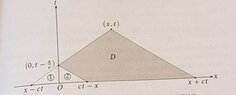
Are maybe the limits of the limits wrong? These limits should describe the following set:

View attachment 8160

Are the limits that I used at the integral of $w(x,t)$ correct? (Wondering)
 

Attachments

  • region.JPG
    region.JPG
    9.7 KB · Views: 111
  • #14
I believe you've already found that it should be:
$$w(x,t)=\frac{1}{2c}\int_0^{t-\frac{x}{c}}\int_{c(t-\tau)-x}^{x+c(t-\tau)}f(y,\tau)dyd\tau+\frac{1}{2c}\int_{t-\frac{x}{c}}^t\int_{x-c(t-\tau)}^{x+c(t-\tau)}f(y,\tau)dyd\tau$$
It also means that some of the steps are not correct yet. (Thinking)
 

Similar threads

  • · Replies 1 ·
Replies
1
Views
3K
  • · Replies 5 ·
Replies
5
Views
3K
  • · Replies 5 ·
Replies
5
Views
2K
  • · Replies 36 ·
2
Replies
36
Views
4K
  • · Replies 2 ·
Replies
2
Views
3K
  • · Replies 7 ·
Replies
7
Views
3K
  • · Replies 14 ·
Replies
14
Views
3K
  • · Replies 3 ·
Replies
3
Views
2K
Replies
7
Views
2K
  • · Replies 1 ·
Replies
1
Views
2K