paraboloid
- 17
- 0
The boundary of a lamina consists of the semicircles [tex]y=\sqrt{1-x^2}[/tex] and [tex]y=\sqrt{4-x^2}[/tex] together with the portions of the x-axis that join them. Find the center of mass of the lamina if the density at any point is proportional to its distance from the origin.
I drew a graph that looks like this
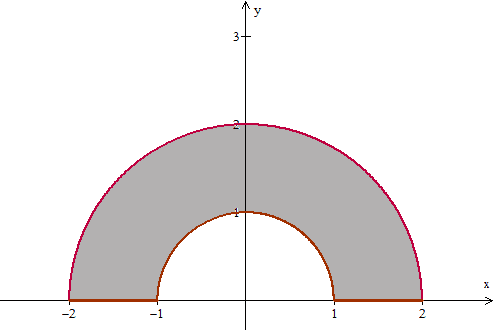
I know that polar coordinates are a good tool to use for circle type questions like this, but I've never encountered something like this before.
If anyone could just step me in the right direction, that would be great,
Thanks
I drew a graph that looks like this
I know that polar coordinates are a good tool to use for circle type questions like this, but I've never encountered something like this before.
If anyone could just step me in the right direction, that would be great,
Thanks
Attachments