Check my mathematics assignment before submission

  • Topic: Engineering 
  • Thread starter Thread starter lee123456789
  • Start date Start date
  • Tags Tags
    Assignment
Join the discussion
Registration is free. Start your own thread to ask a follow-up.
7 replies · 2K views · last reply
lee123456789
Messages
90
Reaction score
5
Homework Statement
Not sure what to put
Relevant Equations
fsd
Hi
Can somebody check my assignment
I did it just need check before submitting
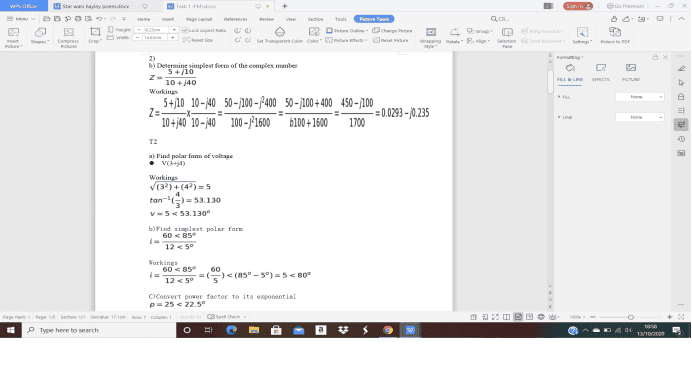
Screenshot of a Word document page showing handwritten-style worked solutions to complex number and phasor problems, including simplifying Z = (5+j10)/(10+j40) to 0.0293 - j0.235 and polar form work for v and i.

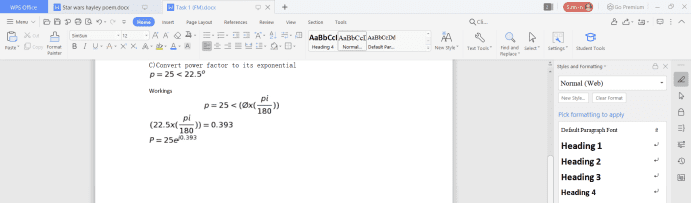
Screenshot of a word processor page showing a worked power-factor conversion: 'c) Convert power factor to its exponential', p = 25 < 22.5°, then 'Workings' with p = 25 < (Øx(pi/180)), (22.5x(pi/180)) = 0.393 and p = 25e^(0.393).

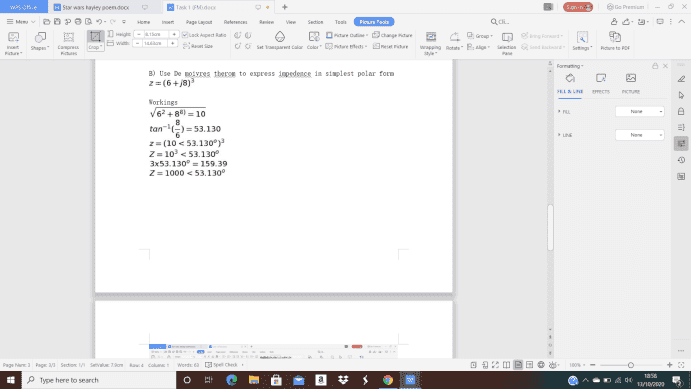
Screenshot of a Word document showing handwritten-style typed workings for De Moivre's theorem: sqrt(6^2 + 8^2) = 10, tan^-1(8/6) = 53.130, z = (10 < 53.130°)^3, Z = 10^3 < 53.130°, 3 x 53.130° = 159.39, Z = 1000 < 53.130°.
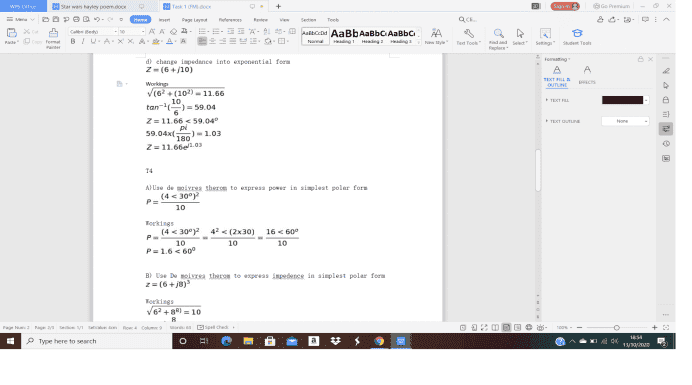
Screenshot of a Word document showing handwritten-style worked maths: impedance in polar form, Z = 11.66 at 59.04 degrees, and De Moivre's theorem steps for power and impedance in simplest polar form.
 
Attachments
  • Equation Z = (5 + j10) / (10 + j40), a complex fraction with numerator 5 + j10 and denominator 10 + j40.
    1602606929593.png
    1.2 KB · Views: 222
  • Equation Z = (5 + j10) / (10 + j40), written as a complex fraction with numerator 5 + j10 and denominator 10 + j40.
    1602606935077.png
    1.2 KB · Views: 208
  • Handwritten-style algebra: Z = (5 + j10)/(10 + j40) x (10 - j40)/(10 - j40) = (50 - j100 - j^2 40)/(100 - j^2 1600), a complex number division multiplied by its conjugate.
    1602607280971.png
    3.2 KB · Views: 214
  • Handwritten complex-number division Z = (5 + j10)/(10 + j40) x (10 - j40)/(b10 - j40) = (a50 - j100 - j^2 400)/(100 - j^2 1600), with the middle step partly unclear.
    1602607872401.png
    4 KB · Views: 216
  • Handwritten-style complex number calculation: Z = (5 + j10)/(10 + j40) x (10 - j40)/(10 - j40) = (50 - j100 - j^2 400)/(100 - j^2 1600) = (50 - j100 + 400)/(b100 + 1600) = (450 - j100)/1700 = 0.0293 - j0.235
    1602608106116.png
    7.2 KB · Views: 222
Physics news on Phys.org
lee123456789 said:
Homework Statement:: Not sure what to put
Relevant Equations:: fsd

Hi
Can somebody check my assignment
I did it just need check before submitting
View attachment 270886
View attachment 270887
View attachment 270889View attachment 270888
I'd like to help, but wow that's really hard to read. Can you use a Snipping Tool to just take screenshots of the work, not including the overall display window stuff? At least that would be easier to read. Thanks.
 
  • Like
Likes   Reactions: Vanadium 50
berkeman said:
I'd like to help, but wow that's really hard to read. Can you use a Snipping Tool to just take screenshots of the work, not including the overall display window stuff? At least that would be easier to read. Thanks.
Handwritten-style worked solutions: simplify (5+j10)/(10+j40) by multiplying by the conjugate to get 0.0293 - j0.235; polar form of 3+j4 as 5 < 53.130°; and 60 < 85° divided by 12 < 5° giving 5 < 80°.

Typed worked solution converting power factor 25 angle 22.5 degrees to exponential form: 22.5 x pi/180 = 0.393, giving P = 25e^(j0.393).

Handwritten-style worked solution: converting impedance Z = 6 + j10 to exponential form, giving Z = 11.66e^j1.03, then de Moivre's theorem for P = (4<30°)^2/10 = 1.6<60°.

Handwritten-style worked solution: Part B asks to use De Moivre's theorem to express impedance in simplest polar form for z = (6 + j8)^3, with workings giving magnitude 10, angle 53.130 degrees, and results 1000 < 159.39 degrees.
 
That's a lot better, thanks! I'll have a look at it in a few minutes if nobody else beats me to it.
 
First three look fine: 2 b), T2a and T2b.
I didn't check the others.

In the future, please post no more than two questions in a thread. With so many questions in a thread, it's hard for people to keep track of what has already been responded to.
 
  • Like
Likes   Reactions: berkeman
Your work for 2 b) is correct until the final numerical value. Note that 450/1700 is not equal to .0293 for example.
 
  • Like
Likes   Reactions: berkeman
Most of the rest looks good too. Note that in T4 d) the square root symbol overbar extends over the result as well. You got the right result, but be careful about ending the square root overbar on the LHS:

Handwritten-style worked line labelled Workings: the square root of (6^2 + (10^2)) = 11.66, with the square root overbar extending over the whole sum.


And there is a similar problem in B), but it's worse and I lost synch with what you were trying to do:

Handwritten-style worked problem: B) Use De Moivre's theorem to express impedance in simplest polar form, z = (6 + j8)^3. Workings: sqrt(6^2 + 8^2) = 10, and tan^-1(8/6) = 53.130.
 
berkeman said:
Most of the rest looks good too. Note that in T4 d) the square root symbol overbar extends over the result as well. You got the right result, but be careful about ending the square root overbar on the LHS:

View attachment 270941

And there is a similar problem in B), but it's worse and I lost synch with what you were trying to do:

View attachment 270942
Hi
thanks for the help. was worrying for awhile.
First time using the software so may handwrite it next time.
sorry can i just check i got it right but the root sign extention was the only wrong thing?
and the J400/1700, which is 0.235 not 0.39 something