wingythingy
- 1
- 0
- TL;DR
- What's with the big prominent circles and/or arcs in photos from bubble chambers? Not the particle tracks, but the arcs that look like they're probably the chamber structure, except for the asymmetrical amount of bubbles around them.
Hello! I've been looking at old bubble chamber photos recently, and a lot of them have a common feature that I can't quite figure out. For instance:
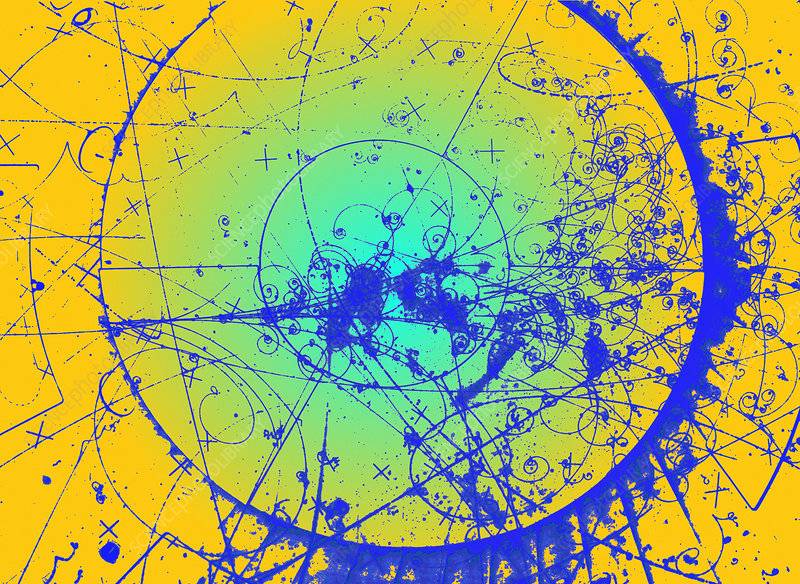
(Via this page, where the caption reads in part: "This has been produced by a muon neutrino (entering from the left) interacting with a neutron at the border of the large circle.")
I understand how bubble chambers work (particles are injected, they interact with other particles in the chamber resulting in decays to still other particles, the magnetic field interacts with particles to create curved tracks depending on momentum and charge, only charged particles leave tracks), so I get what's going on with the particle jet that emanates from left to right, and all the spirals etc. What I don't understand is what the large arc of concentrated bubbles is, along the bottom and the right. Or why it's spiky at the bottom.
Given that it's part of a larger circle, I'm inclined to assume that it's a trick of perspective, and you're seeing part of the physical structure of the chamber opposite the camera. (This was the conclusion drawn in the only other thing I could find on the web about it, on Stack Exchange here.) But given that the high concentration of bubbles is only on the right side of the circle, in the direction of the particle jet, it makes me suspect that there is some kind of actual signal going on there, rather than solely a structural artifact. Maybe it's several subsequent generations' worth of decays making their way to the structure, and interacting en masse with whatever's there? I keep getting stuck on why there are particle tracks on the 'outside' of the circle if it's part of the structure, but if it's just a matter of perspective then I can understand that. Maybe it's an outline of the piston? But again, why would there be a concentration of bubbles in an area that matches the outline of the thing, if it's just a perspective trick?
This photo has the same thing happening, but you can more clearly see a solid(ish) line that borders the big bubbly arc (via CERN, albeit with an unhelpful caption):
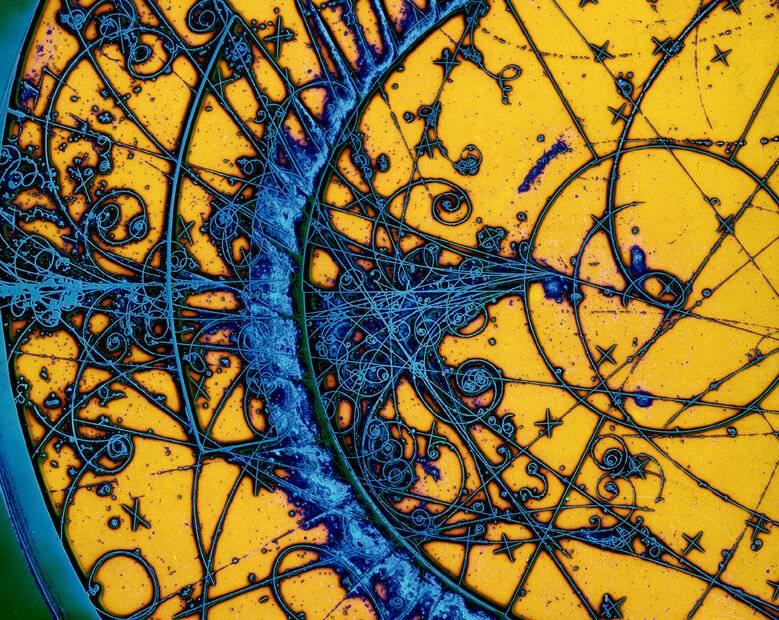
Which, again, makes me think physical structure. (But for the fact that it gets narrower in the center of the frame, which is too confusing in this context to think about.) But what is it? I know that in this cloud chamber photo of the discovery of the positron:
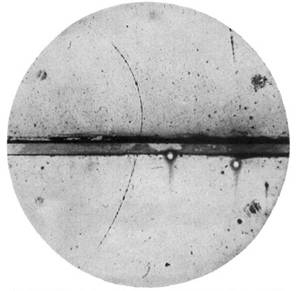
the horizontal line is a lead plate used to slow particles down. Could this be something similar? I've mostly dismissed the idea since it seems like something that should have been mentioned in at least one caption or document I've read, but who am I to say what's silly and what's not!
(Via this page, where the caption reads in part: "This has been produced by a muon neutrino (entering from the left) interacting with a neutron at the border of the large circle.")
I understand how bubble chambers work (particles are injected, they interact with other particles in the chamber resulting in decays to still other particles, the magnetic field interacts with particles to create curved tracks depending on momentum and charge, only charged particles leave tracks), so I get what's going on with the particle jet that emanates from left to right, and all the spirals etc. What I don't understand is what the large arc of concentrated bubbles is, along the bottom and the right. Or why it's spiky at the bottom.
Given that it's part of a larger circle, I'm inclined to assume that it's a trick of perspective, and you're seeing part of the physical structure of the chamber opposite the camera. (This was the conclusion drawn in the only other thing I could find on the web about it, on Stack Exchange here.) But given that the high concentration of bubbles is only on the right side of the circle, in the direction of the particle jet, it makes me suspect that there is some kind of actual signal going on there, rather than solely a structural artifact. Maybe it's several subsequent generations' worth of decays making their way to the structure, and interacting en masse with whatever's there? I keep getting stuck on why there are particle tracks on the 'outside' of the circle if it's part of the structure, but if it's just a matter of perspective then I can understand that. Maybe it's an outline of the piston? But again, why would there be a concentration of bubbles in an area that matches the outline of the thing, if it's just a perspective trick?
This photo has the same thing happening, but you can more clearly see a solid(ish) line that borders the big bubbly arc (via CERN, albeit with an unhelpful caption):
Which, again, makes me think physical structure. (But for the fact that it gets narrower in the center of the frame, which is too confusing in this context to think about.) But what is it? I know that in this cloud chamber photo of the discovery of the positron:
the horizontal line is a lead plate used to slow particles down. Could this be something similar? I've mostly dismissed the idea since it seems like something that should have been mentioned in at least one caption or document I've read, but who am I to say what's silly and what's not!