Constant current source advice

Click For Summary
SUMMARY

The forum discussion centers around building a constant current source circuit for a pharmacokinetic model, as outlined in the AAPT publication by Cock & Janssen. Key components include a 72 µF capacitor, resistors of various values (27k, 297k, 420k, 890k), and current settings of 172 µA to 700 µA. The circuit aims to simulate drug metabolism with a charging time of 0.15 seconds followed by a discharge time of 10 seconds. Participants emphasize the educational value of hands-on soldering experience for advanced chemistry students, despite concerns about the complexity of the circuit.

PREREQUISITES
  • Understanding of RC circuits and time constants
  • Familiarity with basic electronic components (capacitors, resistors, switches)
  • Knowledge of pharmacokinetics and drug dosage modeling
  • Experience with circuit simulation software, such as SPICE
NEXT STEPS
  • Research the design and implementation of constant current sources using transistors and zener diodes
  • Explore circuit simulation techniques using LTspice or similar software
  • Learn about the mathematical modeling of exponential decay in pharmacokinetics
  • Investigate the use of Arduino for timing and control in electronic projects
USEFUL FOR

Advanced chemistry students, electronics hobbyists, educators in STEM fields, and anyone interested in practical applications of pharmacokinetic modeling through circuit design.

  • #31
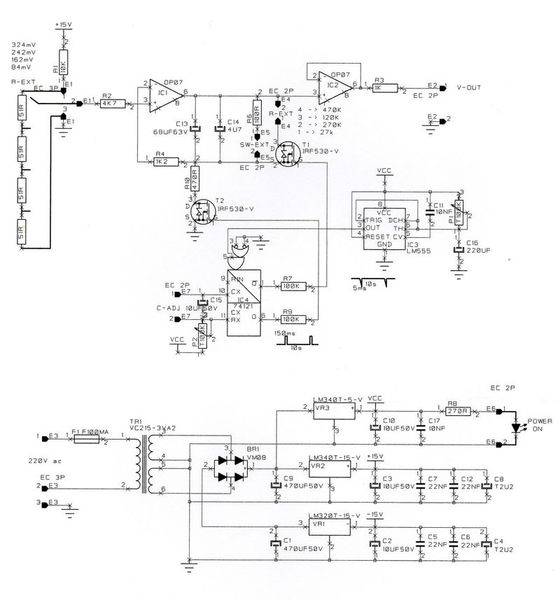
I obtained a schematic of the entire apparatus from the journal article's (retired) author, if anyone is interested.

circuit1.jpg
 
Engineering news on Phys.org
  • #32
He certainly used good quality parts. Are you familiar with those IC's ?

OP07 is a precision opamp.
Left hand one causes voltage selected by selector switch E1 to appear across R10. That's what sets the charging current through your capacitor C13-C14. Observe when T2 is off no current can flow through R10 so capacitor charging current is zero.

Turning on T1 discharges capacitor through whatever resistance is across E4 terminals.

Right hand OP07 is just a buffer to repeat capacitor voltage over at Vout for your meter there. That way a few milliamps of meter current won't discharge the capacitor. .

74121 is a pulse generator, colloquially called a "retriggerable one shot" or "monostable", that makes a pulse of precise duration every time the 555 gives it a "go" pulse. P2-C15 set that pulse width. Its two outputs are complementary, that is when one is high the other is low.

Have fun !