Define Dot Product: A.B = ||A|| ||B|| cos(theta)

Click For Summary
SUMMARY

The discussion centers on the definition and proof of the dot product, represented as A.B = ||A|| ||B|| cos(theta). Two proofs are presented: one utilizing the cosine rule and the other employing projections, both of which assume the validity of the other property being proven. The conversation highlights the circular reasoning in proving the distributive property of the dot product while assuming the dot product's definition. The conclusion emphasizes the need for a clear definition of the dot product, whether in terms of the cosine formula or the component form A.B = a1a2 + b1b2 + c1c2.

PREREQUISITES
  • Understanding of vector mathematics and properties
  • Familiarity with the cosine rule in geometry
  • Knowledge of inner product spaces
  • Basic proficiency in mathematical proofs and logic
NEXT STEPS
  • Study the properties of inner product spaces in detail
  • Explore the geometric interpretation of dot products
  • Learn about vector projections and their applications
  • Review mathematical proofs involving the distributive property of dot products
USEFUL FOR

Mathematicians, physics students, and anyone interested in vector calculus and the foundational concepts of linear algebra.

parshyaa
Messages
307
Reaction score
19
I have seen a proof for the formula of A.B =
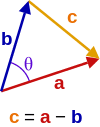
||A|| ||B|| cos(theta)[ proof using the diagram and cosine rule]. In the proof they have assumed that distributive property of dot product is right. diagram is given below
100px-Dot_product_cosine_rule.svg.png
c.c =(a-b).(a-b) = a^2 +b^2 -2(a.b) [ here they used distributive law]
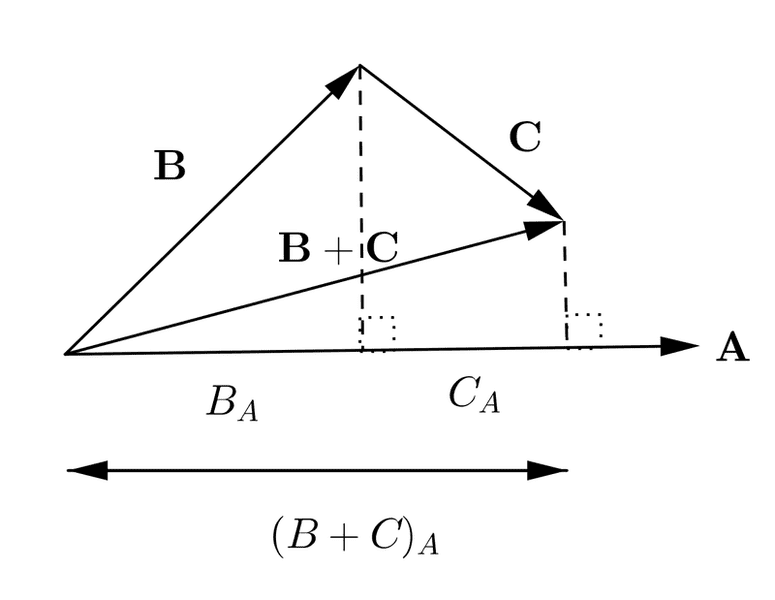
  • I have seen another proof for the distributive property of dot product. There they have assumed that A.B = ||A|| ||B|| cos(theta),And used projections. They have used the diagram as given below.
1280px-Dot_product_distributive_law.svg.png

And projection of vector B on A is ||B||cos(theta) = B.a^ ( a^ is a unit vector in the direction of a vector)[ this is possible if the formula of dot product is assumed to be right.
  • How they can do this , for proving dot product A.B = ||A|| ||B|| cos(theta) they have assumed distributive property to be right and for prooving distributive property they have assumed dot product to be right.
Therefore I think that there will be a definition for dot product wether it is A.B = ||A|| ||B|| cos(theta) or A.B = a1a2 +b1b2 +c1c2 (component form). If its a definition then how they have defined it like this.
 
Last edited by a moderator:
Mathematics news on Phys.org
The distributive property of inner product follows immediately from the basic definition of the standard inner product. Given two vectors ##\mathbf v## and ##\mathbf w##, their inner product is ##(\mathbf v, \mathbf w) = \overline v_1 w_1 + \overline v_2 w_2 + \ldots + \overline v_N w_N##. From this, it should be straight forward to see that ##(\mathbf v + \mathbf w,\mathbf z) = (\mathbf v,\mathbf z)+(\mathbf w,\mathbf z)##.
 
Hey parshyaa.

The cosine rule is done for the general proof and one uses the results for length in arbitrary R^n.
 

Similar threads

  • · Replies 7 ·
Replies
7
Views
2K
  • · Replies 16 ·
Replies
16
Views
2K
  • · Replies 33 ·
2
Replies
33
Views
5K
  • · Replies 1 ·
Replies
1
Views
2K
Replies
5
Views
810
  • · Replies 14 ·
Replies
14
Views
3K
  • · Replies 5 ·
Replies
5
Views
12K
  • · Replies 5 ·
Replies
5
Views
2K
  • · Replies 2 ·
Replies
2
Views
2K
  • · Replies 13 ·
Replies
13
Views
2K