Deriving the SHM equation from Newton's second law and Hooke's law

7 replies · 2K views · last reply
ZARATHUSTRA
Messages
42
Reaction score
0
Member warned about posting without the template and with no effort
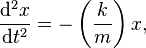
For one-dimensional simple harmonic motion, the equation of motion, which is a second-order linear ordinary differential equation with constant coefficients, could be obtained by means of Newton's second law and Hooke's law
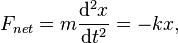
Equation F_net = m d^2x/dt^2 = -kx, relating net force to mass times acceleration and a restoring force proportional to displacement.
and
Equation: d^2x/dt^2 = -(k/m) x, the simple harmonic motion equation in which acceleration is proportional to displacement with a negative sign.
i don't get this part
Equation: omega = square root of (k divided by m), with omega on the left and the square root of k/m on the right.
which [PLAIN]http://upload.wikimedia.org/math/6/5/6/656fd81e91b7ad38db0c1f263dd5f4af.png[/B]

so can somebody explain it to me? Thank you
 
Last edited by a moderator:
What don't you get?
 
The first part is the solution to the differential equation.
The second part is a recast of the solution with one function (cosine).
If you let ##\frac{c_2}{c_1}=\tan \phi## this is the angle sum identity for cosine.
 
Equation ω = √(k/m), where ω is angular frequency, k is the spring constant and m is mass.
why? why "w'' = the square root of 'k' divided by 'm' i don't get this equation
 
Try plugging ##x(t) = A\cos(\omega t-\varphi)## into the differential equation.
 
vela said:
Try plugging ##x(t) = A\cos(\omega t-\varphi)## into the differential equation.
how do they people get this equation?
Equation for angular frequency of simple harmonic motion: omega equals the square root of k over m, where k is the spring constant and m is the mass.
, where does it come from? can you show me process of deducting this formula? THANKS!
 
Did you try plugging x(t) into the differential equation?
 
It is simply a notational convenience. You could continue to use sqrt(k/m) everywhere but that gets messy.