Destructive interference of sound

Click For Summary
SUMMARY

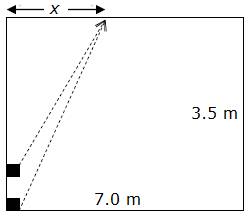
The discussion focuses on calculating the shortest distance along a wall where destructive interference occurs between two loudspeakers, each emitting sound at a frequency of 690 Hz. The speakers are positioned 0.50 m apart in a room measuring 3.5 m by 7.0 m. The user initially attempts to apply the concept of constructive interference but is advised to simplify the problem by substituting variables. The calculation leads to a nonreal answer for the distance x, indicating a potential error in the approach or assumptions made during the calculation.

PREREQUISITES
  • Understanding of sound wave interference principles
  • Familiarity with the concept of wavelength and frequency
  • Basic algebra and manipulation of equations
  • Knowledge of the Pythagorean theorem in two dimensions
NEXT STEPS
  • Study the principles of destructive interference in wave physics
  • Learn how to calculate wavelength from frequency using the formula λ = v/f
  • Explore variable substitution techniques in algebra for solving complex equations
  • Investigate the implications of nonreal solutions in physical contexts
USEFUL FOR

Physics students, acoustics engineers, and anyone interested in sound wave behavior and interference patterns.

sparkle123
Messages
172
Reaction score
0
Two loudspeakers are separated by 0.50 m on one wall of a room measuring 3.5 m by 7.0 m at a temperature of 22°C. Both speakers generate a constant amplitude sound of frequency 690 Hz, in phase with each other, radiating equally in all directions. What is the shortest distance x along the adjacent wall where an observer will hear no sound? Ignore any reflections from the walls.
c75e0f11.jpg


I think that constructive interference means the lengths differ by an odd multiple of half the wavelength (0.249 m).
so sqrt(x^2 + 3.5^2) - sqrt(x^2 + 3^2) = 0.249 (2k + 1)

But this is really complicated...Please give me a hint on how to start?
 
Physics news on Phys.org
Life is easier if you replace x2+9 by a new variable, say y. Move √y to the right-hand side and square the equation, y will cancel. Solve for √y. Decide what k gives the smallest possible value for it, then compute x.

ehild
 
Thanks, but I get a nonreal answer for x. the min of y is 1.064E-12
 

Similar threads

  • · Replies 7 ·
Replies
7
Views
3K
Replies
3
Views
4K
Replies
3
Views
3K
  • · Replies 3 ·
Replies
3
Views
3K
Replies
7
Views
5K
  • · Replies 2 ·
Replies
2
Views
4K
Replies
20
Views
5K
  • · Replies 20 ·
Replies
20
Views
3K
  • · Replies 19 ·
Replies
19
Views
4K