Detailed solution of an envelopes example in a math book

  • Context: Undergrad 
  • Thread starter Thread starter vgarg
  • Start date Start date
  • Tags Tags
    solution
Join the discussion
Ask a follow-up here, or get your own question answered by working scientists, mathematicians and engineers — people, not an autocomplete.
Real named experts · corrections over time · the nuance an AI answer skips
5 replies · 3K views
vgarg
Messages
11
Reaction score
0
TL;DR
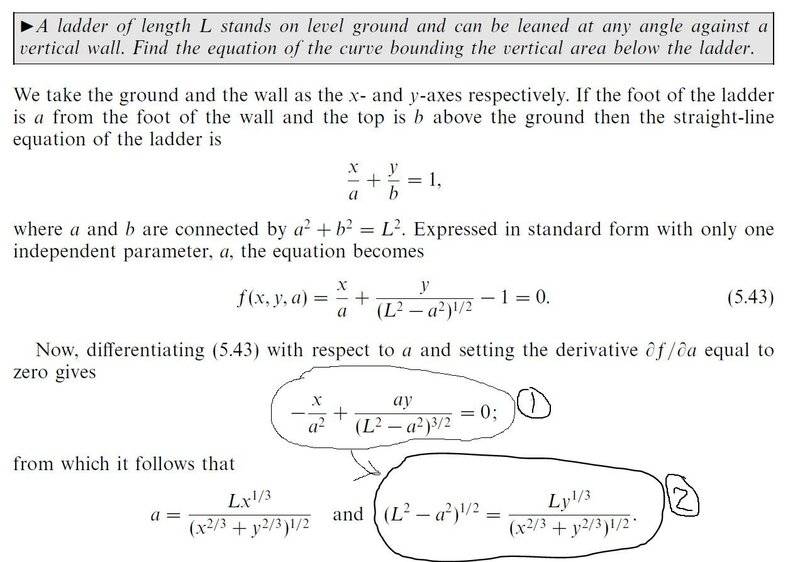
I am looking for steps for the solution of an envelopes example in Mathematical Methods for Physics and Engineering book
Can someone please show me the steps from circled equation 1 to 2?
Envelopes.JPG

Thank you.
 
Last edited:
Physics news on Phys.org
If you replace ##x \leftrightarrow y## and ##a \leftrightarrow b## in the previous equation, you get the last equation.
 
Last edited:
Reply
  • Like
Likes   Reactions: vgarg, DrClaude and Orodruin
I believe the author of your text book? @Orodruin
 
Reply
  • Like
Likes   Reactions: vgarg
Hill said:
If you replace ##x \leftrightarrow y## and ##a \leftrightarrow b## in the previous equation, you get the last equation.
To clarify: By the symmetry of the problem, you could have solved it for ##b## to get
$$
b = \frac{L y^{1/3}}{(x^{2/3} + y^{2/3})^{1/2}}
$$
instead of
$$
a = \frac{L x^{1/3}}{(x^{2/3} + y^{2/3})^{1/2}}
$$

Then simply substitute ##b## in the first equation using ##a^2 + b^2 = L^2##.
 
Last edited:
Reply
  • Like
Likes   Reactions: vgarg and Hill
Thank you very much for your help. I will sure list the author of the book in any future post.