Determine domain for a trig ratio and the general solution of angle me

Click For Summary
SUMMARY

The discussion focuses on determining the domain and general solutions for the equation sin(θ) = √3/2. Participants clarify that the solutions exist in the first and second quadrants, leading to general solutions expressed as θ = 60° + 360n and θ = 120° + 360n. The conversation also addresses the combination of solutions, specifically how 0 + 360n and 180 + 360n can be simplified to 0 + 180n, representing all multiples of 180. The importance of understanding the periodic nature of the sine function is emphasized for deriving these solutions.

PREREQUISITES
  • Understanding of trigonometric functions, specifically sine.
  • Familiarity with angle measures in degrees and radians.
  • Knowledge of periodic functions and their general solutions.
  • Ability to manipulate and combine trigonometric equations.
NEXT STEPS
  • Study the periodic properties of the sine function in detail.
  • Learn how to derive general solutions for trigonometric equations.
  • Explore the concept of co-terminal angles and their applications.
  • Practice solving trigonometric equations involving different quadrants.
USEFUL FOR

Students and educators in mathematics, particularly those focusing on trigonometry, as well as anyone involved in solving trigonometric equations and understanding their graphical representations.

Coco12
Messages
272
Reaction score
0
Problem statement
Given sin theta (sqrt 3)/2
Determine the domain for the following solution
https://www.physicsforums.com/attachments/655052) determine each general solution using the angle measure specified.
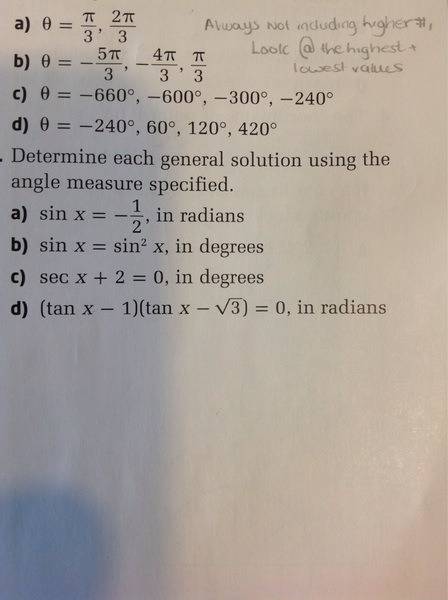
ImageUploadedByPhysics Forums1389443143.728586.jpg


Revelant equations

Attempt at solution1What is the reasoning behind that? For example if you look at b , the answers a re all in the first and second quadrant. Would you just look at the highest and lowest value?
2) I found the angle measure for each solution. I thought u just find the angle measure and then write the equation for the co terminal angle (
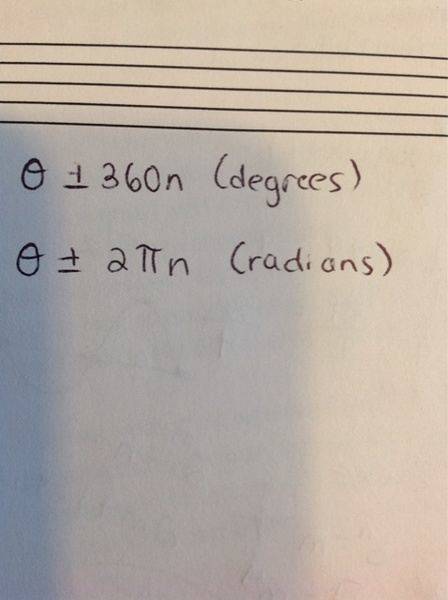
ImageUploadedByPhysics Forums1389443276.807035.jpg
)

That worked for a but in b) one of the answer was 180n... Where did that come from? I got 180 + 360n but 180n?
This is the same situation for d , they did not put( 2pi), instead they had the angle then plus or minus pi.
 
Physics news on Phys.org
Not quite sure what Q1 is supposed to be. Is it this: "Given that sin(θ) = (√3)/2 and x < θ < y, find x and y (maximal interval?) such that the solutions are as given in a, b, c etc."? Asking for a domain is a bit strange since it could be \Re minus the unwanted solutions.

2b is a quadratic, so you would expect two sets of solutions. Please post your working.
 
haruspex said:
Not quite sure what Q1 is supposed to be. Is it this: "Given that sin(θ) = (√3)/2 and x < θ < y, find x and y (maximal interval?) such that the solutions are as given in a, b, c etc."? Asking for a domain is a bit strange since it could be \Re minus the unwanted solutions.

2b is a quadratic, so you would expect two sets of solutions. Please post your working.

For 1, it just asked for the domain given that sine theta is (sqrt 3)/2 and the following solutions.

For 2b, I brought over the sin x and got sin x=0 and sin x=1 when I factored it out. That would be equivalent to 90 degrees, 0 and 180 degrees. How do u write the general solution tho?
 
Coco12 said:
For 2b, I brought over the sin x and got sin x=0 and sin x=1 when I factored it out. That would be equivalent to 90 degrees, 0 and 180 degrees. How do u write the general solution tho?
Depends what form you require it in. You know what the repeat interval of the sine function is, so you could just say the solutions are α+2nπ where α is any of ... etc. If you want it as a single function of some integer parameter that's a little more convoluted. You could include terms like (-1)n or even in.
 
haruspex said:
Depends what form you require it in. You know what the repeat interval of the sine function is, so you could just say the solutions are α+2nπ where α is any of ... etc. If you want it as a single function of some integer parameter that's a little more convoluted. You could include terms like (-1)n or even in.
That is what I did: the 2 pi n . However the back of the book has 90+ (2pi)n and 180 n. where did the 180 n come from?
 
Coco12 said:
That is what I did: the 2 pi n . However the back of the book has 90+ (2pi)n and 180 n. where did the 180 n come from?
You had 0 + 360n, 90+360n, 180+360n. The first and last can be combined as 0+180n.
 
haruspex said:
You had 0 + 360n, 90+360n, 180+360n. The first and last can be combined as 0+180n.
What do you mean by the first and last can be combined ? Do you mean 0+360n and 180+360n? Since 360n is common among both, u just leave it as n?
 
Last edited by a moderator:
Coco12 said:
What do u mean by the first and last can be combined ? Do u mean 0+360n and 180+360n? Since 360n is common among both, u just leave it as n?

I mean that the union of the sets 0+360n, 180+360n is the set 0+180n.
The first is ... -720, -360, 0, +360, +720, ..., the second is ... -540, -180, +180, +540 ..., and combining them gives ... -720, -540, -360, -180, 0, +180, +360, ...
 
Coco12 said:
What do you mean by the first and last can be combined ? Do you mean 0+360n and 180+360n? Since 360n is common among both, u just leave it as n?

Coco -- check your PMs. I have fixed up this post of yours...
 
  • #10
berkeman said:
Coco -- check your PMs. I have fixed up this post of yours...
Thank you. Really sorry, sometimes when I type really fast, I forget not to use text speak. I will keep it in mind next time.
 
  • #11
haruspex said:
I mean that the union of the sets 0+360n, 180+360n is the set 0+180n.

The first is ... -720, -360, 0, +360, +720, ..., the second is ... -540, -180, +180, +540 ..., and combining them gives ... -720, -540, -360, -180, 0, +180, +360, ...
Oh. So you figure out both of the plus and minus for each to find the results then combine them to give a simplified equation?
 
  • #12
Coco12 said:
Oh. So you figure out both of the plus and minus for each to find the results then combine them to give a simplified equation?
Yes, except that it shouldn't involve such a detailed development. I only wrote it out like that to make it absolutely clear. You should spot that 180 is a common factor through 0+360n and 180+360n, so they reduce to 180{0 + 2n, 1+2n}, which means the even and odd multiples of 180, therefore all multiples of 180.
 

Similar threads

  • · Replies 4 ·
Replies
4
Views
2K
  • · Replies 2 ·
Replies
2
Views
2K
Replies
19
Views
7K
  • · Replies 1 ·
Replies
1
Views
5K
  • · Replies 1 ·
Replies
1
Views
5K
  • · Replies 1 ·
Replies
1
Views
2K
  • · Replies 5 ·
Replies
5
Views
11K
  • · Replies 6 ·
Replies
6
Views
4K
  • · Replies 4 ·
Replies
4
Views
8K
Replies
5
Views
17K