Determining Suitable Contour for $\int_0^{\infty} \dfrac{\log (x) }{x^2 +1 } dx$

  • Context: MHB 
  • Thread starter Thread starter Amer
  • Start date Start date
Click For Summary
SUMMARY

The discussion focuses on determining a suitable contour for the integral $\int_0^{\infty} \frac{\log(x)}{x^2 + 1} dx$. It establishes that the integral evaluates to zero, as shown through the substitution $x \mapsto \frac{1}{x}$, leading to the conclusion that $I = 0$. The proposed contour involves a semicircular path and rays emanating from the imaginary axis, but it is noted that the combination of the logarithmic function and the contour does not yield a valid result, necessitating alternative approaches such as using $\frac{\log^2(z)}{z^2 + 1}$ or adjusting the branch cut.

PREREQUISITES
  • Complex analysis, specifically contour integration
  • Understanding of logarithmic functions in the complex plane
  • Knowledge of residue theorem and singularities
  • Familiarity with substitution techniques in integrals
NEXT STEPS
  • Study the residue theorem in complex analysis
  • Learn about branch cuts and their implications in complex logarithms
  • Investigate the properties of $\log^2(z)$ and its integration over contours
  • Explore alternative methods for evaluating improper integrals
USEFUL FOR

Mathematicians, students of complex analysis, and anyone interested in advanced techniques for evaluating integrals involving logarithmic functions.

Amer
Messages
259
Reaction score
0
what is the suitable contour for the integral
$\displaystyle \int_0^{\infty} \dfrac{\log (x) }{x^2 +1 } dx $

and why ? or what is the method to determine a good one?
 
Physics news on Phys.org
Amer said:
what is the suitable contour for the integral
$\displaystyle \int_0^{\infty} \dfrac{\log (x) }{x^2 +1 } dx $

and why ? or what is the method to determine a good one?

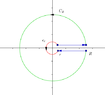
Let $\varepsilon > 0$ be small and $R>0$ be large.
1) Start at $i\varepsilon$, in the clockwise direction draw semicircle $C$ centered at $0$ that ends at $-i\varepsilon$.
2) Draw rays emanating at $\pm i\varepsilon$, endpoints of $C$, to the left, so $-t\pm i\varepsilon $ for $t\geq 0$.
3) Draw circle $\Gamma$ centered at $0$ of radius $R$.
4) The rays intersect $\Gamma$ at points $\alpha,\beta$ with $\text{Im}(\alpha) > \text{Im}(\beta)$.

Now define $\Gamma_1$ as contour starting at $\beta$, travel counterclockwise along $\Gamma$ until reaching $\alpha$. Travel linearly along ray until reaching $i\varepsilon$. Then move clockwise along $C$ until reaching $-i\varepsilon$. Then travel linearly along ray until returning back to $\alpha$.

Define the function,
$$ f(z) = \frac{\log z}{z^2 + 1} $$
Where $\log z$ is the principal logarithm and integrate,
$$ \oint_{\Gamma_1} f(z) ~ dz $$
 
Amer said:
what is the suitable contour for the integral
$\displaystyle \int_0^{\infty} \dfrac{\log (x) }{x^2 +1 } dx $

and why ? or what is the method to determine a good one?

In...

http://mathhelpboards.com/calculus-10/improper-integral-involving-ln-6103-post27786.html#post27786

... in elementary fashion it has been demonstrated that...

$\displaystyle \int_{0}^{\infty} \frac{\ln x}{1 + x^{2}}\ dx = 0\ (1)$

... but it is also been demonstrated that no suitable contour of integration in the complex plane for the integral (1) exists... Kind regards $\chi$ $\sigma$
 
The best way of computing that integral is to rather use a substitution $x\mapsto 1/x$.

Let $I = \int_0^{\infty} \frac{\log x}{x^2+1} ~ dx$. Now, let $y = \frac{1}{x}$, so that $y' = -\frac{1}{x^2}$ and $x = \frac{1}{y}$. Rewrite,
$$ \frac{\log x}{x^2+1} = \frac{\log x}{x^2+1} \cdot \left( -\frac{1}{x^2} \right) \cdot \left( -x^2 \right) = \frac{ \log \frac{1}{y}}{ \frac{1}{y^2} + 1 } \cdot y' \cdot \left( -\frac{1}{y^2} \right) = \frac{\log y}{y^2+1} \cdot y' $$
Futhermore, $y(0) = \infty$ and $y(\infty) = 0$, so that,
$$ I = \int_0^{\infty} \frac{\log x}{x^2+1} ~ dx = \int_{\infty}^{0} \frac{\log y}{y^2+1} ~ dy = - I $$
This implies that $I=0$.
 
ThePerfectHacker said:
Let $\varepsilon > 0$ be small and $R>0$ be large.
1) Start at $i\varepsilon$, in the clockwise direction draw semicircle $C$ centered at $0$ that ends at $-i\varepsilon$.
2) Draw rays emanating at $\pm i\varepsilon$, endpoints of $C$, to the left, so $-t\pm i\varepsilon $ for $t\geq 0$.
3) Draw circle $\Gamma$ centered at $0$ of radius $R$.
4) The rays intersect $\Gamma$ at points $\alpha,\beta$ with $\text{Im}(\alpha) > \text{Im}(\beta)$.

Now define $\Gamma_1$ as contour starting at $\beta$, travel counterclockwise along $\Gamma$ until reaching $\alpha$. Travel linearly along ray until reaching $i\varepsilon$. Then move clockwise along $C$ until reaching $-i\varepsilon$. Then travel linearly along ray until returning back to $\alpha$.

Define the function,
$$ f(z) = \frac{\log z}{z^2 + 1} $$
Where $\log z$ is the principal logarithm and integrate,
$$ \oint_{\Gamma_1} f(z) ~ dz $$

That combination of function and contour won't work. The log term will vanish.

You either need to consider $ \displaystyle f(z) = \frac{\log^{2} z}{1+z^{2}} $, or you could move the branch cut from the negative real axis to the negative imaginary axis and integrate around a contour that consists of the real axis (indented at the origin) and the upper half of the circle $|z|=R$.
 
If we integrate the function

$$f=\frac{\log^2(z)}{z^2+1}$$

along the contour

View attachment 2411

$$\left(\oint_{C_R}+\oint_{c_r} \right)f(z)\,dz + \int^R_r \frac{\log^2(x)}{x^2+1}\,dx-\int^{R}_r\frac{(\log(x)+2\pi i)^2}{x^2+1}\,dx =2\pi i \sum_{i=1}^2\text{Res}(f,z_i)$$

Taking $R\to \infty$ and $r \to 0$

Then we have

$$-4\pi i\int^\infty_0 \frac{\log(x)}{x^2+1}\,dx+4\pi^2\int^{\infty}_0\frac{1}{x^2+1}\,dx =2\pi i \sum_{i=1}^2\text{Res}\left(\frac{\log^2(z)}{z^2+1},\pm i \right)$$

$$\sum_{i=1}^2\text{Res}\left(\frac{\log^2(z)}{z^2+1},\pm i \right)=\left(\frac{\log^2(i)}{2i} -\frac{\log(-i)^2}{2i}\right)=-\frac{\pi^2}{8i}+\frac{9\pi^2}{8i}=-i\pi^2$$

$$-4\pi i\int^\infty_0 \frac{\log(x)}{x^2+1}\,dx+4\pi^2\int^{\infty}_0\frac{1}{x^2+1}\,dx =2\pi^3$$

Hence we have that

$$\int^{\infty}_0\frac{1}{x^2+1}\,dx=\frac{\pi}{2}$$

$$\int^\infty_0 \frac{\log(x)}{x^2+1}\,dx=0$$
 

Attachments

  • keyhole.png
    keyhole.png
    4.4 KB · Views: 107
Last edited:

Similar threads

  • · Replies 2 ·
Replies
2
Views
2K
  • · Replies 2 ·
Replies
2
Views
2K
  • · Replies 4 ·
Replies
4
Views
3K
  • · Replies 2 ·
Replies
2
Views
2K
  • · Replies 29 ·
Replies
29
Views
3K
  • · Replies 3 ·
Replies
3
Views
2K
  • · Replies 11 ·
Replies
11
Views
3K
  • · Replies 7 ·
Replies
7
Views
2K
  • · Replies 3 ·
Replies
3
Views
2K
Replies
5
Views
3K