Determining the dimension of a given PDE

Click For Summary
SUMMARY

The discussion centers on determining the dimension of partial differential equations (PDEs), specifically analyzing two equations: ##u_t + uu_{xx} + u_{xxx} = 1## and ##u_t + u_{xx} + u_{xxx} = 1##. The consensus is that the first PDE is two-dimensional due to the lack of a clear distinction between time (t) and space (x) variables, while the second is considered one-dimensional. Participants clarify that the term ##u_{xxx}## refers to the third derivative of u with respect to x, emphasizing that all variables in these equations are dimensionless in the context of physical dimensions.

PREREQUISITES
  • Understanding of partial differential equations (PDEs)
  • Familiarity with independent variables in mathematical contexts
  • Knowledge of dimensional analysis in physics
  • Basic comprehension of the Korteweg-de Vries (KdV) equation
NEXT STEPS
  • Study the properties of nonlinear PDEs, particularly the KdV equation
  • Explore dimensional analysis techniques in mathematical physics
  • Learn about the implications of independent variables in PDE formulations
  • Investigate the classification of PDEs based on their dimensions and characteristics
USEFUL FOR

Mathematicians, physicists, and engineering professionals involved in the study of partial differential equations and their applications in modeling physical phenomena.

chwala
Gold Member
Messages
2,828
Reaction score
424
TL;DR
Let me have the pde equation below as our point of reference;

##u_t+u_{xx} + u_{xxx} = 1##
Now in my understanding from text ...just to clarify with you guys; the pde is of dimension 2 as ##t## and ##x## are the indepedent variables or it may also be considered to be of dimension 1, that is if there is a clear distinction between time and space variables.

Your insight on this is appreciated.
 
Last edited:
Physics news on Phys.org
Just to clarify, does ##uxxx## means ##ux^3## or ##u_{xxx}## ?
Dimension you mean is space-time, physical dimension L,T,M or number of variables ?
 
Last edited:
anuttarasammyak said:
Just to clarify, does ##uxxx## means ##ux^3## or ##u_{xxx}## ?
Dimension you mean is space-time, physical dimension L,T,M or number of variables ?
Amended. Dimension as it relates to pde's ...
 
chwala said:
TL;DR Summary: Let me have the two pde equations below as our point of reference;

##u_t+uu_{xx} + u{xxx} = 1## and ##u_t+u_{xx} + u{xxx} = 1##

Now in my understanding from text ...just to clarify with you guys; the first pde is of dimension 2 as there is no clear distinction between time and space variables whereas the second pde would be of dimension 1.
To answer @anuttarasammyak's question, I believe the third term in both equations is ##u_{xxx}##, but was missing the underscore following u. If we categorize these equations by their domains, since the independent variables are t and x, the domain is two-dimensional.
 
  • Like
Likes   Reactions: chwala
chwala said:
Amended. Dimension as it relates to pde's ...
Thanks, I got it. As for dimension, I would say all u, t and x are are dimensionless in the sense of physical dimension because 1 in RHS is dimensionless.
 
Mark44 said:
To answer @anuttarasammyak's question, I believe the third term in both equations is ##u_{xxx}##, but was missing the underscore following u. If we categorize these equations by their domains, since the independent variables are t and x, the domain is two-dimensional.
The definition may vary depending on the context...dimension may also be in reference to the spatial part of the pde...if there is a clear distinction between time and the space variables.
 
chwala said:
The definition may vary depending on the context...dimension may also be in reference to the spatial part of the pde...if there is a clear distinction between time and the space variables.
That doesn't make sense to me. The only independent variables are t and x. The function u evidently depends only on these two variables, so u(t, x) is a surface in three dimensions with a two-dimensional domain.
 
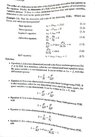
Here is the text page...
 

Attachments

  • CamScanner 02-10-2024 14.26_1.jpg
    CamScanner 02-10-2024 14.26_1.jpg
    43 KB · Views: 111
The page you uploaded reserves the term "dimension" solely for spacial variables, but not a temporal one. That seems a bit artificial to me, but whatever...
 
  • Like
Likes   Reactions: chwala
  • #10
From Wikipedia KdV equation:
-------------------------
Definition
The KdV equation is a nonlinear, dispersive partial differential equation for a function ##{\displaystyle \phi }## of two dimensionless real variables,
##{\displaystyle x} ## and ## {\displaystyle t} ## which are proportional to space and time respectively:[5]
------------------------
It says "a function ##{\displaystyle \phi }## of two dimensionless real variables" .
I have not been falimiar with KdV equation form of RHS 1.
 
  • Informative
Likes   Reactions: chwala

Similar threads

  • · Replies 5 ·
Replies
5
Views
3K
  • · Replies 4 ·
Replies
4
Views
4K
  • · Replies 2 ·
Replies
2
Views
3K
  • · Replies 2 ·
Replies
2
Views
2K
  • · Replies 2 ·
Replies
2
Views
3K
  • · Replies 5 ·
Replies
5
Views
2K
Replies
1
Views
2K
  • · Replies 4 ·
Replies
4
Views
3K
  • · Replies 4 ·
Replies
4
Views
3K
  • · Replies 6 ·
Replies
6
Views
4K