Development of a Bike Trainer (rollers)

  • Thread starter Thread starter Alex65
  • Start date Start date
Alex65
Messages
9
Reaction score
0
I want to make a roller bike trainer. Right now, I only have two rollers from a treadmill for the rear wheel of the bike. My question is: why is it so hard to turn the pedals compared to the rollers on a factory-made bike trainer? The shafts have 6202 RS and 6203 RS bearings, with cylinders having wall thicknesses of 2.5 mm and 3 mm
 
Engineering news on Phys.org
Welcome to PF.

What is the diameter of the rollers?
How far apart are the rollers?
What is the rear wheel outer diameter?
What tire pressure do you have?
 
The roller diameters are 40 mm and 46 mm. The distance between them is 19 cm. The outer diameter of the rear wheel is 28 inches. The tire pressure is 45 PSI
 
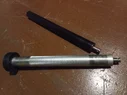
How heavy are the rollers? Are they easy to turn by hand? Can you upload a picture? (use the "Attach files" link below the Edit window)
 
The bike wheel is not dropping down far between the rollers, multiplying the friction load, so that is not a problem.

I suspect the tire pressure is too low for such small diameter rollers. That will deform the tire rubber significantly as it passes the rollers, which will be inefficient and heat the rubber.

Maybe you are riding in too high a gear, so the rollers are spinning much faster than is efficient.

Are the differently sized rollers connected in any way, such that they must roll at the same RPM?
 
I tried riding with different tire pressures and in different gears, but the effect was almost the same. The rollers are not connected to each other and spin independently
 
berkeman said:
How heavy are the rollers? Are they easy to turn by hand? Can you upload a picture? (use the "Attach files" link below the Edit window)
The roller weights are 1.75 kg and 2.2 kg. They are not difficult to spin, but even with my maximum effort they make at most three revolutions. The frame is currently disassembled
 

Attachments

  • IMG_20260203_062655_029.webp
    IMG_20260203_062655_029.webp
    61.1 KB · Views: 2
Alex65 said:
The shafts have 6202 RS and 6203 RS bearings ...
Alex65 said:
They are not difficult to spin, but even with my maximum effort they make at most three revolutions. The frame is currently disassembled
The 620xRS bearings have rubber lip seals that will drag if dry, and may stop the rollers spinning freely. If after cleaning and oiling, you want them to spin for longer, then you will need to use the 620xZZ suffix bearings that have a metal screen on both sides, without frictional contact.

You should make sure that the bearings are free, and have not worn, wound up hair, or have dried grease on the shaft. Clean the bearings and lip seals, then lubricate with light machine oil. You can usually pop the rubber seals carefully off the side of the bearing, which will allow them to be cleaned and then reassembled.
 
The bearings are lubricated and not worn. Thank you
 
  • #10
Alex65 said:
They are not difficult to spin, but even with my maximum effort they make at most three revolutions.
Sorry, what does this mean? Are you saying that when you spin them by hand and stop pushing on them they only rotate 3 times before stopping?
 
  • #11
Yes, that’s correct. After being spun by hand and released, they only make about three revolutions before stopping
 
  • #12
Sounds like the bearings need to be replaced. Unless you like the resistance training on your bike when using the rollers... :wink:
 
  • Agree
Likes   Reactions: 256bits
  • #13
A bicycle is designed to roll freely across a flat surface, on a wheel with a radius of about 15". You have rollers with a radius of less than 1", so I think the rollers are too small in diameter, or the tyres are much too soft for those rollers.

I asked Google what size rollers are typically used, and it replied: "Bicycle trainer rollers typically range in diameter from 57mm to 114mm (roughly 2.25 to 4.5 inches). The specific diameter determines the resistance level and difficulty, with smaller rollers generally providing higher resistance, while larger rollers offer lower resistance".
 
  • #15
berkeman said:
Sounds like the bearings need to be replaced. Unless you like the resistance training on your bike when using the rollers... :wink:
You may be right, although on the other hand, despite the treadmill being old, it hasn’t been used much. I disassembled two bearings, but I didn’t find any obvious signs of wear
 
  • #16
Are 6202 and 6203 bearings ideal for a roller bike trainer?
 
  • #17
Baluncore said:
A bicycle is designed to roll freely across a flat surface, on a wheel with a radius of about 15". You have rollers with a radius of less than 1", so I think the rollers are too small in diameter, or the tyres are much too soft for those rollers.

I asked Google what size rollers are typically used, and it replied: "Bicycle trainer rollers typically range in diameter from 57mm to 114mm (roughly 2.25 to 4.5 inches). The specific diameter determines the resistance level and difficulty, with smaller rollers generally providing higher resistance, while larger rollers offer lower resistance".
Thank you for the information. I thought this might be the reason, but I didn’t realize it could make the rollers so hard to turn
In general, I want to make a trainer with larger rollers — it seems to me that for wheels of this size, rollers with a diameter of 12 cm would be more suitable. But there are two issues here as well
First, I don’t know what material to use or how to make the bushings between the bearings and the cylinders straight and precise without special equipment
Second, I don’t know if an additional part is needed — a tube that sits between the two bearings and prevents them from tilting inward (there are external retainers) — what it should be made of and whether it should fit tightly on the shaft
 
  • #18
Alex65 said:
First, I don’t know what material to use or how to make the bushings between the bearings and the cylinders straight and precise without special equipment ...
You really need to find someone local who has a lathe to make the components, from either metal or timber. The type of lathe available will determine the easiest way to fabricate the machine.

If you cannot find a lathe, search 'conveyor roller' on a website like eBay, and you may find exactly what you need, complete with axle and bearings, at a very reasonable price.

Metal tube, could be cut to length and sleeved to locate the bearings, or a disc end could be made in a metal lathe to carry the bearings.

The rollers could be made in a wood lathe, First drill an axial hole, so that a long axle can pass through without contact. The axle could be a 30" long, threaded rod. The outer bearing race will seat in a recess cut in the end of the roller. The long through axle would then position the inner races, with an external tube on the axle, or a nut on the threaded rod, to press on the inner race, to keep the bearing in the end of the roller.

Alex65 said:
Are 6202 and 6203 bearings ideal for a roller bike trainer?
The 62xx series, also 60xx, 68xx, and 69xx, are low-cost deep-groove ball bearings, which is sufficient for the application. The inner diameter needs to fit over the axle, while the outer diameter needs to be smaller than the roller diameter. Search "deep groove ball bearing" on the web to see lists of possible sizes to select from. I would expect the axle to be about 16mm (0.625") diameter.

Will you have a slave roller under the front wheel, driven by a rear roller?
 

Similar threads

  • · Replies 7 ·
Replies
7
Views
3K
  • · Replies 2 ·
Replies
2
Views
3K
  • · Replies 14 ·
Replies
14
Views
7K
  • · Replies 10 ·
Replies
10
Views
3K
  • · Replies 21 ·
Replies
21
Views
5K
  • · Replies 2 ·
Replies
2
Views
4K
Replies
6
Views
4K
  • · Replies 2 ·
Replies
2
Views
1K
Replies
14
Views
10K
  • · Replies 1 ·
Replies
1
Views
3K