Difficulties in Measuring the Contact Angle of a Sessile Droplet

andrewlee123
Messages
1
Reaction score
0
TL;DR
How can I determine the contact angle of a sessile droplet precisely from side-view photos? I'd also like some insights into issues about lighting, low-angle measurements, and ambient conditions.
I am studying the contact angle of a sessile droplet (water and alcohol mixtures) on both horizontal and inclined surfaces. I capture side-view images with a 24 MP Canon camera and analyze them with a CNN-based pipeline in Python. However, I have run into several issues:
  1. A 24 MP Canon seems to have enough resolution, but I still find it hard to determine the contour from side-view photos of the droplet, and therefore the contact angle, even after using CNN and other analysis tools in my Python code.
螢幕擷取畫面 2026-04-26 173332.webp
螢幕擷取畫面 2026-04-26 173808.webp
螢幕擷取畫面 2026-04-26 173823.webp

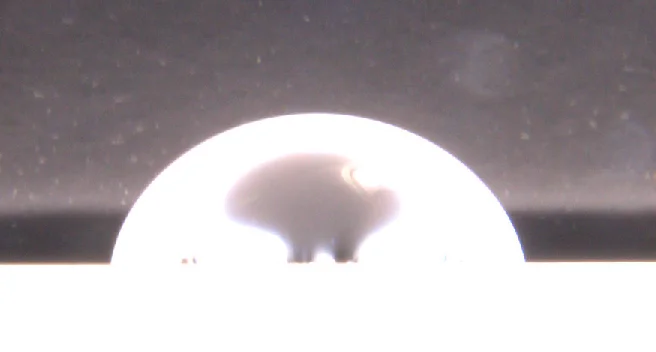
The first picture above shows the side view of the droplet, and I focus on analyzing the right contact angle, as illustrated in the second and third figures. However, I’m unsure which measurement approach is correct - specifically, how close the diagonal lines should be to the contour of the water droplet. Both methods seem reasonable. A similar issue came up when I tried to automate the analysis with code. I also used the image processed by CNN (Sobel operator), but it didn’t really improve the situation:
螢幕擷取畫面 2026-04-26 180157.webp

  1. Lighting problems: As shown above, different regions of the droplet show different colors. Under strong light, the center of the water droplet even appears noticeably darker than its surroundings. Also, I wonder whether a black background (including the table and the screen behind the droplet) is preferred.
螢幕擷取畫面 2026-04-26 180919.webp

  1. The contact angle is difficult to measure when it is too small (for an alcohol droplet or a water droplet that evaporates over roughly 7 hours). I understand this is a common technical bottleneck, and the usual solution is to use higher-resolution imaging, but my Canon camera is already the highest-resolution instrument available to me.
  2. Continuing to the dynamics inside the droplet (e.g., Marangoni flow and the coffee-ring effect), I tried applying fluorescent powder to track the flow of a binary solvent droplet. Unfortunately, the particles seem too heavy to follow the flow, and they tend to overlap or aggregate within the camera’s field of view.
Besides, are there cheaper alternatives to contact angle goniometers or tensiometers? I would like to somewhat automate my experiment and improve measurement accuracy by controlling ambient factors such as air humidity, temperature, and possibly pressure (though I’m not sure about this one), as well as other factors that might affect the contact angle.
 
Physics news on Phys.org
Welcome to PF.

Paging @Ranger Mike in case he's run across anything like this in his measurement experience.
 
andrewlee123 said:
TL;DR: How can I determine the contact angle of a sessile droplet precisely from side-view photos? I'd also like some insights into issues about lighting, low-angle measurements, and ambient conditions.

This type of measurement was a major part of my dissertation. As you have noticed, it's not a simple measurement. I have a few thoughts/suggestions:

Most important: what is your measurement goal in terms of accuracy and precision? Do you want 2 significant digits or 4? "As accurate as possible" is a bad goal.

Lighting: backlight the drop so it appears in silhouette. If you can illuminate with a monochromatic plane wave, that's even better.

Evaporation: as the alcohol evaporates, the contact angle will change.

Sample prep: if the surface is even slightly rough (or there is heterogeneous adsorbed material), you will get contact angle hysteresis, which will become apparent as you apply the drop to the surface. Make sure every drop is dispensed (almost) exactly the same way.

Surface prep/repeatability: microsurface properties impact the macroscopic contact angle. Re-using the same surface over and over will not give repeatable results due to chemical contamination (residue from the fluid, impurities in the fluid, air humidity = adsorbed water, changes to surface roughness if there is a pre-existing fluid film, etc. etc.

Magnification: I don't think it's 'standardized', but you really need to be imaging at the microscale- 0.01 to 0.1 mm length scales.

Good luck!
 
  • Informative
Likes   Reactions: berkeman
andrewlee123 said:
TL;DR: How can I determine the contact angle of a sessile droplet precisely from side-view photos? I'd also like some insights into issues about lighting, low-angle measurements, and ambient conditions.

I am studying the contact angle of a sessile droplet (water and alcohol mixtures) on both horizontal and inclined surfaces. I capture side-view images with a 24 MP Canon camera and analyze them with a CNN-based pipeline in Python. However, I have run into several issues:
  1. A 24 MP Canon seems to have enough resolution, but I still find it hard to determine the contour from side-view photos of the droplet, and therefore the contact angle, even after using CNN and other analysis tools in my Python code.
View attachment 371217View attachment 371218View attachment 371219
The first picture above shows the side view of the droplet, and I focus on analyzing the right contact angle, as illustrated in the second and third figures. However, I’m unsure which measurement approach is correct - specifically, how close the diagonal lines should be to the contour of the water droplet. Both methods seem reasonable. A similar issue came up when I tried to automate the analysis with code. I also used the image processed by CNN (Sobel operator), but it didn’t really improve the situation:
View attachment 371220
  1. Lighting problems: As shown above, different regions of the droplet show different colors. Under strong light, the center of the water droplet even appears noticeably darker than its surroundings. Also, I wonder whether a black background (including the table and the screen behind the droplet) is preferred.
View attachment 371221
  1. The contact angle is difficult to measure when it is too small (for an alcohol droplet or a water droplet that evaporates over roughly 7 hours). I understand this is a common technical bottleneck, and the usual solution is to use higher-resolution imaging, but my Canon camera is already the highest-resolution instrument available to me.
  2. Continuing to the dynamics inside the droplet (e.g., Marangoni flow and the coffee-ring effect), I tried applying fluorescent powder to track the flow of a binary solvent droplet. Unfortunately, the particles seem too heavy to follow the flow, and they tend to overlap or aggregate within the camera’s field of view.
Besides, are there cheaper alternatives to contact angle goniometers or tensiometers? I would like to somewhat automate my experiment and improve measurement accuracy by controlling ambient factors such as air humidity, temperature, and possibly pressure (though I’m not sure about this one), as well as other factors that might affect the contact angle.
Well, I am just an outsider here who likes science but I have to say, it is great that you are using a neural network for determining the contact angle of water. Goes to show that AI can be used for useful scientific research instead of making slop. CNNs were invented in the late 20th century, long before transformers (LLM architecture) was. I wish you luck on this one, man.
 
Convert all of your active part prints to CAD 3D models. You can scan your legacy part prints at any FedEx office. Pricing: $5.99/3 sq. ft. or less $9.99 over 3 sq. ft. Store the scan in PDF format. The problem is that this scan is a Raster scan ( pixelated) in PDF Raster format. This will have to be converted to a Vector PDF format and can be done easily by any CAD savvy person.


To determine if it is in Vector format vs raster.

PDF Vector format it can easily convert it to 3D CAD model if you have Simens NX, Solidworks, Solid Edge, AutoCad, Auto Desk Fusion, Catia and Unigraphics CAD software. All can import and convert 2D to 3D and most have been able to do so for ten years!
Additionally, there are dozens of on line services that can convert your part prints to CAD.

There are many free CAD software's available on line to analyze the feature you require.
 

Similar threads

  • · Replies 1 ·
Replies
1
Views
2K
  • · Replies 2 ·
Replies
2
Views
2K