Diminishing returns from particle accelerators

  • Context: Undergrad 
  • Thread starter Thread starter BWV
  • Start date Start date
  • Tags Tags
    Particle
Join the discussion
Registration is free. Ask a follow-up in this thread, or start your own.
7 replies · 2K views
BWV
Messages
1,690
Reaction score
2,022
Curious about this (https://en.wikipedia.org/wiki/Particle_accelerator)
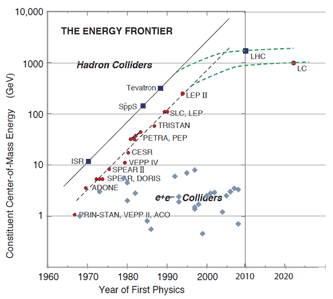
Particle_Accelerator_Livingston_Chart_2010.png

which indicates diminishing returns on new particle accelerators. However to uncover new physics, presumably you need to keep increasing the Lorentz factor by the roughly 10x trend here:

LorentzFactor-1024x768.png

So is this hopeless?
 
  • Like
Likes   Reactions: artis and Charles Link
Physics news on Phys.org
I think this doesn't just apply to particle accelerators but to pretty much everything. Like mining ore for example, the easily accessible one gets mined first and fastest, then as you go deeper for more the ore gets less and you get more investment for less return.

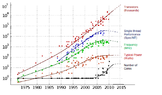
Those graphs seem oddly similar to Moore's law for example, and we know now we are at the point where the climb in the graph is going flat.
 
Although to note one thing, unlike the feature size on microprocessor architecture where we know there won't be any surprises and a minimum is/will soon be reached in high energy physics we don't know whether or not something interesting might still be hiding at a higher energy that we have not yet accessed.

So in a sense it's not a straight forward comparison
 
Also there is a positive feedback with moores law - smaller microprocessors are more efficient (per transistor) than larger ones - the power usage of processors has remained about flat for the last 20 years - with particle accelerators inefficiencies would increase with size

1619294326782.jpeg
 

Attachments

  • 1619294200540.png
    1619294200540.png
    19 KB · Views: 210
Well, to uncover new physics one may need something else apart from higher energy, for example, detector/technical development in some other part of the experimental setup.
 
  • Like
Likes   Reactions: Charles Link