Discover 4 Milky Way Arms: Older Galaxies?

  • Context: High School 
  • Thread starter Thread starter TEFLing
  • Start date Start date
  • Tags Tags
    Galaxies
Click For Summary

Discussion Overview

The discussion revolves around the structure of the Milky Way galaxy, specifically focusing on the identification of four spiral arms and their characteristics. Participants explore the implications of these findings on the understanding of galaxy formation and structure, including the nature of spiral arms and their relationship to star formation.

Discussion Character

  • Exploratory
  • Technical explanation
  • Debate/contested
  • Mathematical reasoning

Main Points Raised

  • Some participants note that the Milky Way has four spiral arms, with the Perseus and Scutum-Centaurus arms being more prominent and star-rich compared to the Sagittarius and Outer arms, which are described as more tightly wound.
  • One participant questions how a spiral galaxy can exhibit different types of arm winding, suggesting that the tightly wound arms may represent older structures.
  • Another participant mentions that spiral arms are not permanent features but rather an artifact of density waves, indicating that stars move in and out of these arms over time.
  • Concerns are raised about the accuracy of artistic representations of the Milky Way, with one participant stating that raw data does not align neatly with these impressions, highlighting the complexity of the galaxy's structure.
  • Participants discuss the messy nature of actual 21cm radiation data from molecular clouds, contrasting it with simplified artistic depictions.
  • There is interest in comparing radio data with Gaia's star map, with questions about the causes of observed features such as shadows in the Galactic anticenter direction.
  • One participant suggests that the Milky Way may resemble other galaxies like Andromeda or NGC 2841, based on the data presented.
  • Another participant emphasizes the variability in spiral structures among galaxies, referencing the work of Elmgreen and Elmgreen on flocculent spiral galaxies.
  • Discussion includes observations of 21cm emission data at large radii, suggesting that the Milky Way could be similar in size to the Pinwheel Galaxy (M101).

Areas of Agreement / Disagreement

Participants express a range of views regarding the structure and characteristics of the Milky Way's spiral arms, with no consensus reached on the implications of the findings or the nature of the arms themselves. The discussion remains unresolved with multiple competing perspectives presented.

Contextual Notes

Participants note limitations in the data, including the complexity of the galaxy's structure and the dependence on various observational techniques. There are also unresolved questions regarding the interpretation of the 21cm emission data and its implications for understanding the Milky Way's spiral structure.

TEFLing
Messages
237
Reaction score
22
https://Earth'sky.org/space/new-map-confirms-four-milky-way-arms
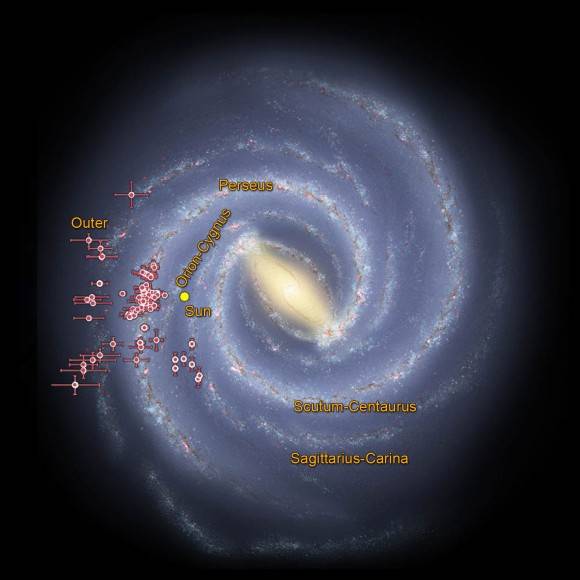
young-stars-milky-way-e1433529533593.jpg

...four spiral arms. The arms are where most stars in the galaxy are born. They contain most of the galaxy’s gas and dust, the raw ingredients for new stars.

Two of the arms, called Perseus and Scutum-Centaurus, seem to be more prominent and jam-packed with stars, while the Sagittarius and Outer arms have as much gas as the other two arms but not as many stars.​

The "minor" arms (Sagittarius & Outer) are more tightly wound. How can one spiral galaxy have more than one type of arm winding, aren't spirals classified according to a single degree of arm winding?

Are the more tightly wound arms, which evidently lack as many bright young stellar nurseries, older structures?
 

Attachments

  • young-stars-milky-way-e1433529533593.jpg
    young-stars-milky-way-e1433529533593.jpg
    26 KB · Views: 1,650
Astronomy news on Phys.org
Not sure this helps, but spiral arms are not permanent structures. They are an artifact of density waves, as stars move in and out of the arms.
 
  • Like
Likes   Reactions: sophiecentaur, davenn and TEFLing

Attachments

  • Milky Way nurseries.jpeg
    Milky Way nurseries.jpeg
    40.9 KB · Views: 1,110
Actual raw data of 21cm radiation from Molecular Clouds is much messier, like M101, obvious "swirling whorl" of dust-lanes, yet without any grandly designed arms.

Hence, our position in the "Orion Spur" arm segment is unsurprising, the whole whirling maelstrom of dust-lanes in the MWG disk is much more complex that the artist impression "cartoon" publicized widely on the web.

Obviously the artist's impression is better for outreach, yet the actual data is more complicated:

bjDoE.jpg
References:
https://astronomy.stackexchange.com...y-early-21-cm-map-of-the-milky-way-oort-et-al
https://www.researchgate.net/publication/228773700_Observations_of_Milky_Way_at_21_cm_Wavelength_at_the_Bosscha_Observatory
Milky Way nurseries with 21cm raw data twice over.png
 

Attachments

  • Milky Way nurseries with 21cm raw data twice over.png
    Milky Way nurseries with 21cm raw data twice over.png
    69.6 KB · Views: 848
  • bjDoE.jpg
    bjDoE.jpg
    52.7 KB · Views: 848
Interesting to see the actual radio data, it could be interesting to compare it with Gaia's star map. But what causes the "shadow" in the direction of Galactic anticenter? Orion molecular cloud complex?
 
Ratman said:
Interesting to see the actual radio data, it could be interesting to compare it with Gaia's star map. But what causes the "shadow" in the direction of Galactic anticenter? Orion molecular cloud complex?
think that's the solar system ecliptic plane, but great question
 
The data would be more funky at 0 and 180 degrees. It is co-rotating. The distance of a pixel is determined by the blue/red shift of the gas emission. At 180 the shift is just the random motion of the gas and does not indicate distance.
 
  • Like
Likes   Reactions: Ratman, alantheastronomer and TEFLing
From raw data:

Milky Way map with arms.jpg


Milky Way map.jpg


Offer that the Milky Way more resembles Andromeda (M31) or NGC 2841

Andromeda-Galaxy-M31-NASA.jpg


ngc2841_hstColombari_1080.jpg
 

Attachments

  • Milky Way map with arms.jpg
    Milky Way map with arms.jpg
    46.1 KB · Views: 787
  • Milky Way map.jpg
    Milky Way map.jpg
    41.1 KB · Views: 700
  • Andromeda-Galaxy-M31-NASA.jpg
    Andromeda-Galaxy-M31-NASA.jpg
    105.6 KB · Views: 671
  • ngc2841_hstColombari_1080.jpg
    ngc2841_hstColombari_1080.jpg
    28 KB · Views: 591
  • #10
Spiral structure in disk galaxies is not an exact science. See the work of Elmgreen and Elmgreen, Vassar College, on "flocculent spiral galaxies" or look at images of them on the Hubble website to see the wide variations among spirals.
 
  • Like
Likes   Reactions: TEFLing
  • #11
lemme add one more thing :)

Hard to tell what's happening within the Solar radius of 8kpc

However, found some data on 21cm emission at large radii up to 25kpc... suggests our galaxy more resembles M101 "Pinwheel Galaxy", and that like that major spiral, our galaxy is also ~50kpc across

Milky Way map modern large.png


Milky Way map modern large annotated.png


PIA15630_hires.jpg
 

Attachments

  • Milky Way map modern large.png
    Milky Way map modern large.png
    129.9 KB · Views: 744
  • Milky Way map modern large annotated.png
    Milky Way map modern large annotated.png
    131.6 KB · Views: 715
  • PIA15630_hires.jpg
    PIA15630_hires.jpg
    37.6 KB · Views: 619

Similar threads

  • · Replies 2 ·
Replies
2
Views
6K
  • · Replies 19 ·
Replies
19
Views
8K
  • · Replies 1 ·
Replies
1
Views
2K
  • · Replies 19 ·
Replies
19
Views
4K
  • · Replies 0 ·
Replies
0
Views
3K
Replies
8
Views
4K
  • · Replies 2 ·
Replies
2
Views
3K
  • · Replies 1 ·
Replies
1
Views
4K
  • · Replies 4 ·
Replies
4
Views
3K
  • · Replies 4 ·
Replies
4
Views
2K