Prove It
Gold Member
MHB
- 1,434
- 20
View attachment 5635
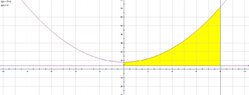
Here is a graph of the region to be rotated. Notice that it is being rotated around the same line that is the lower boundary.
View attachment 5636
The volume will be exactly the same if everything is moved down by 4 units, with the advantage of being rotated around the x-axis. So using the rule for finding the volume of a solid formed by rotating $\displaystyle \begin{align*} f(x) \end{align*}$ around the x axis: $\displaystyle \begin{align*} V = \int_a^b{ \pi\,\left[ f(x) \right] ^2\,\mathrm{d}x } \end{align*}$ the volume we want is $\displaystyle \begin{align*} V &= \int_0^8{\pi\, \left( x^2 + 4 \right) ^2 \,\mathrm{d}x } \end{align*}$.
Here is a graph of the region to be rotated. Notice that it is being rotated around the same line that is the lower boundary.
View attachment 5636
The volume will be exactly the same if everything is moved down by 4 units, with the advantage of being rotated around the x-axis. So using the rule for finding the volume of a solid formed by rotating $\displaystyle \begin{align*} f(x) \end{align*}$ around the x axis: $\displaystyle \begin{align*} V = \int_a^b{ \pi\,\left[ f(x) \right] ^2\,\mathrm{d}x } \end{align*}$ the volume we want is $\displaystyle \begin{align*} V &= \int_0^8{\pi\, \left( x^2 + 4 \right) ^2 \,\mathrm{d}x } \end{align*}$.