Does a Compression Spring's Pitch Affect Its Constant k?

Click For Summary

Discussion Overview

The discussion centers on the relationship between a compression spring's pitch (rise angle) and its spring constant k. Participants explore various formulas and interpretations regarding how pitch affects spring stiffness, with references to different sources and examples.

Discussion Character

  • Debate/contested
  • Technical explanation
  • Mathematical reasoning

Main Points Raised

  • Bob questions whether the pitch or rise angle of a compression spring affects its spring constant k, citing differing sources on the topic.
  • Bob presents a formula for k and argues that neglecting pitch leads to incorrect conclusions, using extreme cases to illustrate his point.
  • One participant notes that the formula includes the number of active coils, suggesting that changing the pitch alters this number but does not affect stiffness for a fixed number of coils.
  • Another participant agrees with the previous point, stating that stiffness remains constant for a fixed number of coils regardless of pitch angle.
  • Bob challenges this assertion by questioning the reasoning behind the equivalence of stiffness for different pitch angles, reiterating his extreme-case examples.
  • A participant responds by suggesting that as the angle approaches zero, the spring behaves like a curved beam, and its stiffness is influenced by the length of the wire, not just the angle.
  • The same participant also mentions that as the angle approaches 90 degrees, the number of turns decreases, leading to a prediction of increased stiffness according to the formula.

Areas of Agreement / Disagreement

Participants express differing views on the impact of pitch on spring constant k, with some asserting that it does not affect stiffness for a fixed number of coils, while others challenge this perspective using extreme cases. The discussion remains unresolved regarding the relationship between pitch and k.

Contextual Notes

Participants highlight limitations in the application of simple formulas at extreme angles, indicating that assumptions about coil behavior and the number of turns may not hold in all scenarios.

bobfei
Messages
29
Reaction score
0
Hi,

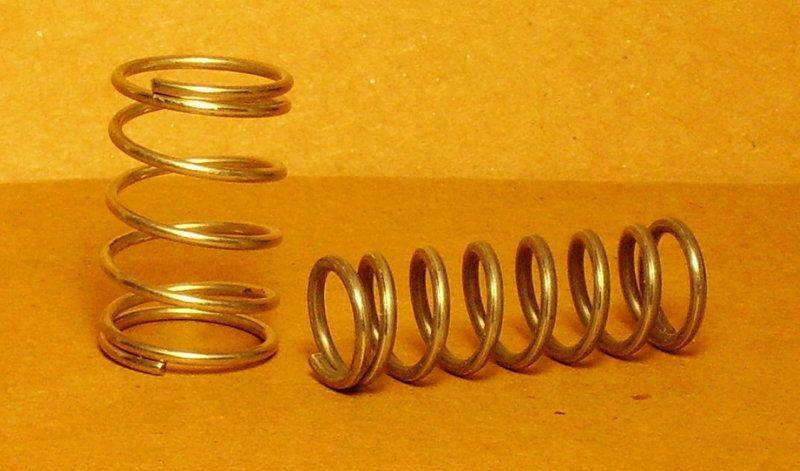
Compression_Springs.JPG

Does a compression spring’s pitch or rise angle have any relation with its spring constant k?
I checked various sources and they differ on this. Some sites simply asks you to feed input into a simple formula:
k=Gd4/3D3na
in which
k: spring constant
G: material’s shear modulus
d: diameter of the wire
D: outer diameter of each winding​
An example of this treatment can be found at http://www.efunda.com/DesignStandards/springs/calc_comp_designer_eqn.cfm.

On the other hand, some other sites require knowing the pitch between each winding, or equivalently rise angle θ, and result varies with different pitch/θ even all four parameters above remain unchanged. An example is at http://www.planetspring.com/pages/compression-spring-calculator-coil-calculator.php?id=compression.

I strongly suspect the first type of treatment above is incorrect. Consider extreme case:
1. θ →0° : This means we are not winding the spring up so all windings remains on the same plane. Of course when approaching this extreme k would approach zero.
2.. θ →90°: This corresponding the case when we are pulling the string straight without any winding and it points straight upward. Trying to compressing such a “spring” on the two ends is like compressing a stick rod, and we would get extremely large resistance due
to the rigidity of the material itself. Obviously in this case k → infinity​

It is then quite clear that θ cannot be overlooked, and the first kind of treatment above is obviously wrong.

I wonder why so many websites are still providing that answer? Could someone help or give a derivation of the compression spring k formula?


Bob
 

Attachments

  • k_formula.jpg
    k_formula.jpg
    1.3 KB · Views: 699
Engineering news on Phys.org
Your first formula includes ##n_a## which is thie number of active coils in the spring. If you change the pitch angle, then for a fixed length of spring you change ##n_a##.

Actually the first formula tells you something interesting: for a foxed number of coils, the stiffness does NOT depend on the pitch angle. A "long" spring with 10 coils and a big pitch angle has about the same stiffness as a "short" spring with 10 coils and a small pitch angle.

You can only choose two of the pitch angle, the length of the spring, and the number of coils as independent quantities.
 
Aleph,
AlephZero said:
Actually the first formula tells you something interesting: for a foxed number of coils, the stiffness does NOT depend on the pitch angle. A "long" spring with 10 coils and a big pitch angle has about the same stiffness as a "short" spring with 10 coils and a small pitch angle.
This is what I cannot understand: why k(small angle, 10 coils) = k(large angle, 10 coils)? see the below extreme-case reasoning?
Bobsun said:
1. θ →0° : This means we are not winding the spring up so all windings remains on the same plane. Of course when approaching this extreme k would approach zero.
2.. θ →90°: This corresponding the case when we are pulling the string straight without any winding and it points straight upward. Trying to compressing such a “spring” on the two ends is like compressing a stick rod, and we would get extremely large resistance due
to the rigidity of the material itself. Obviously in this case k → infinity
 
Why do you think k approaches 0 when the angle is small? Allowing for the fact that the coils can't intersect each other, when θ → 0 the wire is wound into a spiral. That acts like a curved beam, and its stiffness depends on the length of the wire (i.e. the number of turns).

For a fixed number of turns (and a fixed length of wire), it doesn't make much difference if the angle is exactly 0 or just close to 0.

These simple formulas don't really apply when θ → 90, but for a fixed length of spring, as θ → 90 the number of turns ##n_a## → 0 so the first formula does predict the stiffness gets very large.
 

Similar threads

  • · Replies 1 ·
Replies
1
Views
3K
  • · Replies 2 ·
Replies
2
Views
5K
  • · Replies 3 ·
Replies
3
Views
2K
  • · Replies 6 ·
Replies
6
Views
2K
Replies
7
Views
4K
  • · Replies 15 ·
Replies
15
Views
4K
  • · Replies 5 ·
Replies
5
Views
4K
  • · Replies 1 ·
Replies
1
Views
3K
  • · Replies 4 ·
Replies
4
Views
3K
  • · Replies 2 ·
Replies
2
Views
2K