Kashmir
- 466
- 74
Goldstein 2nd ed.
In its Appendix is given the derivation of Bertrands Theorem.
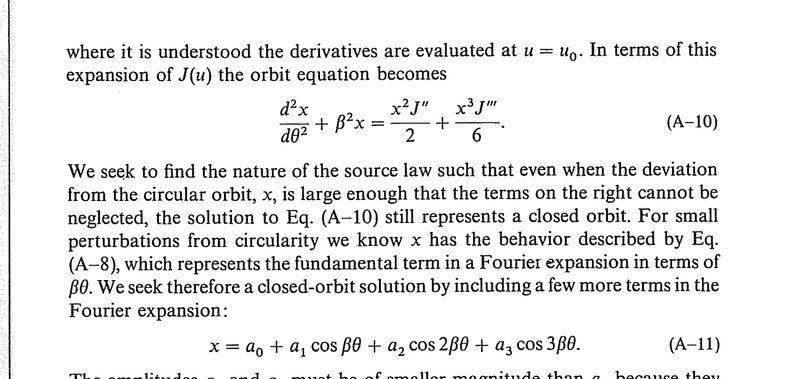 Here ##x=u-u_0## is the deviation from circularity and ##J(u)=-\frac{m}{l^{2}} \frac{d}{d u} V\left(\frac{1}{u}\right)=-\frac{m}{l^{2} u^{2}} f\left(\frac{1}{u}\right)##
If the R.H.S of A-10 was zero, the solution was then ##a \cos(β\theta)##. However if there are terms on the RHS as given in equation A-10 the author writes the solution as a Fourier sum involving only cosine terms .
Now how does the author know that we should use a Fourier expansion of ##x## using only cosine terms with argument ##β\theta##?
In its Appendix is given the derivation of Bertrands Theorem.
If the R.H.S of A-10 was zero, the solution was then ##a \cos(β\theta)##. However if there are terms on the RHS as given in equation A-10 the author writes the solution as a Fourier sum involving only cosine terms .
Now how does the author know that we should use a Fourier expansion of ##x## using only cosine terms with argument ##β\theta##?
Last edited: