Elastic collision between billiard balls at 4.00 m/s

  • Thread starter Thread starter ejantz
  • Start date Start date
  • Tags Tags
    Ball Speed
Join the discussion
Registration is free. Ask a follow-up in this thread, or start your own.
7 replies · 3K views
ejantz
Messages
5
Reaction score
0
Homework Statement
A billiard ball moves at a speed of 4.00m/s and collides elastically with an identical stationary ball. As a result, the stationary ball flies away at a speed of 1.69m/s, as shown in Figure A2.12. Determine the final speed and direction of the incoming ball after the collision and the direction of the stationary ball after the collision
Relevant Equations
KEi = KE1 + KE2
p1x + p2x = p'1x + p'2x
p1y + p2y = p'1y + p'2y
cos(theta1)^2 + sin(theta1)^2 = cos(theta2)^2 + sin(theta2)^2
I know this question has been asked before but I really need some help finishing this final piece of the puzzle.. I have attached an image of my work to show how far I have gotten towards the solution but my unfamiliarity with trigonometry equations has gotten my stuck. Please assist! thank you
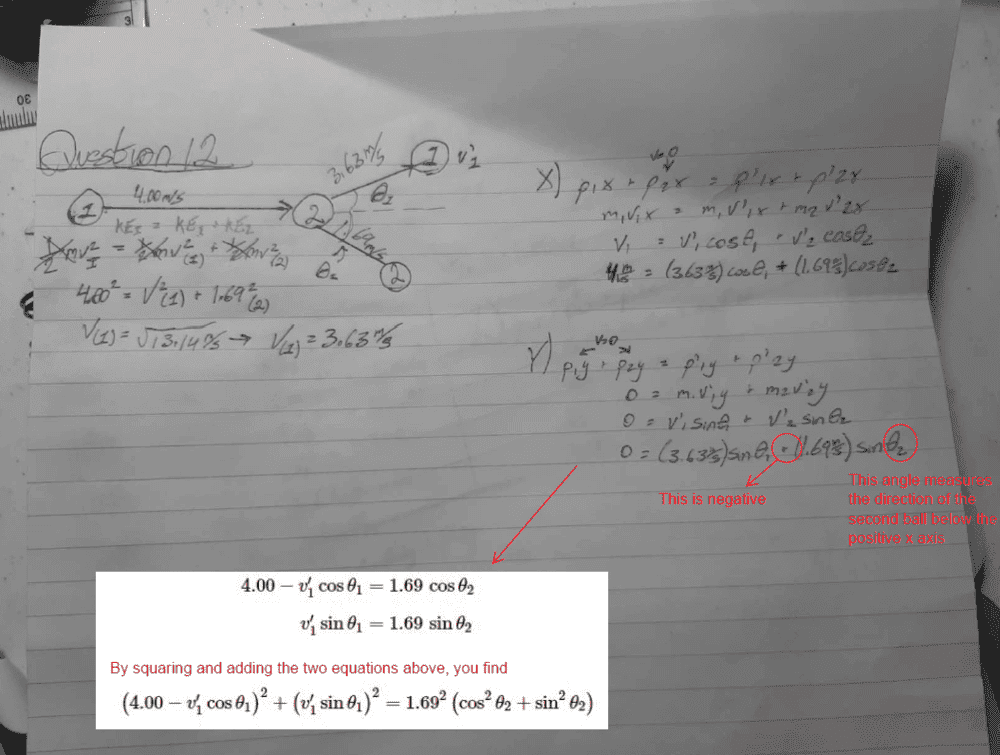
243402
 

Attachments

  • 20190506_211049.jpg
    20190506_211049.jpg
    51.4 KB · Views: 469
Physics news on Phys.org
ejantz said:
Problem Statement: A billiard ball moves at a speed of 4.00m/s and collides elastically with an identical stationary ball. As a result, the stationary ball flies away at a speed of 1.69m/s, as shown in Figure A2.12. Determine the final speed and direction of the incoming ball after the collision and the direction of the stationary ball after the collision
Relevant Equations: KEi = KE1 + KE2
p1x + p2x = p'1x + p'2x
p1y + p2y = p'1y + p'2y
cos(theta1)^2 + sin(theta1)^2 = cos(theta2)^2 + sin(theta2)^2
Remember, ##\sin^2(\theta) + \cos^2(\theta) = 1 ## for any angle.
 
  • Like
Likes   Reactions: ejantz
okay perfect, yes. so next step:
(4 - v'1 cosθ1)^2 + (v'1 sinθ1)^2 = 1.69^2 (cos^2 θ2 + sin^2 θ2)
this second part would be: = 2.8561 X 1 = 2.8561
but the first half now I am still struggling.. should i substitute in the v'1 (3.63) value?
(4^2 - 3.63^2 X cos^2 θ1) + (3.63^2 X sin^2 θ1) = 2.8561
2.8231 X cos^2 θ1 + 13.1769 X sin^2 θ1 = 2.8561
2.8231 X cos^2 θ1 = 2.8561 - 13.1769 X sin^2 θ1
2.8231 X cos^2 θ1 = -10.32 X sin^2 θ1
(2.82 / -10.32) = (sin^2 θ1 / cos^2 θ1)
-0.2735 = tan θ1
θ1 = tan-1(-0.2735) = -15.3

θ1 + θ2 = 90
θ2 = 90 - (-15.3)
θ2 = 105.3

I know I went wrong somewhere.. thank you for your help!
 
ejantz said:
okay perfect, yes. so next step:
(4 - v'1 cosθ1)^2 + (v'1 sinθ1)^2 = 1.69^2 (cos^2 θ2 + sin^2 θ2)
this second part would be: = 2.8561 X 1 = 2.8561
but the first half now I am still struggling.. should i substitute in the v'1 (3.63) value?
(4^2 - 3.63^2 X cos^2 θ1) + (3.63^2 X sin^2 θ1) = 2.8561
##(4 - v'1 \cosθ1)^2 ## is not equal to ##(4^2 - 3.63^2 \cos^2 θ1)##
How do you get the square of (a-b)?
 
  • Like
Likes   Reactions: ejantz
ohhh right, okay:
(4 − v′1 cosθ1)^2 = 2.8561
v'1^2 cos^2 θ1 − 8v'1 cos θ1 +16 = 2.8561
(3.63)^2 cos^2 θ1 - 8(3.63)cos(θ) + 16 = 2.8561
13.1769 cos^2 θ1 - 29.04 cos θ1 + 13.1439

apply the quadratic equation for: 13.1769 x^2 - 29.04 x + 13.1439
= 1.57 and 0.63
θ1 = cos-1 0.63 (cannot take inverse of 1.57)
θ1 = 50.95

θ1 + θ2 = 90
θ2 = 90 - (50.95)
θ2 = 39.1

does that look correct??
 
ah no sorry i completely forgot about the other half of the equation! ignore the previous post, check this:

(4 - v'1 cosθ1)^2 + (v'1 sinθ1)^2 = 1.69^2 (cos^2 θ2 + sin^2 θ2)
(4 − v′1 cosθ1)^2 + ((3.63)^2 X sin^2 θ1) = 2.8561

(4 − v′1 cosθ1)^2 --> v'1^2 cos^2 θ1 − 8v'1 cos θ1 +16

(3.63)^2 cos^2 θ1 - 8(3.63)cos(θ) + 16 + (13.1769 X sin^2 θ1) = 2.856
13.1769 cos^2 θ1 - 29.04 cos θ1 + 13.1769 sin^2 θ1 +13.144 = 0
 
ooo okay, then what about this:
13.1769 (cos^2 θ1 + sin^2 θ1) = 29.04 cos θ1 - 13.144
13.1769 = 29.04 cos θ1 - 13.144
cos θ1 = (13.1769 + 13.144) / 29.04
θ1 = cos-1 (0.906)
θ1 = 25.0

θ1 + θ2 = 90
θ2 = 90 - (25.0)
θ2 = -25

woww that was such a struggle, I am sorry, I think I may have it this time though??
 
ejantz said:
ah no sorry i completely forgot about the other half of the equation! ignore the previous post, check this:

(4 - v'1 cosθ1)^2 + (v'1 sinθ1)^2 = 1.69^2 (cos^2 θ2 + sin^2 θ2)
(4 − v′1 cosθ1)^2 + ((3.63)^2 X sin^2 θ1) = 2.8561

(4 − v′1 cosθ1)^2 --> v'1^2 cos^2 θ1 − 8v'1 cos θ1 +16

(3.63)^2 cos^2 θ1 - 8(3.63)cos(θ) + 16 + (13.1769 X sin^2 θ1) = 2.856
13.1769 cos^2 θ1 - 29.04 cos θ1 + 13.1769 sin^2 θ1 +13.144 = 0
OK. apply sin2(θ1 )+cos2(θ1 )=1 again.
 
  • Informative
Likes   Reactions: ejantz