Energy density of an electromagnetic field

Click For Summary
SUMMARY

The energy density of an electromagnetic field in a linear dielectric is accurately expressed using the formula \( u = \frac{1}{2} \vec{E} \cdot \vec{D} \). This relationship is derived from macroscopic electrodynamics, where \( \vec{D} \) is defined as \( \vec{D} = \epsilon \vec{E} = \epsilon_0 \epsilon_r \vec{E} \). The discussion highlights the importance of integrating only over free charge while acknowledging that neglecting bound charge can lead to inaccuracies. For a deeper understanding, Griffith's "Electrodynamics" provides essential insights, particularly in section 4.4.3 regarding energy in dielectric systems.

PREREQUISITES
  • Understanding of electromagnetic fields and energy density
  • Familiarity with linear dielectrics and their properties
  • Knowledge of macroscopic electrodynamics principles
  • Basic calculus, particularly integration techniques
NEXT STEPS
  • Study Griffith's "Electrodynamics", focusing on section 4.4.3 "Energy in Dielectric Systems"
  • Explore the implications of bound charge in electromagnetic theory
  • Learn about Markovian linear-response theory and its applications
  • Investigate the differences between macroscopic and microscopic electrodynamics
USEFUL FOR

Physicists, electrical engineers, and students studying electromagnetic theory, particularly those interested in the behavior of dielectrics in electric fields.

PhysicsKT
Messages
17
Reaction score
0
The energy density of an electromagnetic field with a linear dielectric is often expressed as

1994848e8909b58aaa7dfa748264681c15b04cdb.png
. It is also known that energy can be found by
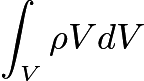
90ce12f273329132bc0a22e77cabd6fadd9317ec.png
. Using the latter, the energy density is found to be

2b95635ceca0346d915aadc5ef5f3f8047d12dd6.png
, as is well known. If you integrate the latter only over free charge and ignore bound charge, you write

a3e754ebda6b4b4d609f6ac85bb3d8b3f6fa3516.png
, use integration by parts, and obtain the first result. Does the first result neglect the energy from bound charge? If not, why does

2b95635ceca0346d915aadc5ef5f3f8047d12dd6.png
break down (I.e. why can’t one find the energy with a dielectric by treating the bound charge as its own independent charge arrangement and using formulae for a vacuum?)
 

Attachments

  • 1994848e8909b58aaa7dfa748264681c15b04cdb.png
    1994848e8909b58aaa7dfa748264681c15b04cdb.png
    741 bytes · Views: 706
  • 90ce12f273329132bc0a22e77cabd6fadd9317ec.png
    90ce12f273329132bc0a22e77cabd6fadd9317ec.png
    1,020 bytes · Views: 615
  • 2b95635ceca0346d915aadc5ef5f3f8047d12dd6.png
    2b95635ceca0346d915aadc5ef5f3f8047d12dd6.png
    826 bytes · Views: 672
  • a3e754ebda6b4b4d609f6ac85bb3d8b3f6fa3516.png
    a3e754ebda6b4b4d609f6ac85bb3d8b3f6fa3516.png
    700 bytes · Views: 556
  • 2b95635ceca0346d915aadc5ef5f3f8047d12dd6.png
    2b95635ceca0346d915aadc5ef5f3f8047d12dd6.png
    826 bytes · Views: 562
Physics news on Phys.org
You are mixing macroscopic with microscopic electrodynamics. For macroscopic electrodynamics ##u=\vec{E} \cdot \vec{D}/2## is correct. Within Markovian linear-response theory ##\vec{D}=\epsilon \vec{E}=\epsilon_0 \epsilon_r \vec{E}##.
 
  • Like
Likes   Reactions: Delta2
I see. Makes perfect sense now. Thanks!
 

Similar threads

  • · Replies 4 ·
Replies
4
Views
3K
  • · Replies 10 ·
Replies
10
Views
2K
  • · Replies 4 ·
Replies
4
Views
2K
  • · Replies 2 ·
Replies
2
Views
1K
  • · Replies 10 ·
Replies
10
Views
1K
  • · Replies 7 ·
Replies
7
Views
2K
  • · Replies 2 ·
Replies
2
Views
2K
  • · Replies 1 ·
Replies
1
Views
2K
  • · Replies 2 ·
Replies
2
Views
2K
  • · Replies 1 ·
Replies
1
Views
968