Engine design -- Fusion powered rockets

Click For Summary
SUMMARY

The forum discussion centers on the feasibility of a fusion-powered rocket engine design utilizing "heavy fusion technology." Participants conclude that such a design is currently impractical due to the inability to achieve functional fusion power, with references to existing concepts like the BIS Daedalus and challenges faced by various fusion reactor designs, including Tokamak and Stellerator. The discussion emphasizes that while the artistic representations of the engine are visually appealing, they do not reflect realistic engineering principles or current scientific capabilities.

PREREQUISITES
  • Understanding of fusion energy concepts, specifically D-T and H-H fusion reactions.
  • Familiarity with existing fusion reactor designs such as Tokamak and Stellerator.
  • Knowledge of propulsion systems, particularly fusion drives and their theoretical applications.
  • Awareness of the challenges in achieving practical fusion power and its implications for spacecraft design.
NEXT STEPS
  • Research the operational principles of ITER and its approach to D-T fusion reactions.
  • Explore the Bussard ramjet concept and its portrayal in science fiction literature.
  • Investigate the limitations and potential of heavy fusion technology in propulsion systems.
  • Examine the environmental impacts of fusion propulsion, particularly regarding radiation during deceleration.
USEFUL FOR

Aerospace engineers, physicists, science fiction enthusiasts, and anyone interested in advanced propulsion technologies and the future of space travel.
Xforce
Messages
73
Reaction score
6
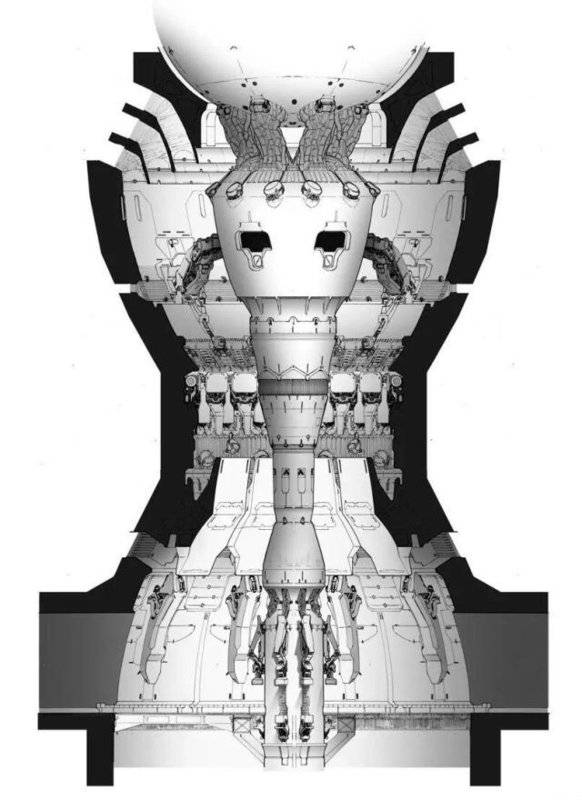
I found this interesting engine design on the internet. It is one of the most powerful and largest machines human have ever designed. It is a fusion powered propulsion device, it uses “heavy fusion technology” which can use any elements lighter than Fe-56 as power source. Is this design feasible?
upload_2019-3-14_12-25-29.jpeg
 

Attachments

  • upload_2019-3-14_12-25-29.jpeg
    upload_2019-3-14_12-25-29.jpeg
    56.1 KB · Views: 967
Physics news on Phys.org
No, not at this time since we can't even get fusion power to work yet.
 
  • Like
Likes   Reactions: Dale
IIRC, nearest we've got to a practicable fusion powered rocket is the BIS Daedalus design, but that approach foundered on the difficulties of pulsed 'laser ignition'. Seems that's as hard to 'break even' as Tokamak, Stellerator etc configurations...

( I'm not current on the Polywell design, but I lost interest when that ran into apparently intractable scaling issues... )
 
upload_2019-3-14_14-51-49.jpeg

This is another view of that thruster...
 

Attachments

  • upload_2019-3-14_14-51-49.jpeg
    upload_2019-3-14_14-51-49.jpeg
    48.8 KB · Views: 741
What is the source of this image?
 
Xforce said:
Is this design feasible?
You should just put it into the right novel and it'll do miracles.
But in real life, no.
 
The source of this image is google image. Same thing as this concept graph.
upload_2019-3-14_20-17-13.jpeg
 

Attachments

  • upload_2019-3-14_20-17-13.jpeg
    upload_2019-3-14_20-17-13.jpeg
    76.4 KB · Views: 1,095
Xforce said:
Is this design feasible?
You're asking an Engineering Question here. No amount of Artist's Impressions will constitute evidence of the practicability of anything.
The sort of images that you have supplied are presented in countless sales pitches for countless schemes for doing all sorts of things. They can sometimes convince people to part with their money. . . . . . . . . . .
 
  • Like
Likes   Reactions: Ryan_m_b
Xforce said:
The source of this image is google image. Same thing as this concept graph.
Please make it a habit to post a link to any images that you post at the PF (or at any online discussion forum). It is generally a copyright violation to post images without attribution. Thank you.
 
  • #10
Xforce said:
The source of this image is google image. Same thing as this concept graph.
View attachment 240224

That’s not a technical design, that’s art. It might be good, detailed art but it’s no more feasible than a Star Wars technical manual showing you the insides of an X-wing. It’s completely made up for entertainment.
 
  • Like
Likes   Reactions: Nik_2213 and Bystander
  • #11
Ok, I just want to show the size and the exhaust of that engine. The bluish color suggests that the temperature of the plasma beam is more than 40000 degrees kelvin, something like a blue giant star’s surface. Materials will melt down unless there is a magnetic nozzle, and there is one in design. From the huge size and advanced fusion technology, we know that this thing is impossible in the near future. But once we can construct this type of thruster, it will readily propel the largest starships and given enough numbers ang enough time, propel planets:)
 
  • #12
Well, that 'China’s First Hard Sci-fi Film' might look a bit interesting but I don't think you should take the 'hard' part so seriously. It might seem bit like guerilla marketing.
 
Last edited:
  • #13
I am not advertising anything, I just want to discuss if the scientific principles of this thing works in reality, that is why it is in the sci-fi area. But I only see people repelling this idea.
 
  • #14
Xforce said:
But I only see people repelling this idea.
Xforce said:
From the huge size and advanced fusion technology, we know that this thing is impossible in the near future.
Not so much "repelling" or rejecting, just providing a reality check. And from your 2nd post above that I quoted, it seems like you understand that it's a (long) ways off. That's all.
 
Last edited:
  • #15
From a 'hard' science fiction approach it is difficult to understand a need for such a large device. If you are moving a large asteroid or space habitat, slow and steady makes sense such as a continuous ion drive. A fusion device as suggested in the art work would likely pollute the environment and cause massive radiation problems during deceleration when the star ship or habitat essentially 'follows' the drive exhaust.

Two drive suggestions from published 'scientific' SF:

1) Fusion drives including Bussard ramjets and gravtity control appear in many Larry Niven novels such as "Protector" and the Ringworld series. Niven describes design, operation and dangers associated with fusion drives in "Protector" including long term maintenance.

2) Glen Cook presents a very economical 'hyper drive' powered by matter (hydrogen) / antimatter annihilation in the combat SF novel "Passage at Arms". Climbers resemble your OP picture but at a reasonable size limit of 9,000 tons. The author imposes strict size limits for climbers because they enter another dimension, analogous to submarines using another dimension than surface vessels. Larger craft utilize fusion drives as does a climber before it is fueled with antimatter. See this synopsis if interested https://matthilliard.wordpress.com/?s=passage+at+arms
 
Last edited:
  • #16
Xforce said:
Is this design feasible?

Hmmm, not sure about that.

Basically, the "heavy fusion" aspect (and I'm acknowledging that this conversation is off an artists diagram so won't get too fussy about the detail) may not be a practical design feature. We know of two basic types of fusion reactions: those that preserve the number of protons and neutrons, and those that involve a conversion between protons and neutrons. The first type is the focus of our fusion-energy projects (ITER for example) and is commonly referred to as the D-T fusion reaction, while the second starts stars burning and is commonly referred to as the H-H fusion reaction. We focus on the D-T in energy generation because the net energy release from the D-T reaction is forty times greater than the H-H reaction. (Which is not to suggest that H-H is "energy poor." Both reactions liberate a lot of energy, esp. compared to how we normally generate the stuff!)

But the trouble with the "heavy fusion technology" aspect is that not all elements fuse usefully. Wikipedia has a very detailed - and physics heavy - overview of this at https://en.wikipedia.org/wiki/Nuclear_fusion#Important_reactions, but essentially, only a few light elements (hydrogen, helium, and boron just barely) make the grade as practical fusion fuels. So expecting to top up the tanks with oxygen or carbon and fuse it up to power the thrusters, is very unlikely.
 
  • Like
Likes   Reactions: Klystron
  • #17
Xforce said:
I am not advertising anything, I just want to discuss if the scientific principles of this thing works in reality, that is why it is in the sci-fi area. But I only see people repelling this idea.
This isn't too surprising when you think PF is a Scientific Forum. The 'appealing' picture in your OP was not likely to be treated seriously, I'm afraid and it probably overshadowed your question about 'Heavy Fusion'.
 

Similar threads

  • · Replies 16 ·
Replies
16
Views
7K
  • · Replies 61 ·
3
Replies
61
Views
11K
  • Poll Poll
  • · Replies 12 ·
Replies
12
Views
2K
Replies
2
Views
3K
  • · Replies 70 ·
3
Replies
70
Views
11K
  • · Replies 3 ·
Replies
3
Views
2K
  • · Replies 35 ·
2
Replies
35
Views
5K
  • · Replies 5 ·
Replies
5
Views
2K
  • · Replies 5 ·
Replies
5
Views
2K
  • · Replies 1 ·
Replies
1
Views
4K