Event Horizon Telescope Results Released Yesterday (April 10, 2019)

Click For Summary

Discussion Overview

The discussion revolves around the recent release of results from the Event Horizon Telescope (EHT), specifically focusing on the imaging of supermassive black holes, including Sagittarius A* and M87. Participants explore the implications of these results, the nature of the images produced, and the scientific significance of the findings.

Discussion Character

  • Exploratory
  • Technical explanation
  • Debate/contested
  • Conceptual clarification

Main Points Raised

  • Some participants discuss the nature of the simulations shown, questioning what they represent regarding the black hole and its surroundings.
  • There are mentions of the accretion disk around the black hole, with some participants clarifying that the image reflects gas and other materials orbiting the black hole.
  • Some express curiosity about the implications of the findings for theories such as Hawking radiation, with differing views on whether there are any implications for such theories.
  • Participants inquire about the nature of the image, questioning how it differs from previous images of matter falling into black holes and whether this counts as the first direct detection of black holes.
  • There is discussion about the colorization of the image, with some participants explaining that the colors represent the intensity of radio-wave radiation rather than visible light.
  • Some participants express skepticism about the novelty of the image, asking how it differs from earlier representations of black holes.
  • Clarifications are made regarding the source of light in the image, with some stating that the image is derived from radio signals and not optical light.
  • There are humorous contributions, including limericks related to black holes, showcasing a lighter side to the discussion.

Areas of Agreement / Disagreement

Participants express a mix of curiosity and skepticism regarding the implications and novelty of the EHT results. There is no clear consensus on the significance of the findings, with multiple competing views on the interpretation of the images and their scientific implications.

Contextual Notes

Some discussions highlight limitations in understanding the image, such as the dependence on colorization choices and the nature of the radio emissions versus optical visibility. There are also unresolved questions about the exact nature of the accretion disk and the photon sphere.

Messages
37,418
Reaction score
14,253
Media Advisory: Press Conference on First Result from the Event Horizon Telescope
April 10, 15:00 CEST (13:00 UTC. In 8 days and 13 hours)
Livestream links are on that website.

The Event Horizon Telescope is a collection of radio telescopes all over the world which recorded data from the supermassive black hole in the center of the Milky Way. Combining the different data sets leads to a virtual telescope as large as Earth in terms of angular resolution - good enough to resolve the area directly around the black hole.

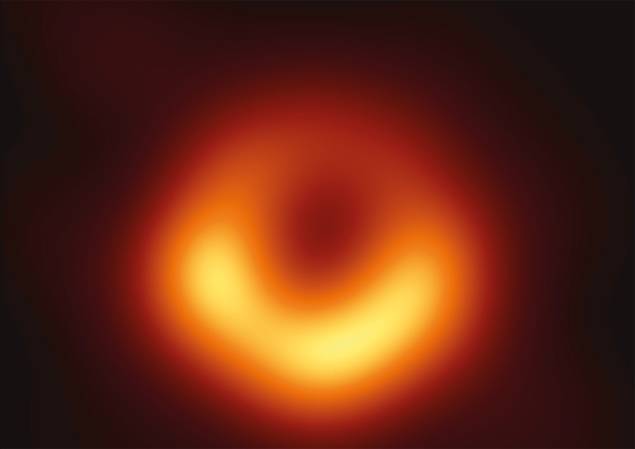
This article shows some simulations how it might look like.Edit: The first image:
first_image_of_black_hole-jpg.jpg
 

Attachments

  • 0*audPc-ZIRncVPj6r.jpg
    0*audPc-ZIRncVPj6r.jpg
    18.5 KB · Views: 3,909
Last edited:
  • Like
  • Informative
Likes   Reactions: JD_PM, DennisN, Choppy and 10 others
Astronomy news on Phys.org
Sorry, what are those simulations supposed to be showing? The SMBH eclipsing a star that is near the center of the MWG? Sorry if I'm missing the obvious...
 
The accretion disk around the black hole - gas and random other stuff orbiting the black hole closely. Brighter: More stuff.

There shouldn't be stars that close. We know one that has a periapsis speed of 3% the speed of light, but that is still outside the range the Event Horizon Telescope is interested in.
 
  • Like
Likes   Reactions: berkeman
Hmm, apparently it is "a groundbreaking result from the EHT".
 
I guess this will expand the horizon of our knowledge...
 
  • Haha
  • Love
  • Like
Likes   Reactions: pinball1970, Borg, Ibix and 1 other person
Is this just a first light/data release or is there some accompanying journal article?
 
I'm sure there will be at least a note, but probably a preprint or publication that comes with the press conference.
 
This is in one hour from now!

Livestream e.g. here at ESO.
 
  • Like
Likes   Reactions: fresh_42 and Borg
  • #10
Kind of like the simulations...
Screenshot, poor quality.

blackhole.png


Edit: After some color corrections and so on. Left observation, right a theory prediction.

blackhole3.png
 
  • Like
Likes   Reactions: QuantumQuest, Mlesnita Daniel and Drakkith
  • #11
M87 it is!
 
  • #12
first_image_of_black_hole.jpg
 
  • Like
Likes   Reactions: Mlesnita Daniel, QuantumQuest, JD_PM and 1 other person
  • #14
  • Like
Likes   Reactions: JD_PM and mishima
  • #15
Greg Bernhardt said:

I wonder what the implications for Hawking radiation and other black hole theories are.

Also, there's just too much crap in the way to get a clear shot of Sagittarius right?
 
  • #16
tade said:
I wonder what the implications for Hawking radiation and other black hole theories are.
There would be no implications for Hawking radiation. A black hole this massive would essentially have a temperature of absolute zero.
 
  • #17
Amazing picture!
 
  • #18
So does this count as the first direct detection of black holes?
 
Last edited:
  • #20
Video from Veritasium on how to understand the image of a black hole:

 
  • Like
Likes   Reactions: pinball1970, eloheim, Jimster41 and 7 others
  • #22
Cool picture, but what is actually new here? Haven't we already gotten pictures of matter falling into black holes? Is this just cooler because it's circular and black in the middle?
 
  • Like
Likes   Reactions: Comeback City and Greg Bernhardt
  • #23
berkeman said:
Sorry for the dumb question (especially if it's already been addressed), but if they used 8 radio telescopes to form this image, where did the visible light colors come from?
Colorization. Somebody picked them.
 
  • Like
Likes   Reactions: davenn
  • #24
Drakkith said:
Video from Veritasium on how to understand the image of a black hole:


This is a very good explanation of what the black hole image shows.
 
  • Like
Likes   Reactions: DaveC426913 and hutchphd
  • #25
russ_watters said:
Colorization. Somebody picked them.

what is the visible spectrum image expected to look like? Based on the physics, I'm guessing almost identical to the radio image?
 
  • #26
russ_watters said:
Haven't we already gotten pictures of matter falling into black holes?
No.
 
  • Like
Likes   Reactions: krater
  • #27
The colors just visualize the intensity of the (radio-wave) radiation. Brighter/yellow: More radiation. Darker/red: Less radiation. It is synchrotron radiation, visible light would come from thermal radiation, it can have a different distribution. Gas clouds between the black hole and us absorb too much visible light.

@russ_watters: It is the first time we see a black hole as more than just a point-like object in the sky.
 
  • Like
Likes   Reactions: davenn and berkeman
  • #28
Orodruin said:
No.
I'm really not trying to be difficult, but how is this new image any different from that standpoint, from this one:

xtej1118_xray_420.jpg


mfb said:
@russ_watters: It is the first time we see a black hole as more than just a point-like object in the sky.
So, high enough resolution that we can see a black disk in the middle? Fair enough.
 
  • #29
russ_watters said:
I'm really not trying to be difficult, but how is this new image any different from that standpoint, from this one:
You are not really seeing the event horizon. You are seeing the products in terms of radiation coming from there but it is a point object so you have not really resolved anything. This image resolves the direct effects near the event horizon.
 
  • Like
Likes   Reactions: davenn
  • #30
berkeman said:
Sorry for the dumb question (especially if it's already been addressed), but if they used 8 radio telescopes to form this image, where did the visible light colors come from?

https://abc7news.com/science/heres-the-first-ever-direct-image-of-a-black-hole/5241612/
View attachment 241632

View attachment 241633

They used a paint-by-numbers kit. :cool:

Also the picture kind of looks like a smiley face maybe it knows it'll gobble up our planet sometime in the distant future perhaps and end of simulation for us.
 
  • Haha
Likes   Reactions: sysprog

Similar threads

Replies
12
Views
2K
  • · Replies 5 ·
Replies
5
Views
2K
  • · Replies 0 ·
Replies
0
Views
2K
Replies
3
Views
3K
  • · Replies 21 ·
Replies
21
Views
3K
  • · Replies 8 ·
Replies
8
Views
3K
  • · Replies 1 ·
Replies
1
Views
2K
  • · Replies 3 ·
Replies
3
Views
2K
  • Poll Poll
  • · Replies 3 ·
Replies
3
Views
2K
  • · Replies 15 ·
Replies
15
Views
6K