Exponentially damped dipole - line broadening

3 replies · 2K views · last reply
unscientific
Messages
1,728
Reaction score
13
For an EM wave close to the transition frequency ##\omega_{21}##, we assume the dipole moment to be exponentially damped and oscillating:

[tex]p(t) = p(0) e^{-\frac{\gamma}{2}t} cos(\omega_0 t)[/tex]

Why do we expect the electric field to be proportional to ##\dot p##?

Taken from my lecturer notes on laser and atomic physics:
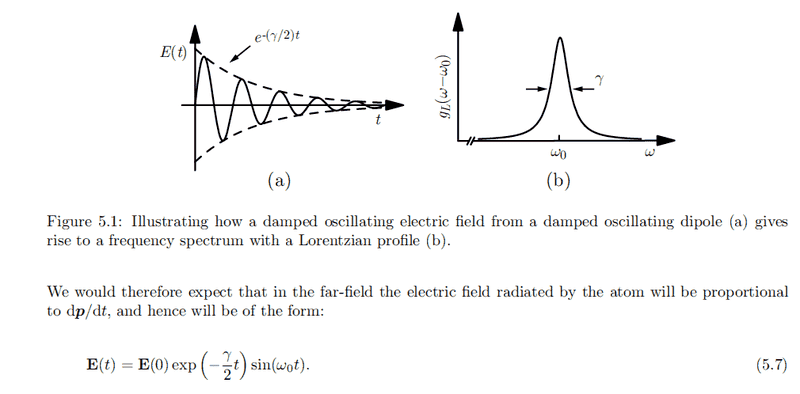
Two-panel figure: (a) a damped oscillating field E(t) decaying within dashed envelopes labelled e^(-(γ/2)t); (b) a Lorentzian peak in g(ω-ω₀) versus ω, centred at ω₀ with width γ marked.
 
If a dipole moment changes(it is created by charge accelerations), it emit EM wave in classic treatment. Therefore we can get E(t) proportional to dp/dt.
 
abbas_majidi said:
If a dipole moment changes(it is created by charge accelerations), it emit EM wave in classic treatment. Therefore we can get E(t) proportional to dp/dt.
Please explain the "classical treatment".
 
unscientific said:
Please explain the "classical treatment".
In classical physics accelerated charges can emit EM waves, it is used in making antenna. A dipole changes with time is a antenna and its behavior is explained by classical physics compleatly. Therefore if you use ' electric field to be proportional to ##\dot p##', you consider atoms like antenna or in other words you use classical treatment of atoms.