Extra terms in the Action in Zee chapter 1.3?

  • Context: Graduate 
  • Thread starter Thread starter looseleaf
  • Start date Start date
  • Tags Tags
    Terms
Click For Summary
SUMMARY

The discussion centers on the origin of the tau and sigma terms in the expression related to the self-interaction energy V of the field ##\varphi##, specifically in equation (2). These terms are identified as arbitrary coupling constants that arise when expressing the self-interaction part of the function V in a series of ##\varphi##. Additionally, a query regarding the transition from 3-momentum to 4-momentum in the Sidney Coleman lectures is raised, specifically concerning the dropping of the operator on the right side of the equation ##e^{i P . x}\alpha(p)e^{-i P . x} = e^{-i p . x}\alpha(p)##.

PREREQUISITES
  • Understanding of quantum field theory concepts, particularly self-interaction energy.
  • Familiarity with the notation and mathematical expressions used in quantum mechanics.
  • Knowledge of the significance of coupling constants in field theories.
  • Basic grasp of momentum representation in quantum mechanics.
NEXT STEPS
  • Study the derivation of self-interaction energy in quantum field theory.
  • Explore the role of coupling constants in various field theories.
  • Learn about the transition from 3-momentum to 4-momentum in quantum mechanics.
  • Review Sidney Coleman’s lectures for deeper insights into quantum field theory concepts.
USEFUL FOR

Students and researchers in quantum field theory, physicists interested in self-interaction energies, and anyone looking to deepen their understanding of momentum transitions in quantum mechanics.
looseleaf
Messages
24
Reaction score
1
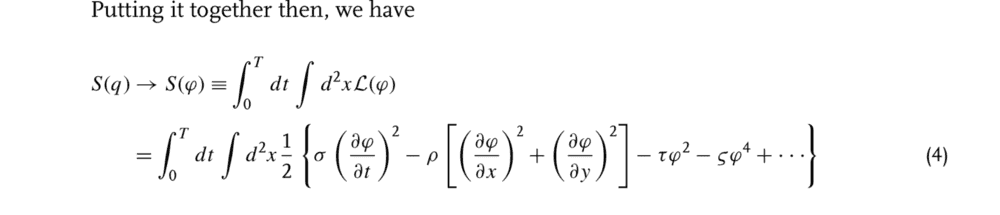
Hi, could someone please explain where the tau and sigma terms come from in this expression:

Screen Shot 2019-09-20 at 10.47.53 PM.png

I see the kinetic energy and quadratic "mattress" potential terms, but the tau and sigma kinda come out of nowhere. Where are they from?
 
Physics news on Phys.org
These are just arbitrary coupling constants. They originate from the self interaction energy V of the field ##\varphi## with itself in equation (2). It is a way of expressing the self interaction part of the arbitrary function V in a series of ##\varphi##.
 
Last edited:
  • Like
Likes   Reactions: looseleaf
Hans de Vries said:
These are just arbitrary coupling constants. They originate from the self interaction energy V of the field ##\varphi## with itself in equation (2). It is a way of expressing the self interaction part of the arbitrary function V in a series of ##\varphi##.

Thanks that makes sense.

I was wondering if anyone could address another question I had?
This one is from the Sidney Coleman lectures (2.72)

##e^{i P . x}\alpha(p)e^{-i P . x} = e^{-i p . x}\alpha(p)##

i'm confused why we drop the operator on the right side when we go from 3-momentum to 4-momentum?
 

Similar threads

  • · Replies 0 ·
Replies
0
Views
882
  • · Replies 1 ·
Replies
1
Views
1K
  • · Replies 1 ·
Replies
1
Views
1K
  • · Replies 5 ·
Replies
5
Views
2K
  • · Replies 2 ·
Replies
2
Views
1K
  • · Replies 1 ·
Replies
1
Views
714
  • · Replies 1 ·
Replies
1
Views
2K
  • · Replies 1 ·
Replies
1
Views
2K
  • · Replies 5 ·
Replies
5
Views
2K
  • · Replies 1 ·
Replies
1
Views
2K