Field axioms - is there an axiom for multiplication with zero?

Click For Summary
SUMMARY

The discussion centers on the absence of a specific axiom for multiplication with zero in the axioms of the real numbers, denoted as ##\mathbb{R}##. Participants clarify that the equation ##x \cdot 0 = 0## is not an axiom but can be derived from existing axioms, particularly through the use of distribution and additive inverses. The conversation highlights the complexity of listing all truths about the real number system, referencing Patrick Grim's proof regarding the infinite nature of such truths. The consensus is that while ##0 \cdot x = 0## is a fundamental truth, it must be derived rather than stated as an axiom.

PREREQUISITES
  • Understanding of real number axioms, specifically those related to addition and multiplication.
  • Familiarity with mathematical proofs and derivations.
  • Knowledge of concepts such as additive inverses and distribution in algebra.
  • Basic comprehension of set theory and its implications on truth statements.
NEXT STEPS
  • Study the derivation of multiplication properties from the axioms of ##\mathbb{R}##.
  • Explore the implications of Patrick Grim's proof on the nature of mathematical truths.
  • Investigate the concept of full theories in mathematical logic.
  • Learn about the axiomatic foundations of algebra and their historical development.
USEFUL FOR

Mathematicians, educators, students of mathematics, and anyone interested in the foundational principles of algebra and real number theory.

musicgold
Messages
303
Reaction score
19
Homework Statement
This is not a homework problem.
I am reading a proof and not sure why a particular step is taken / not taken.
Relevant Equations
why is there no axiom like X . 0 = 0
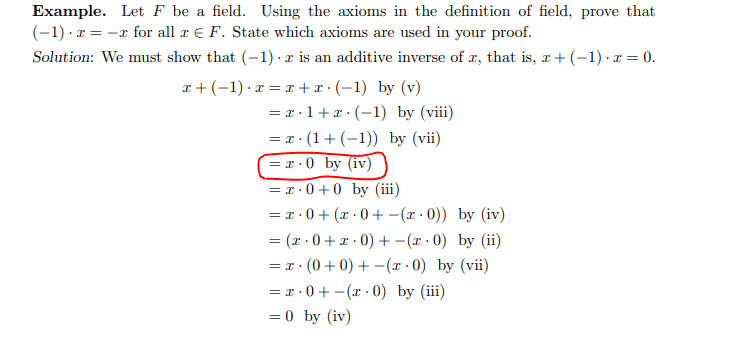
Please refer to the screenshot below. Every step is justified with an axiom. Please see the link to the origal document at the bottom.

I am trying to understand why the proof was not stopped at the encircled step.
1. Is there no axiom that says ## x \cdot 0 = 0 ## ?
2. Isn't the sixth step using the fact that a 0 can be represented by ## x \cdot 0 ## ?
1569627486682.png
Document
 
Last edited:
Physics news on Phys.org
The line you marked is just using 1+(-1)=0, replacing the left hand side by the right hand side in the previous line.
 
The sixth step is using the fact that ##a + (-a)=0##, with ##a = x\cdot0##. Afaik, ##0## only appears in the axioms when defining addition, that it has any special role for multiplication needs to be derived.
 
  • Like
Likes   Reactions: musicgold and mfb
##x.0=x.(0+0)= x.0+x.0##
Add ##-x.0## to both sides to obtain ##x.0=0##.
 
  • Like
Likes   Reactions: musicgold
I have sometime wondered whether it would be possible to state the axioms of ##\mathbb{R}## in a different way so that ##0\cdot x=0## would be one of them but they would still describe exactly the same number system. The normal set of axioms doesn't contain that property, it has to be derived.

You can't start listing every possible truth about the real number system, anyway, because there's an infinite number of those truths. Actually, it's too infinite to even form a proper set (in the sense of set theory), as the Patrick Grim's proof for "There is no set of all truths" should also apply to any statement "There is no set of all truths about entity X".

http://www.pgrim.org/articles/grim_no_set_of_all_truths.pdf
 
Last edited:
  • Like
Likes   Reactions: musicgold
There is no "axiom" that x.0= 0 because it can be proven from the other axioms. By "distribution", x(y+ 0)= xy+ x0. But y+ 0= y so x(y+ 0)= xy. From xy= xy+ x0, add the "additive inverse" of xy to both sides to get x0= 0.
 
  • Like
Likes   Reactions: musicgold
hilbert2 said:
I have sometime wondered whether it would be possible to state the axioms of ##\mathbb{R}## in a different way so that ##0\cdot x=0## would be one of them but they would still describe exactly the same number system. The normal set of axioms doesn't contain that property, it has to be derived.

You can't start listing every possible truth about the real number system, anyway, because there's an infinite number of those truths. Actually, it's too infinite to even form a proper set (in the sense of set theory), as the Patrick Grim's proof for "There is no set of all truths" should also apply to any statement "There is no set of all truths about entity X".

http://www.pgrim.org/articles/grim_no_set_of_all_truths.pdf
In my experience this is called the full theory,aka, all statements /wffs that can be assigned a truth value.
 

Similar threads

  • · Replies 26 ·
Replies
26
Views
959
  • · Replies 4 ·
Replies
4
Views
2K
Replies
6
Views
2K
  • · Replies 3 ·
Replies
3
Views
5K
  • · Replies 4 ·
Replies
4
Views
4K
  • · Replies 1 ·
Replies
1
Views
2K
Replies
7
Views
2K
  • · Replies 65 ·
3
Replies
65
Views
8K
Replies
5
Views
4K
  • · Replies 24 ·
Replies
24
Views
4K