Find the domain of the inverse of a function

Join the discussion
Registration is free. Ask a follow-up in this thread, or start your own.
3 replies · 2K views
chwala
Gold Member
Messages
2,844
Reaction score
434
Homework Statement
Kindly see attached problem
Relevant Equations
domain and inverse of functions concept
This is a textbook problem:

1632880387875.png


now for part a) no issue here, the range of the function is ##-1≤f(x)≤299##

now for part b)

i got ##x≥-1##
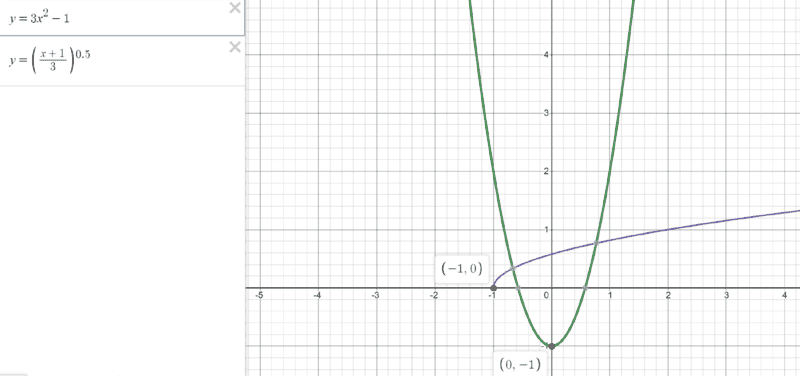
1632880550296.png
but the textbook indicates the solution as ##x≥0## hmmmmm i think, that's not correct...
 
Physics news on Phys.org
chwala said:
Homework Statement:: Kindly see attached problem
Relevant Equations:: domain and inverse of functions concept

This is a textbook problem:

View attachment 289875

now for part a) no issue here, the range of the function is ##-1≤f(x)≤299##

now for part b)

i got ##x≥-1##
View attachment 289876but the textbook indicates the solution as ##x≥0## hmmmmm i think, that's not correct

...I think i see why..." a function qualifies to have an inverse if its only ##1-1## or many to one ...but not one to many...we have to restrict the domain in order to realize a function lol :cool:
 
Last edited by a moderator:
chwala said:
...I think i see why..." a function qualifies to have an inverse if its only ##1-1## or many to one
I think a "many to one" function can’t have an inverse over its whole domain. In fact that’s why your original function, y = f(x) = 3x² -1, only has an inverse over part of its domain.

f(x) = 3x² -1 is many-to-one. For example, both x = 1 and x = -1 gives the same value of y = 3x² – 1 = 2.

So, if we are given y = 2, we can’t ‘get back’ to a unique value for x.

In this question, by limiting the original function’s domain to x≥0, we restrict the function so now it is one-to-one and the inverse function exists.

(But that’s a non-mathematician’s view.)
 
Steve4Physics said:
I think a "many to one" function can’t have an inverse over its whole domain. In fact that’s why your original function, y = f(x) = 3x² -1, only has an inverse over part of its domain.

f(x) = 3x² -1 is many-to-one. For example, both x = 1 and x = -1 gives the same value of y = 3x² – 1 = 2.

So, if we are given y = 2, we can’t ‘get back’ to a unique value for x.

In this question, by limiting the original function’s domain to x≥0, we restrict the function so now it is one-to-one and the inverse function exists.

(But that’s a non-mathematician’s view.)
That's correct, an inverse would suffice if we restrict the domain...in general, for quadratics this would be determined by the ##x## co- ordinate value at the turning point of the graph.
 
Last edited: