Find the volume of the solid of revolution, or state that it does not exist. #2

Click For Summary
SUMMARY

The discussion focuses on finding the volume of the solid of revolution formed by revolving the region bounded by the function f(x) = 6(4-x)^(-1/3) and the x-axis over the interval [0, 4) about the y-axis. Participants recommend using the shell method for this calculation, as it allows for a single integral representation of the volume. The integral is expressed as 2π times the integral from 0 to 4 of x * (6(4-x)^(-1/3)) dx. Substitution is suggested to simplify the integral, specifically using u = 4 - x.

PREREQUISITES
  • Understanding of solid of revolution concepts
  • Familiarity with the shell method for volume calculation
  • Knowledge of integral calculus and u-substitution
  • Ability to interpret and graph functions
NEXT STEPS
  • Study the shell method for calculating volumes of solids of revolution
  • Learn about the washer method and its applications in volume calculations
  • Practice u-substitution in integral calculus
  • Explore graphical tools for visualizing functions and their revolutions
USEFUL FOR

Students and educators in calculus, particularly those focusing on volume calculations of solids of revolution, as well as anyone looking to deepen their understanding of integral calculus techniques.

abc1
Messages
9
Reaction score
0
I'm having some trouble with this problem:

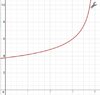
Find the volume of the solid of revolution, or state that it does not exist. The region bounded by f(x)= 6(4-x)^(-1/3) and the x-axis on the interval [0,4) is revolved avout the y-axis.

How would I be able to tell whether to use the shell, disk, or washer method?
 
Physics news on Phys.org
We can use a function plotter to see the graph on the indicated interval:

View attachment 2238

Looks to me like I would try the shell method. Can you state the volume of an arbitrary shell?
 

Attachments

  • abc.jpg
    abc.jpg
    16.5 KB · Views: 131
How can I tell that I have to use the shell method?

Would the formula for this be 2pi times the integral from 0 to 4 of x* (6(4-x)^(-1/3) dx ?

So then, how would I take the limit of this? What test should I use?
 
abc said:
How can I tell that I have to use the shell method?

Would the formula for this be 2pi times the integral from 0 to 4 of x* (6(4-x)^(-1/3) dx ?

So then, how would I take the limit of this? What test should I use?

You don't have to use the shell method, but can you see that the shell method allows for the computation of the volume as a single integral whereas the washer method will require an integral to be added to a cylinder? Either way would work though. In fact, I recommend to students to use more than one method both as a check as for the practice.

I always like to start by computing an element of the volume and then integrating. It appears that you do have the correct integral representing the volume. I think first though, I would use the substitution:

$$u=4-x$$

What do you have now?
 
Would it be 2pi times the integral from 0 to 4 of x* -(6(u)^(-1/3) du ?
 
abc said:
Would it be 2pi times the integral from 0 to 4 of x* -(6(u)^(-1/3) du ?

You want to write that $x$ out front in terms of $u$...:D
 
so the limit as u approaches infinity from 4 to 0 of 2pi times the integral from 0 to 4 of (4-x)* -(6(u)^(-1/3) du since we have to rewrite the limits of integration as well because of the u-substitution?
 

Similar threads

  • · Replies 11 ·
Replies
11
Views
3K
Replies
7
Views
3K
  • · Replies 4 ·
Replies
4
Views
1K
  • · Replies 3 ·
Replies
3
Views
2K
  • · Replies 1 ·
Replies
1
Views
2K
  • · Replies 13 ·
Replies
13
Views
3K
  • · Replies 2 ·
Replies
2
Views
2K
  • · Replies 3 ·
Replies
3
Views
2K
Replies
2
Views
2K
  • · Replies 5 ·
Replies
5
Views
2K