Find the x coordinate where angle PXQ is maximized

  • Context: High School 
  • Thread starter Thread starter anemone
  • Start date Start date
  • Tags Tags
    2015
Join the discussion
Registration is free. Ask a follow-up in this thread, or start your own.
1 reply · 2K views
anemone
Gold Member
MHB
POTW Director
Messages
3,851
Reaction score
115
Here is this week's POTW:

-----

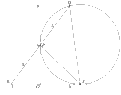
Point $Q$ lies at $(3,\,8)$ and point $P$ lies at $(0,\,4)$. Find the $x$ coordinate of the point $X$ on the $x$ axis maximizing $\angle PXQ$.

-----

Remember to read the http://www.mathhelpboards.com/showthread.php?772-Problem-of-the-Week-%28POTW%29-Procedure-and-Guidelines to find out how to http://www.mathhelpboards.com/forms.php?do=form&fid=2!
 
Physics news on Phys.org
Congratulations to the following members for their correct solution::)

1. Opalg
2. MarkFL
3. greg1313

Solution from Opalg:

If $X$ is a point on a circle through $P$ and $Q$ then the angle $\angle PXQ$ will be inversely proportional to the radius of the circle. So we want the smallest radius for which the circle intersects the $x$-axis. In other words, we want the circle to be tangent to the axis at $X$.

Let $R$ be the point $(-3,0)$ at which the line $QP$ meets the $x$-axis. The length $PR$ is $5$ units (because $OPR$ is a 3-4-5 triangle). Similarly $QR = 10$.

A euclidean theorem says that $RX^2 = RP.RQ = 5\times 10 = 50$. Therefore $\boxed{OX = \sqrt{50} - 3 \approx 4.071}$.

Note 1. It looks from the diagram as though the circle is tangent to the $y$-axis at $P$. In fact, it is not. If $OP$ was a tangent, it would follow that $OP = OX$. But the $y$-coordinate of $P$ is $4$, just fractionally different from $\sqrt{50} - 3$.

Note 2. For completeness, one ought to add that there is another circle through $P$ and $Q$ that touches the $x$-axis, at $(-3-\sqrt{50},0)$ on the negative axis. But the radius of that circle is much larger than that of the circle in the diagram, so the corresponding angle is smaller.

Alternate solution from MarkFL:
Let:

$$\theta\equiv\angle PXQ$$

On the interval $(-\infty,-3]$, we have:

$$\theta(x)=\arctan\left(\frac{4}{x}\right)-\arctan\left(\frac{8}{x-3}\right)$$

We find:

$$\d{\theta}{x}=\frac{4\left(x^2+6x-41\right)}{\left(x^2+16\right)\left(x^2-6x+73\right)}$$

The only critical numbers come from the roots of the quadratic in the numerator, and the quadratic formula gives (discarding the root outside the given domain):

$$x=-3-5\sqrt{2}$$

We find:

$$\theta\left(-3-5\sqrt{2}\right)\approx0.171153837842922$$

Observing that:

$$\theta(3)=0$$

$$\lim_{x\to-\infty}\theta=0$$

We conclude that in this interval, we have:

$$\theta_{max}\approx0.171153837842922$$

On the interval $(-3,0)\,\cup\,(3,\infty)$, we have:

$$\theta(x)=\arctan\left(\frac{8}{x-3}\right)-\arctan\left(\frac{4}{x}\right)$$

For which we naturally find the critical value:

$$x=-3+5\sqrt{2}$$

And:

$$\theta\left(-3+5\sqrt{2}\right)\approx0.661111164096650$$

We then observe:

$$\lim_{x\to-3}\theta=0$$

$$\lim_{x\to0^{-}}\theta\approx0.358770670270572$$

$$\lim_{x\to3^{+}}\theta\approx0.643501108793284$$

$$\lim_{x\to\infty}\theta=0$$

We conclude that in this interval, we have:

$$\theta_{max}\approx0.661111164096650$$

And finally on the interval $(0,3)$ we find:

$$\theta(x)=\arctan\left(\frac{8}{x-3}\right)-\arctan\left(\frac{4}{x}\right)+\pi$$

We will find no critical values on this interval, and at the end-points we find:

$$\lim_{x\to0^{+}}\theta\approx0.358770670270572$$

$$\lim_{x\to3^{-}}\theta\approx0.643501108793284$$

And so, in conclusion, we find that:

$$x=-3+5\sqrt{2}$$

maximizes $\theta$ for all $x$.
 

Attachments

  • angle.gif
    angle.gif
    3.8 KB · Views: 155