Finding current using superposition with three resistors and two voltage sources

5 replies · 12K views · last reply
VinnyCee
Messages
486
Reaction score
0
Find I in the circuit using the superposition principle:

Circuit schematic with a 16 V source and 6 ohm resistor on the left, a 2 ohm resistor and 4 A current source in parallel in the middle, and an 8 ohm resistor and 12 V source on the right, with a ground at the bottom.


My work so far:

[tex]I\,=\,I_1\,+\,I_2\,+\,I_3[/tex]
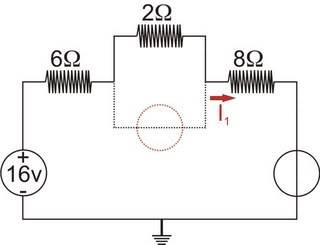
Circuit schematic with a 16 V voltage source on the left, a 6 Ω resistor on the top left, a 2 Ω resistor on the top middle, an 8 Ω resistor on the top right, a dotted-outline current source, and a labelled current I1 with an arrow on the right branch, joined to ground at the bottom.


This reduces down to:
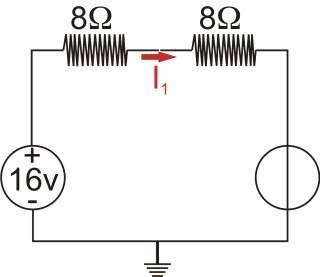
Circuit schematic with a 16 V voltage source on the left, two 8 Ω resistors in series along the top wire, a red arrow labelled I1 showing current to the right, and an unlabelled circuit element on the right side connected to ground.


[tex]16\,V\,=\,I_1\,(8\Omega)[/tex]
[tex]I_1\,=\,\frac{16\,V}{8\Omega}\,=\,2\,A[/tex]

Circuit schematic with a 6 ohm resistor in the left branch, a 2 ohm resistor in the top middle branch, and an 8 ohm resistor in the right branch, with a 12 V source on the right and a current arrow labelled I2 in the middle branch.


This reduces down to:
Circuit schematic with a voltage source on the left and a 12 V source on the right, two 8 Ω resistors in series along the top wire, and current I2 labeled with a red arrow between them, returning to ground at the bottom.


[tex]I_2\,=\,-\frac{12\,V}{8\Omega}\,=\,-\frac{3}{2}[/tex]

But how do I solve this circuit?:
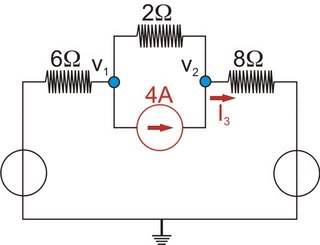
Circuit schematic with a 6 ohm resistor and an 8 ohm resistor on the outer branches, a 2 ohm resistor on top, a 4 A current source in the middle branch with nodes v1 and v2, voltage sources on the left and right, and a ground at the bottom.
 
Last edited:
First of all. The equivalent load for the two voltage sources is [tex]16\Omega[/tex] and not [tex]8\Omega[/tex]. So, I1 = 1A and I2 = -3/4A.
For the third circuit, forget the ground. The [tex]6\Omega[/tex] and [tex]8\Omega[/tex] resistors are in series and their series equivalent is in parallel with the [tex]2\Omega[/tex] resistor.
 
The cuurent that I am looking for (I1) is in between the two resistors that are 8-ohms. I know they are in series and combined they are 16-ohm but don't I have to leave them like that to get the right answer since the current is between them?
 
VinnyCee said:
The cuurent that I am looking for (I1) is in between the two resistors that are 8-ohms. I know they are in series and combined they are 16-ohm but don't I have to leave them like that to get the right answer since the current is between them?
That current goes through both resistors. It is OK to keep them separate, but then you have two voltage drops of 8I1 and 8I1. The net effect is the same as one 16 ohm resistor. You do not have to keep them separate; you can always replace a series combination of resistors by one equivalent resistor.
 
OIC - The same current goes through both resistors BECAUSE they are in series!

So that means that:

[tex]I_1\,=\,1\,A[/tex]

[tex]I_2\,=\,-\frac{3}{4}\,A[/tex]

But how do I find [itex]I_3[/itex] in the last circuit?

Circuit schematic with two voltage sources on the left and right, a 6 ohm resistor and a 2 ohm resistor on top and a 8 ohm resistor on the right, nodes labelled v1 and v2, a 4 A current source in the middle branch with its arrow pointing right, a current labelled I3 with a red arrow to the right of node v2, and a ground symbol at the bottom.
 
Last edited:
SGT said:
For the third circuit, forget the ground. The [tex]6\Omega[/tex] and [tex]8\Omega[/tex] resistors are in series and their series equivalent is in parallel with the [tex]2\Omega[/tex] resistor.

So the circuit would look like this?:

Circuit schematic with a 2 ohm resistor on the left and a 14 ohm resistor on the right, joined at the bottom to a ground symbol, with a 4 A current source in the centre pointing upward and labelled I3 on each side.


[tex]4\,A\,=\,I_3\,+\,I_3'[/tex]

[tex]14\,\left(4\,A\,=\,\frac{v_1}{2\Omega}\,+\,\frac{v_1}{14\Omega}\right)[/tex]

[tex]v_1\,=\,7\,V[/tex]

[tex]I_3\,=\,\frac{v_1}{14\Omega}\,=\,\frac{(7\,V)}{14\Omega}\,=\,\frac{1}{2}\,A[/tex]

[tex]I\,=\,I_1\,+\,I_2\,+\,I_3[/tex]

[tex]I\,=\,\left(1\,A\right)\,+\,\left(-\,\frac{3}{4}\,A\right)\,+\,\left(\frac{1}{2}\,A\right)\,=\,\frac{3}{4}\,A[/tex]

That is right, thanks everyone!
 
Last edited: