Finding Derivative of a Function

  • Context: MHB 
  • Thread starter Thread starter rcs1
  • Start date Start date
  • Tags Tags
    Derivative Function
Click For Summary

Discussion Overview

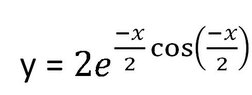
The discussion revolves around finding the derivative of the function \( y = 2e^{-\frac{x}{2}\cos{\left( -\frac{x}{2} \right)}} \). Participants explore the application of the chain rule and product rule in differentiation, while seeking clarification on the steps involved in the process.

Discussion Character

  • Technical explanation
  • Mathematical reasoning
  • Debate/contested

Main Points Raised

  • Some participants suggest using the chain rule for differentiating composite functions, noting that if \( y = e^{f(x)} \), then \( y' = e^{f(x)} f'(x) \).
  • One participant expresses confusion about the differentiation process and questions whether they should first take the derivative of \( y = 2e^u \).
  • Another participant emphasizes that the exponent is a function itself, requiring the application of the chain rule, and outlines the need to differentiate the product of functions using the product rule.
  • There are mentions of specific derivatives, such as \( \sin'(x) = \cos(x) \) and \( \cos'(x) = -\sin(x) \), as part of the differentiation process.
  • Some participants request step-by-step guidance on the differentiation process, indicating a lack of clarity on how to proceed.
  • One participant reflects on the significance of the forum for seeking help with challenging problems.

Areas of Agreement / Disagreement

Participants generally agree on the necessity of using the chain rule and product rule for differentiation. However, there is no consensus on the specific steps to take or the clarity of the explanation, as some express confusion and seek further assistance.

Contextual Notes

Some participants struggle with the trigonometric aspects of the function and the application of differentiation rules, indicating that the discussion may be limited by varying levels of understanding among participants.
rcs1
Messages
10
Reaction score
0
I am so happy that i found this site because it's been few days now that i haven't solved this function.
I hope somebody here can help me on finding the derivative of this function..Thank you so much.
 

Attachments

  • 429060_2605370537191_1342729595_31997174_1335955240_n.jpg
    429060_2605370537191_1342729595_31997174_1335955240_n.jpg
    6.6 KB · Views: 98
Physics news on Phys.org
If $y = e^{f(x)}$ then $y' = e^{f(x)} f'(x) $. Try that.
 
rcs said:
I am so happy that i found this site because it's been few days now that i haven't solved this function.
I hope somebody here can help me on finding the derivative of this function..Thank you so much.

What Danny is using is the Chain Rule. The more general result of the chain rule is that if $ \displaystyle y = y \left( u(x) \right) $ (a function of a function), then $ \displaystyle \frac{dy}{dx} = \frac{du}{dx} \cdot \frac{dy}{du} $.

So in your case, you have $ \displaystyle y = 2e^{-\frac{x}{2}\cos{\left( -\frac{x}{2} \right)}} $, so let $ \displaystyle u = -\frac{x}{2}\cos{\left( - \frac{x}{2} \right)} $ so that $ \displaystyle y = 2e^u $. Can you now evaluate $ \displaystyle \frac{du}{dx} $ and $ \displaystyle \frac{dy}{du} $?
 
sir,

do u mean that i have to get the derivative first of the whatever is y = 2e^u

does that ln y = ln e^2u?

then ln y = 2u remain and manipulate for the derivate of 2u?

hope u i am doing it correctlyThank you
 
rcs said:
sir,

do u mean that i have to get the derivative first of the whatever is y = 2e^u

does that ln y = ln e^2u?

then ln y = 2u remain and manipulate for the derivate of 2u?

hope u i am doing it correctlyThank you

No, that's incorrect. Say we had $ \displaystyle y = 2e^x $, what would $ \displaystyle \frac{dy}{dx} $ be?

To find $ \displaystyle \frac{dy}{du} $ from $ \displaystyle y = 2e^u $ is identical, it's just that the function is a function of u instead of x, and the derivative is taken with respect to u instead of x.
 
Prove It said:
No, that's incorrect. Say we had $ \displaystyle y = 2e^x $, what would $ \displaystyle \frac{dy}{dx} $ be?

To find $ \displaystyle \frac{dy}{du} $ from $ \displaystyle y = 2e^u $ is identical, it's just that the function is a function of u instead of x, and the derivative is taken with respect to u instead of x.
:( made me so confuse
 
rcs said:
:( made me so confuse

What's the derivative of $ \displaystyle e^x $?
 
Prove It said:
What's the derivative of $ \displaystyle e^x $?
isn't not e^x also?
 
Correct! Now consider the case of $ \displaystyle e^{f(x)}$. The derivative is $ \displaystyle e^{f(x)}*f'(x)$. What is f(x) in this problem and what is the derivative of f(x)?

[sp]$ \displaystyle f(x)= -\frac{x}{2}\cos{\left( - \frac{x}{2} \right)} $[/sp]
 
Last edited:
  • #10
Jameson said:
Correct! Now consider the case of $ \displaystyle e^{f(x)}$. The derivative is $ \displaystyle e^{f(x)}*f'(x)$. What is f(x) in this problem and what is the derivative of f(x)?

[sp]$ \displaystyle f(x)= -\frac{x}{2}\cos{\left( - \frac{x}{2} \right)} $[/sp]
that is my problem now... i have a hard of solving trigonometry :( so hard for me on that ...
 
  • #11
can anybody show or help me on a step by step on this please?

thanks a lot
 
  • #12
rcs said:
can anybody show or help me on a step by step on this please?

thanks a lot

One personal remark first: I don't like the idea that we should do your work ...

1. You must see at once that
$ f(x)=2 e^{-{\tfrac12}x \cdot \cos\left(-{\tfrac12}x \right)} $ is an exponential function.

What function do you get if you differentiate $ f(x)=e^x $ ?

2. You must see at once that your function is not a simple exponential function. The exponent is a function itself. Thus you have to use the chain rule when differentiating your function:
$ f(x) = e^{u(x)}~\implies~ f'(x) = e^{u(x)} \cdot u'(x) $

3. You must see at once that the exponent of your function is a product of functions. To differentiate a product of functions you have to use the product rule:

$ f(x) = g(x) \cdot h(x) ~ \implies~ f'(x) = h(x) \cdot g'(x) + g(x) \cdot h'(x) $

With your function you have:
$ g(x) = -{\frac12}x $ and
$ h(x) = \cos\left( -\frac12 x \right) $

4. You are supposed to know that
$ \sin'(x) = \cos(x) $ ...$ \cos'(x) = -\sin(x) $ ... $ -\sin'(x) = -\cos(x) $ ...$ -\cos'(x) = \sin(x) $ ...
That means during the differentiation of the exponent you have to differentiate the cos-function. BUT: the argument of the cos-function isn't a simple x therefore you must use the chain rule here:

$ f(x) = \cos(u(x))~\implies~f'(x) = -\sin(u(x)) \cdot u'(x) $

5. Now collect all the results to one brand-new function.
 
  • #13
earboth said:
One personal remark first: I don't like the idea that we should do your work ...

1. You must see at once that
$ f(x)=2 e^{-{\tfrac12}x \cdot \cos\left(-{\tfrac12}x \right)} $ is an exponential function.

What function do you get if you differentiate $ f(x)=e^x $ ?

2. You must see at once that your function is not a simple exponential function. The exponent is a function itself. Thus you have to use the chain rule when differentiating your function:
$ f(x) = e^{u(x)}~\implies~ f'(x) = e^{u(x)} \cdot u'(x) $

3. You must see at once that the exponent of your function is a product of functions. To differentiate a product of functions you have to use the product rule:

$ f(x) = g(x) \cdot h(x) ~ \implies~ f'(x) = h(x) \cdot g'(x) + g(x) \cdot h'(x) $

With your function you have:
$ g(x) = -{\frac12}x $ and
$ h(x) = \cos\left( -\frac12 x \right) $

4. You are supposed to know that
$ \sin'(x) = \cos(x) $ ...$ \cos'(x) = -\sin(x) $ ... $ -\sin'(x) = -\cos(x) $ ...$ -\cos'(x) = \sin(x) $ ...
That means during the differentiation of the exponent you have to differentiate the cos-function. BUT: the argument of the cos-function isn't a simple x therefore you must use the chain rule here:

$ f(x) = \cos(u(x))~\implies~f'(x) = -\sin(u(x)) \cdot u'(x) $

5. Now collect all the results to one brand-new function.
Thank you so much... i only thought of the use of term help in this website... this is the significance of this website now... because there are some instances that some people really don't know that problem and seek for help...

thanks so much!
 
  • #14
if y = e^(f(x) then dy/dx = f'(x)*e^(f(x))

this means to multiply the original function (e^x) by the deravative of x which is positive 1 (+1), to give itself as the differential. The differential of e^x = e^x. (this is pretty cool)
or y = e^x then dy/dx = e^x.
 

Similar threads

  • · Replies 5 ·
Replies
5
Views
3K
  • · Replies 4 ·
Replies
4
Views
1K
  • · Replies 15 ·
Replies
15
Views
2K
  • · Replies 15 ·
Replies
15
Views
3K
  • · Replies 12 ·
Replies
12
Views
3K
  • · Replies 8 ·
Replies
8
Views
3K
  • · Replies 16 ·
Replies
16
Views
3K
  • · Replies 3 ·
Replies
3
Views
4K
  • · Replies 17 ·
Replies
17
Views
2K
  • · Replies 2 ·
Replies
2
Views
2K