eleventhxhour
- 73
- 0
View attachment 2480
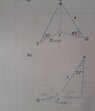
3) Determine the value of x to the nearest centimetre.
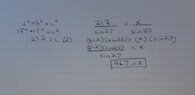
So for 3a) I found the angles of each of the sides by subtracting 180 (D is 55 on the first triangle, and 45 degrees on the second). Then I found "f" (the side opposite angle F) by using the Sine law, and I got 18cm. Then I used the sine law to find the length of the dashed line and I got 8.6cm. Then with this, I used the sine law again to calculate x. In the end, I got 12.2 cm. However, the answer in the textbook is 15cm. What did I do wrong?
For 3b, I did something similar. I found that the smaller triangle is isosceles, so the angles are: D is 70 degrees, B is 40 degrees and the one that isn't labelled is also 70 degrees. On the bigger triangle, angle B is 63 degrees. Then I used the sine law to calculate the horizontal line from B. I got 21.9cm. Then I used the sine law again to calculate x, which I found to be 48.2. However, the textbook says that x = 37.9cm. What did I do wrong?
Thanks!
3) Determine the value of x to the nearest centimetre.
So for 3a) I found the angles of each of the sides by subtracting 180 (D is 55 on the first triangle, and 45 degrees on the second). Then I found "f" (the side opposite angle F) by using the Sine law, and I got 18cm. Then I used the sine law to find the length of the dashed line and I got 8.6cm. Then with this, I used the sine law again to calculate x. In the end, I got 12.2 cm. However, the answer in the textbook is 15cm. What did I do wrong?
For 3b, I did something similar. I found that the smaller triangle is isosceles, so the angles are: D is 70 degrees, B is 40 degrees and the one that isn't labelled is also 70 degrees. On the bigger triangle, angle B is 63 degrees. Then I used the sine law to calculate the horizontal line from B. I got 21.9cm. Then I used the sine law again to calculate x, which I found to be 48.2. However, the textbook says that x = 37.9cm. What did I do wrong?
Thanks!
Attachments