Finding principal inertias for a painted area

  • Thread starter fabiancillo
  • Start date
5 replies · 2K views · last reply
fabiancillo
Messages
27
Reaction score
1
Thread moved from the technical forums to the schoolwork forums
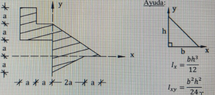
Hello I have problems with this exercise

For the painted area calculate inertias with respect to the x and y axes and the principal inertias

Hint:
$I_x = \displaystyle\frac{bh^3}{12}$
$I_{xy} = \displaystyle\frac{b^2h^2}{24}$

Thanks
 
Attachments
  • Cross-section of a shaded area on x and y axes with dimensions marked as a, a, 2a and a, plus a right triangle with legs h and b and formulas for Ix and Ixy.
    inerciaprincipals.png
    158.2 KB · Views: 188
Keeping in mind the superposition property of the moment of inertia, can you split this shape up into pieces and evaluate ##I_x## and ##I_y## for them separately?
 
ergospherical said:
Keeping in mind the superposition property of the moment of inertia, can you split this shape up into pieces and evaluate ##I_x## and ##I_y## for them separately?
I am totally blocked
 
fabiancillo said:
I am totally blocked
That's also called a moment of inertia!
 
  • Haha
  • Like
Likes   Reactions: jbriggs444, haruspex and ergospherical
fabiancillo said:
$$I_x = \displaystyle\frac{bh^3}{12}$$
$$I_{xy} = \displaystyle\frac{b^2h^2}{24}$$
Fixed the LaTeX by doubling the dollar signs.
I note you only quote equations for a triangle. Do you have any for the rectangles? If not, you'll need to cut those into triangles.
Do you know the parallel axis theorem?