Kashmir
- 466
- 74
Quantum mechanics, McIntyre, pg 62
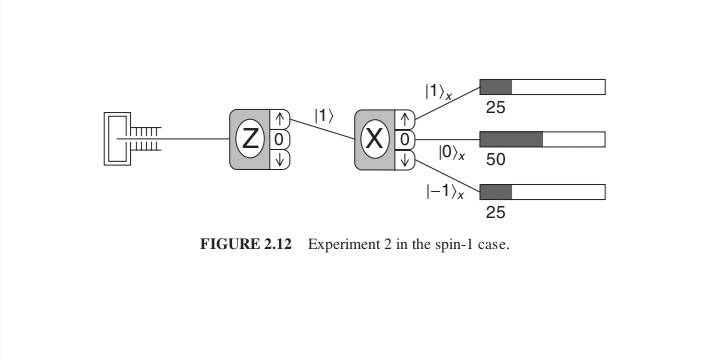
For above spin ##1## Stern Gerlach experiment a set of results is
"##
\begin{array}{c}
\mathcal{P}_{1 x}=\left.\left.\right|_{x}\langle 1 \mid 1\rangle\right|^{2}=\frac{1}{4} \\
\mathcal{P}_{0 x}=\left.\left.\right|_{x}\langle 0 \mid 1\rangle\right|^{2}=\frac{1}{2} \\
\mathcal{P}_{-1 x}=\left.\right|_{x}\left(-\left.1|1\rangle\right|^{2}=\frac{1}{4},\right.
\end{array}
##
as illustrated in Fig. 2.12. These experimental results can be used to determine the ##S_{x}## eigenstates in terms of the ##S_{z}## basis
##
\begin{array}{l}
|1\rangle_{x}=\frac{1}{2}|1\rangle+\frac{1}{\sqrt{2}}|0\rangle+\frac{1}{2}|-1\rangle \\
|0\rangle_{x}=\frac{1}{\sqrt{2}}|1\rangle-\frac{1}{\sqrt{2}}|-1\rangle \\
|-1\rangle_{x}=\frac{1}{2}|1\rangle-\frac{1}{\sqrt{2}}|0\rangle+\frac{1}{2}|-1\rangle
\end{array}
##"To find the ##S_{x}## eigenstates in terms of the ##S_{z}## basis I need two more similar experiments in which the input to Sx analyzer are ##0,-1## spin particles respectively.
However I am getting a sign ambiguity while using the experimental results.
Below are two expressions which both are in line with the experiments:
* ##|1\rangle_{x}=\frac{1}{2}|1\rangle+\frac{1}{\sqrt{2}}|0\rangle+\frac{1}{2}|-1\rangle##
##|0\rangle_{x}=\frac{1}{\sqrt{2}}|1\rangle-\frac{1}{\sqrt{2}}|-1\rangle##
##|-1\rangle_{x}=\frac{1}{2}|1\rangle-\frac{1}{\sqrt{2}}|0\rangle+\frac{1}{2}|-1\rangle ##
* ##|1\rangle_{x}=\frac{1}{2}|1\rangle+\frac{1}{\sqrt{2}}|0\rangle-\frac{1}{2}|-1\rangle##
##|0\rangle_{x}=\frac{1}{\sqrt{2}}|1\rangle+\frac{1}{\sqrt{2}}|-1\rangle##
##|-1\rangle_{x}=\frac{1}{2}|1\rangle+\frac{1}{\sqrt{2}}|0\rangle-\frac{1}{2}|-1\rangle ##How do we resolve this?
For above spin ##1## Stern Gerlach experiment a set of results is
"##
\begin{array}{c}
\mathcal{P}_{1 x}=\left.\left.\right|_{x}\langle 1 \mid 1\rangle\right|^{2}=\frac{1}{4} \\
\mathcal{P}_{0 x}=\left.\left.\right|_{x}\langle 0 \mid 1\rangle\right|^{2}=\frac{1}{2} \\
\mathcal{P}_{-1 x}=\left.\right|_{x}\left(-\left.1|1\rangle\right|^{2}=\frac{1}{4},\right.
\end{array}
##
as illustrated in Fig. 2.12. These experimental results can be used to determine the ##S_{x}## eigenstates in terms of the ##S_{z}## basis
##
\begin{array}{l}
|1\rangle_{x}=\frac{1}{2}|1\rangle+\frac{1}{\sqrt{2}}|0\rangle+\frac{1}{2}|-1\rangle \\
|0\rangle_{x}=\frac{1}{\sqrt{2}}|1\rangle-\frac{1}{\sqrt{2}}|-1\rangle \\
|-1\rangle_{x}=\frac{1}{2}|1\rangle-\frac{1}{\sqrt{2}}|0\rangle+\frac{1}{2}|-1\rangle
\end{array}
##"To find the ##S_{x}## eigenstates in terms of the ##S_{z}## basis I need two more similar experiments in which the input to Sx analyzer are ##0,-1## spin particles respectively.
However I am getting a sign ambiguity while using the experimental results.
Below are two expressions which both are in line with the experiments:
* ##|1\rangle_{x}=\frac{1}{2}|1\rangle+\frac{1}{\sqrt{2}}|0\rangle+\frac{1}{2}|-1\rangle##
##|0\rangle_{x}=\frac{1}{\sqrt{2}}|1\rangle-\frac{1}{\sqrt{2}}|-1\rangle##
##|-1\rangle_{x}=\frac{1}{2}|1\rangle-\frac{1}{\sqrt{2}}|0\rangle+\frac{1}{2}|-1\rangle ##
* ##|1\rangle_{x}=\frac{1}{2}|1\rangle+\frac{1}{\sqrt{2}}|0\rangle-\frac{1}{2}|-1\rangle##
##|0\rangle_{x}=\frac{1}{\sqrt{2}}|1\rangle+\frac{1}{\sqrt{2}}|-1\rangle##
##|-1\rangle_{x}=\frac{1}{2}|1\rangle+\frac{1}{\sqrt{2}}|0\rangle-\frac{1}{2}|-1\rangle ##How do we resolve this?