Finding the Distance Between Buoys: A Cruise Ship Balcony Problem

  • Topic:
  • Thread starter Thread starter mathdrama
  • Start date Start date
  • Tags Tags
    Ship
Join the discussion
Registration is free. Start your own thread to ask a follow-up.
3 replies · 4K views
mathdrama
Messages
20
Reaction score
0
Not really sure how to do this problem. I'm not even sure where the angles are.

5. The balcony of a cruise ship is 25m above sea level. A person standing on the balcony sees two buoy’s in the water below. The first buoy is situated directly east of her at an angle of depression of 32°. The second buoy is situated 65° south of east at an angle of depression of 40°. Find the distance (x) between the two buoys (B1 and B2) .
 

Attachments

Physics news on Phys.org
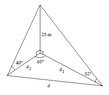
I would begin by drawing a sketch:

View attachment 2514

Now, you can use the Law of Sines to find $d_1$ and $d_2$, and then the Law of Cosines to find $d$, the distance between the buoys.

edit: You could also consider using the tangent function to find $d_1$ and $d_2$.
 

Attachments

  • buoys.jpg
    buoys.jpg
    7.2 KB · Views: 151
MarkFL said:
I would begin by drawing a sketch:

View attachment 2514

Now, you can use the Law of Sines to find $d_1$ and $d_2$, and then the Law of Cosines to find $d$, the distance between the buoys.

edit: You could also consider using the tangent function to find $d_1$ and $d_2$.

Are attachments acceptable or would LaTex still be more convenient?

Could you kindly help me check my work?
 

Attachments

Posting your work here rather than attaching it is much more convenient for those looking at your work.

One issue I have with what you have done, and it is certainly something I have seen many students do, is using rounded values in your computations. It is better to use exact values until the very end, and only then use a decimal approximation is so desired. Errors from rounding can become compounded if used in intermediary steps.

This is how I would work the problem:

$$d_1=25\cot\left(32^{\circ}\right)$$

$$d_2=25\cot\left(40^{\circ}\right)$$

Now use the Law of Cosines:

$$d^2=25^2\cot^2\left(32^{\circ}\right)+25^2\cot^2\left(40^{\circ}\right)-2\cdot25^2\cot\left(32^{\circ}\right)\cot\left(40^{\circ}\right)\cos\left(65^{\circ}\right)$$

$$d=25\sqrt{\cot^2\left(32^{\circ}\right)+\cot^2\left(40^{\circ}\right)-2\cot\left(32^{\circ}\right)\cot\left(40^{\circ}\right)\cos\left(65^{\circ}\right)}\approx38.4813948\text{ m}$$

You see, using rounded values caused you to round up when the true value should be rounded down. Other than this issue though, your method was correct.