Finding the Length of the Right Angle Bisector

  • Context:
  • Thread starter Thread starter Heatherirving
  • Start date Start date
  • Tags Tags
    Angle Length
Join the discussion
Ask a follow-up here, or get your own question answered by working scientists, mathematicians and engineers — people, not an autocomplete.
Real named experts · corrections over time · the nuance an AI answer skips
4 replies · 3K views
Heatherirving
Messages
7
Reaction score
0
Hello

I would need help to continue.

calculation problem:
Given a right angled triangle with catheter lengths a and b length units, determine and indicate the length of the bisectris to the right angle.View attachment 6595

find: Xa^2 + b^2 = (y+z)^2X^2 + y^2 = a ^2X^2 + z^2 = b ^2
 

Attachments
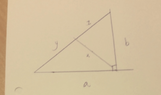
  • ScreenShot_20170509232931.png
    ScreenShot_20170509232931.png
    16.4 KB · Views: 143
Last edited:
Mathematics news on Phys.org
I agree that we can apply the Pythagorean theorem to the right triangle:

$$a^2+b^2=(y+z)^2$$

However, for the two smaller triangles, they aren't necessarily right triangles, so we could apply the Law of Cosines instead:

$$z^2=x^2+b^2-\sqrt{2}bx$$

$$y^2=x^2+a^2-\sqrt{2}ax$$

Adding these last two equations together, we find:

$$y^2+z^2=2x^2+a^2+b^2-\sqrt{2}(a+b)x$$

Application of the Law of Sines yields (where $\theta$ is the angle subtended by $b$ and $z$):

$$\frac{x}{\sin(\theta)}=\sqrt{2}z$$

$$\frac{x}{\cos(\theta)}=\sqrt{2}y$$

Multiplying them together and rewriting the trig. functions as ratios, there results:

$$2yz=\frac{x^2(a^2+b^2)}{ab}$$

Adding this to the previous sum, we get:

$$y^2+2yz+z^2=2x^2+\frac{x^2(a^2+b^2)}{ab}+a^2+b^2-\sqrt{2}(a+b)x$$

Can you proceed?
 
Many thanks for your help; :)
 
Another approach would be to use coordinate geometry...we orient the right triangle in the first quadrant with the right angle at the origin, and to the hypotenuse lies along the line:

$$\frac{x}{a}+\frac{y}{b}=1$$

And the line segment labeled "x" lies along the line:

$$y=x$$

Substituting for $y$ into the first equation, we find:

$$\frac{x}{a}+\frac{x}{b}=1$$

Hence:

$$y=x=\frac{ab}{a+b}$$

Since the diagonal of a square with sides $s$ is $\sqrt{2}s$, we conclude the length of the segment labeled "x" is:

$$x=\frac{\sqrt{2}ab}{a+b}$$

And this agrees with the eventual outcome of my first post in this thread. :D