Finding the Resultant Angle for Vector Addition Using Law of Sines and Cosines

  • Context:
  • Thread starter Thread starter bergausstein
  • Start date Start date
  • Tags Tags
    Resultant
Join the discussion
Registration is free. Ask a follow-up in this thread, or start your own.
4 replies · 3K views
bergausstein
Messages
191
Reaction score
0
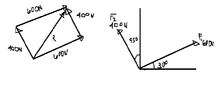
please help me solve the problem graphically,

what I know is that eventually I 'm going to be using law of sine and law of cosine for this problem. my problem is how to determine the necessary angle to be used in that method.

this is how far I can get to, I use parallelogram rule and I'm stuck. please help.

find R and $\theta_R$
 

Attachments
  • Untitled.png
    Untitled.png
    5.1 KB · Views: 161
Last edited:
Mathematics news on Phys.org
If you put the tail of $\vec{F}_2$ on the tip of $\vec{F}_1$, you can perform vector addition, right? How do you perform vector addition?
 
Ackbach said:
If you put the tail of $\vec{F}_2$ on the tip of $\vec{F}_1$, you can perform vector addition, right? How do you perform vector addition?

triangle rule
 
yes using triangle I can add them. But I can't see the proper angle to be use in doing that. please tell me how go about finding that angle.
 
bergausstein said:
yes using triangle I can add them. But I can't see the proper angle to be use in doing that. please tell me how go about finding that angle.
You know that the angle between $\vec{F_1}$ and the horizontal is $30^\circ$. The angle between $\vec{F_2}$ and the horizontal is $45^\circ + 90^\circ$. The difference between those two angles is the angle between $\vec{F_1}$ and $\vec{F_2}$.