MHB Finding the x-value of Max, Min, & Inflexion Point

  • Thread starter Thread starter markosheehan
  • Start date Start date
  • Tags Tags
    Max Point
Click For Summary
The x-values for the maximum, minimum, and inflection point are identified as 0, 8, and 4, respectively. To find critical values, the first derivative of the function f(x) = ax^3 - bx^2 is calculated and set to zero, yielding x-values of 0 and b/(2a) for local extrema. The local minimum occurs at x = b/(2a), while the inflection point is determined by setting the second derivative to zero, resulting in x = b/(4a). This analysis provides the necessary information to address further parts of the problem. Understanding the relationship between derivatives is crucial for identifying these key points.
markosheehan
Messages
133
Reaction score
0
View attachment 6299

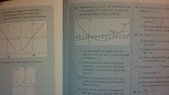
i know how to do the first two parts the x value of the max is 0 and of the minimum is 8 and 4 is the x value of the inflexion point. however i don't know how to do part 3
 

Attachments

  • WIN_20161225_12_24_00_Pro.jpg
    WIN_20161225_12_24_00_Pro.jpg
    69.4 KB · Views: 108
Physics news on Phys.org
Well, for part i) this can be explained using the fact that the first and second derivatives to not share a common root. I agree with your assessment of the $x$-values for the local extrema and point of inflection.

To answer part iii), we need to begin with:

$$f(x)=ax^3-bx^2$$

To find the critical values, we need to compute $f;(x)$ and equate this to zero and solve for $x$:

$$f'(x)=4ax^2-2bx=2x(2ax-b)=0$$

Hence:

$$x\in\left\{0,\frac{b}{2a}\right\}$$

From the graph, we know that the $x$ value of the local minimum must be:

$$x=\frac{b}{2a}$$

For the point of inflection, we set $f''(x)=0$:

$$f''(x)=8ax-2b=2(4a-b)=0$$

Hence, the $x$-value of the point of inflection must be:

$$x=\frac{b}{4a}$$

And now we have enough information to answer part iv). :D
 
There are probably loads of proofs of this online, but I do not want to cheat. Here is my attempt: Convexity says that $$f(\lambda a + (1-\lambda)b) \leq \lambda f(a) + (1-\lambda) f(b)$$ $$f(b + \lambda(a-b)) \leq f(b) + \lambda (f(a) - f(b))$$ We know from the intermediate value theorem that there exists a ##c \in (b,a)## such that $$\frac{f(a) - f(b)}{a-b} = f'(c).$$ Hence $$f(b + \lambda(a-b)) \leq f(b) + \lambda (a - b) f'(c))$$ $$\frac{f(b + \lambda(a-b)) - f(b)}{\lambda(a-b)}...

Similar threads

  • · Replies 9 ·
Replies
9
Views
2K
  • · Replies 4 ·
Replies
4
Views
2K
Replies
3
Views
1K
  • · Replies 10 ·
Replies
10
Views
3K
  • · Replies 4 ·
Replies
4
Views
2K
  • · Replies 1 ·
Replies
1
Views
2K
  • · Replies 3 ·
Replies
3
Views
2K
  • · Replies 4 ·
Replies
4
Views
11K
  • · Replies 3 ·
Replies
3
Views
2K
  • · Replies 3 ·
Replies
3
Views
2K