Finding torque equations for a bottle opener problem

  • Thread starter Thread starter Soicowboy
  • Start date Start date
  • Tags Tags
    Torques
Join the discussion
Registration is free. Start your own thread to ask a follow-up.
24 replies · 5K views · last reply
Soicowboy
Messages
14
Reaction score
3
Homework Statement
Learning from home over quarantine, need help finding online learning material
Relevant Equations
Torque / rotational force?
Hi guys I'm studying at home over lock down would anybody be able to point me in the direction of some online learning material or what concept I should look up to solve this problem and find formulas . I'm stuck and can't find anything relevant online while searching.
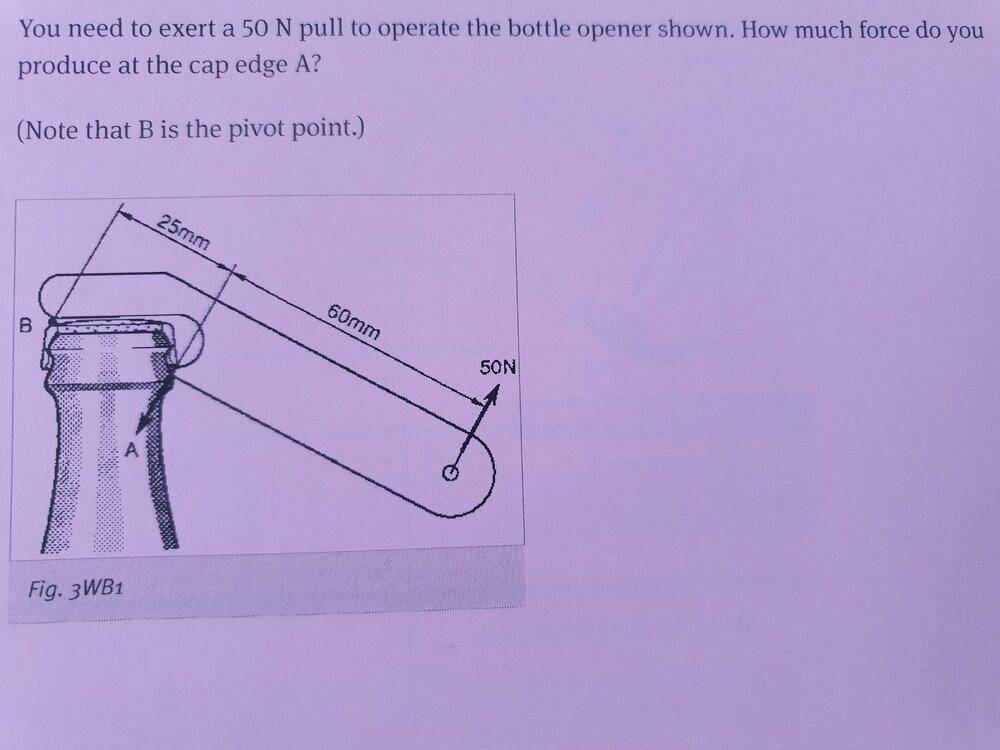
Line drawing of a bottle opener lever pivoting at point B on a bottle cap, with edge A marked. Labels: 25mm from the pivot to the cap edge, 60mm from the cap edge to the handle end, and a 50N force arrow at the handle.


Thanks guys any help is great I'm not really a physics guy this if for a fabrication course I'd normally get help at a night school
 
Last edited by a moderator:
Physics news on Phys.org
Welcome to the PF. :smile:

Are you familiar with drawing free body diagrams (FBDs)? If so draw one for this problem (call the right end where the force is applied "C").

And with FBDs, are you familiar with using the sum of torques and sum of forces to figure out any accelerations, etc. for the object represented by the FBD?

I believe that for this problem you will just set the sum of the two torques B-C and B-A to zero to find the force at B...

Does that help?
 
Thanks a lot I'll look up and learn those concepts and post my working. Appreciate your time thank you
 
  • Like
Likes   Reactions: berkeman
Soicowboy said:
Thanks a lot I'll look up and learn those concepts and post my working. Appreciate your time thank you
Great, we look forward to that. Just to clarify a bit, the two torques on the bottle opener (which you will show in your FBD) are the torque from the 50N force applied at "C" about the fulcrum point at "B", and a counter torque from the force between the opener and the bottlecap at "A" about the same fulcrum point "B".
 
CM = CCM

A x 0.025 = 50N x 0.085
A x 0.025 = 4.25NM

A= 4.25 / 0.025

= 170N?
 
  • Like
Likes   Reactions: Chestermiller
Soicowboy said:
CM = CCM

A x 0.025 = 50N x 0.085
A x 0.025 = 4.25NM

A= 4.25 / 0.025

= 170N?
Yes.
 
Would the same equation and using a FBD and sum of forces be applicable to this problem.

Really appreciate your guys / girls time thank you.
 
Attachments
  • Printed textbook problem showing a claw hammer pulling a nail from a wooden board, with effort P applied at the handle, a 300 dimension along the handle and 50 marked along the board; labelled Fig. 5WB1.
    20200508_120722.jpg
    47.7 KB · Views: 409
Soicowboy said:
Would the same equation and using a FBD and sum of forces be applicable to this problem.

Really appreciate your guys / girls time thank you.
Sure
 
Chestermiller said:
Sure
 
Attachments
  • Handwritten lever diagram: a bar with a fulcrum below its right end, a force P of 200 N pointing up at the left end, a 0.3 m distance from P to a point marked with a question mark and a downward arrow, and 0.05 m from that point to the fulcrum.
    20200508_125712.jpg
    44.3 KB · Views: 295
haruspex said:
Close, but at one point you turned 0.05 into 0.5.
70 / 0.05
= 1400N ?

For part b of the problem. Would you divide the first anwser to find out how much more force is required to generate another 100N.

Thank you so much!
 
Soicowboy said:
= 1400N ?
Yes. It's always a good idea to do a sanity check. Would you expect the force to be more or less than the applied 200N?
Soicowboy said:
For part b of the problem
Part b? Of which problem?
 
  • Like
Likes   Reactions: Soicowboy
haruspex said:
Yes. It's always a good idea to do a sanity check. Would you expect the force to be more or less than the applied 200N?

Part b? Of which problem?
I think I solved it ?
 
Attachments
  • Photo of a printed exam worksheet, Question 6, showing a hammer diagram labelled 350 and 50 and handwritten working for parts (a) and (b) involving moments with 0.05 and 0.35.
    20200508_150808.jpg
    32.2 KB · Views: 285
haruspex said:
Yes. It's always a good idea to do a sanity check. Would you expect the force to be more or less than the applied 200N?

Part b? Of which problem?
Haha yup that makes total sense, wasn't being logical and focusing properly.
 
Soicowboy said:
I think I solved it ?
Your FBD for 6a was wrong.
You need the perpendicular distance from the force to the fulcrum. For P, that means the distance from the fulcrum point to the infinite straight line which is the line of action of P. The exact point where P is applied is not relevant.

Edit: besides, the 300mm and the 50mm are not in the same direction, so it makes no sense to add them.
 
  • Like
Likes   Reactions: Soicowboy
haruspex said:
Your FBD for 6a was wrong.
You need the perpendicular distance from the force to the fulcrum. For P, that means the distance from the fulcrum point to the infinite straight line which is the line of action of P. The exact point where P is applied is not relevant.

Edit: besides, the 300mm and the 50mm are not in the same direction, so it makes no sense to add them.
So you wouldn't include the 50mm on the line and just work off 300mm?
 
haruspex said:
Right.
 
Attachments
  • Worksheet photo titled Question 6 with handwritten moment calculations for a claw hammer levering a nail: part (a) gives A x 0.05 = 200 x 0.3, A = 60, 60 / 0.05 = 1200 N; part (b) works 250 x 0.3 = 75, 75 / 0.05 = 1500 N, and 216.665 N pull on the hammer.
    15900144419985702922549029207744.jpg
    32.5 KB · Views: 257
6a is right now, but I do not understand your working in part b.
What is the 250?
How did you get the last line?
The trouble with just posting numbers is that it gives me no insight into what you are doing. Please explain your steps.