Finding total distance on a position vs time graph

Click For Summary

Homework Help Overview

The discussion revolves around interpreting a position versus time graph to calculate total distance traveled. The original poster expresses confusion regarding their calculations and seeks clarification on the correct approach to determine distance from the graph.

Discussion Character

  • Conceptual clarification, Assumption checking

Approaches and Questions Raised

  • The original poster attempts to calculate distance by multiplying position values by time intervals, leading to confusion about the validity of their results. Participants question the appropriateness of this method and clarify the distinction between position and time.

Discussion Status

Participants are actively engaging in clarifying the concepts involved in interpreting the graph. Some guidance has been provided regarding the correct interpretation of distance in relation to the graph, but there is no explicit consensus on the original poster's calculations.

Contextual Notes

The original poster is preparing for exams and is reviewing material from previous lessons, indicating a potential gap in understanding the fundamental concepts of position versus time graphs.

physicsnerd26
Messages
20
Reaction score
0
I feel terrible for even having to ask this. I'm doing A2 at the moment, and we've gone through these sorts of lessons ever since my early AS days. I'm trying to review my notes cos exams are coming soon and I did some questions, and I'm apparently doing them wrong with what the answers are showing me at the back of the book.

Can anybody explain it to me? I'm talking about the kind of graph that goes from negative to positive.
Here's an example of a graph I'm talking about I found on the internet:
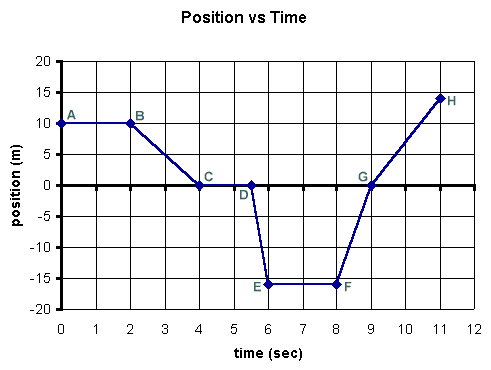
f71554f3-d21e-4a7d-986f-ea89e5208993.gif


What I do is technically
A to B would be -> 10 x 2 = 20m
B to C would be -> (10 x 2)/2 = 10m
C to D would be 0
D to E would be - > (0.5 x -15)/2 = -3.75m, but it's distance so it's 3.75m
E to F would be 0
F to G would be -> (15 x 1)/2 =7.5m
G to H would be -> (2 x 15)/2 = 15m

so overall, I just add them all up so, 20+10+3.75+7.5+15 = 56.25m

Have I been doing it completely wrong?
 
Physics news on Phys.org
I moved the thread to our homework section.
physicsnerd26 said:
A to B would be -> 10 x 2 = 20m
If you spend two seconds standing on a mark on the floor that says "10 meters", which distance did you cover during those two seconds?
If you spend one second running from a mark "-16 meter" to a mark "0" 16 meters away, what is the distance you covered?

It is a position versus time graph, not a speed versus time graph.
 
mfb said:
I moved the thread to our homework section.

Sorry about that. And thanks.

If you spend two seconds standing on a mark on the floor that says "10 meters", which distance did you cover during those two seconds?

So I should do position/time instead of multiplying them together?

If you spend one second running from a mark "-16 meter" to a mark "0" 16 meters away, what is the distance you covered?
Still 16, wouldn't it?

It is a position versus time graph, not a speed versus time graph.

Yeah, I get confused between the two most of the time. Can you tell me if my answers above are correct?
 
physicsnerd26 said:
So I should do position/time instead of multiplying them together?
The answer is much easier. Just check where you are when. If you have to move from position x to y, you have to move by ...
It does not matter how long that takes.
physicsnerd26 said:
Still 16, wouldn't it?
Right, but you calculated a different, wrong value.
physicsnerd26 said:
Yeah, I get confused between the two most of the time. Can you tell me if my answers above are correct?
They are not.
 
  • Like
Likes   Reactions: physicsnerd26
physicsnerd26 said:
A to B would be -> 10 x 2 = 20m
This makes no sense. Between A and B, the position didn't change. Also, the units don't make sense -- you're multiplying a position (in m.) by a time (in sec.) so you wouldn't get meters as a result. In fact, you don't get anything meaningful by multiplying the position by the time.
 
  • Like
Likes   Reactions: physicsnerd26

Similar threads

  • · Replies 9 ·
Replies
9
Views
1K
Replies
12
Views
8K
  • · Replies 3 ·
Replies
3
Views
2K
Replies
8
Views
5K
  • · Replies 3 ·
Replies
3
Views
2K
  • · Replies 4 ·
Replies
4
Views
5K
  • · Replies 2 ·
Replies
2
Views
5K
Replies
5
Views
2K
  • · Replies 17 ·
Replies
17
Views
3K
  • · Replies 2 ·
Replies
2
Views
5K