Math Amateur
Gold Member
MHB
- 3,920
- 48
I am reading "Algebra: An Approach via Module Theory" by William A. Adkins and Steven H. Weintraub ...
I am currently focused on Chapter 2: Rings ...
I need help with an aspect of the proof of Proposition 1.5 ... ...
Proposition 1.5 and its proof read as follows:
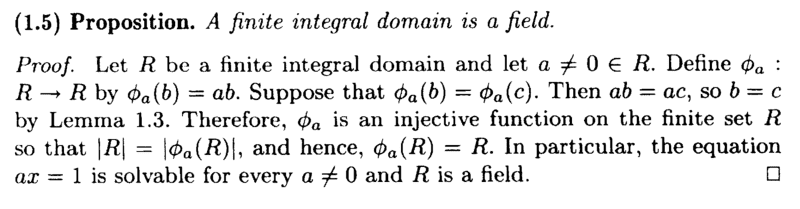 At the end of the above proof from Adkins and Weintraub we read the following:
" ... ... and hence ##\phi_a (R) = R##. In particular, the equation ##ax = 1## is solvable for every ##a \neq 0## and ##R## is a field. ... ... "
Can someone please explain to me how the conclusion that "the equation ##ax = 1## is solvable for every ##a \neq 0## and ##R## is a field" follows from the arguments preceding it ...
Basically I do not understand how the arguments before this statement lead to the conclusion ...Help will be much appreciated ...
Peter
I am currently focused on Chapter 2: Rings ...
I need help with an aspect of the proof of Proposition 1.5 ... ...
Proposition 1.5 and its proof read as follows:
" ... ... and hence ##\phi_a (R) = R##. In particular, the equation ##ax = 1## is solvable for every ##a \neq 0## and ##R## is a field. ... ... "
Can someone please explain to me how the conclusion that "the equation ##ax = 1## is solvable for every ##a \neq 0## and ##R## is a field" follows from the arguments preceding it ...
Basically I do not understand how the arguments before this statement lead to the conclusion ...Help will be much appreciated ...
Peter
