questionpanda
- 3
- 1
- TL;DR
- Question about fluid dynamics in a pipe system to help minimise water overflowing at its source in a basic rainwater system setup using a supplementary tank inlet.
Hi there!
First time poster. Hopefully posting to the correct forum
The attached image has two different pipe setups.
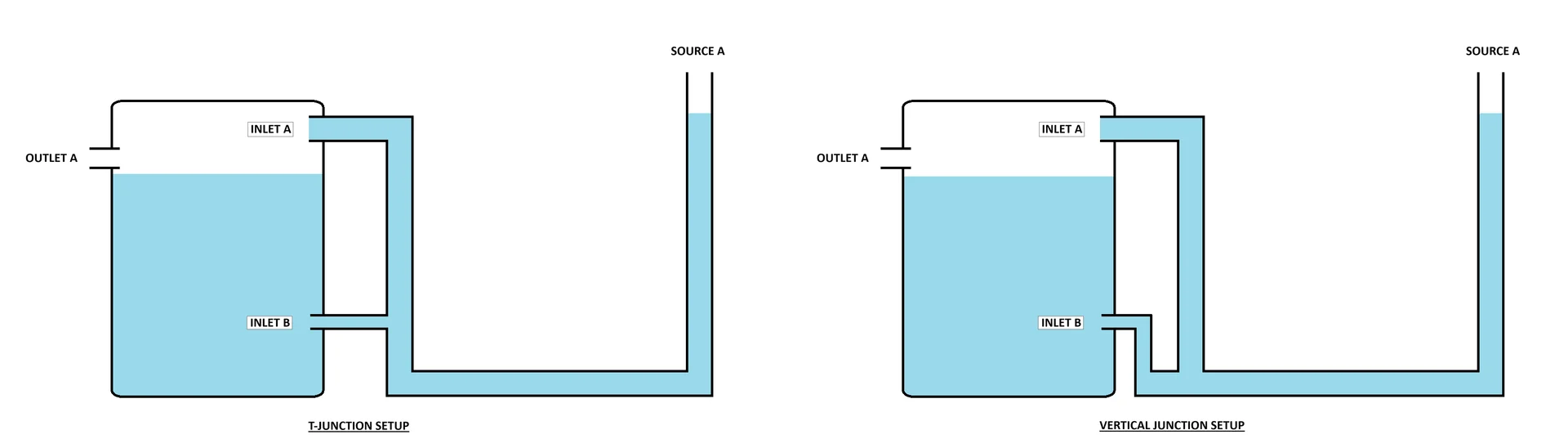
Both setups have a tank with an upper inlet (A) and a lower inlet (B). Inlet B is half the diameter of inlet A.
The setup on the left hand side has inlet B connected as a T-junction to the vertical pipe that feeds water to inlet A.
The setup on the right hand side has inlet B connected to a small vertical riser connected to the main branch of the pipe system.
Water fills the pipe from source A and initially enters the tank via the smaller inlet B.
As water continues to fill the pipe system, the level in the tank and pipe rises.
At some point, water in the pipe system will start entering the tank from the upper inlet A as the water level in the pipe system rises.
Which setup would less likely cause the source point A to overflow if the incoming supply of water is coming in quicker than what the pipe system and tank inlets A and B can cope with?
I have a very limited understanding of fluid dynamics and my initial research using (freely available) AI chatbots has helped me to understand a little about "head pressures" and "communicating vessels". However, the AI chatbots often come up with contradictory answers to my question as to which system is better suited to prevent overflows at the source.
The background to this question is in regards to a rainwater harvesting system that uses charged downpipes (otherwise known as a 'wet system) to fill a water tank. The current system tends to overflow at the source (downpipe) during heavy rain. A rainwater harvesting forum suggested adding a supplementary inlet (B) to the water tank to provide some relief to the main inlet (A).
I would appreciate if some one can better explain in (basic terms) the "fluid dynamics" that are occurring in the different setups.
First time poster. Hopefully posting to the correct forum
The attached image has two different pipe setups.
Both setups have a tank with an upper inlet (A) and a lower inlet (B). Inlet B is half the diameter of inlet A.
The setup on the left hand side has inlet B connected as a T-junction to the vertical pipe that feeds water to inlet A.
The setup on the right hand side has inlet B connected to a small vertical riser connected to the main branch of the pipe system.
Water fills the pipe from source A and initially enters the tank via the smaller inlet B.
As water continues to fill the pipe system, the level in the tank and pipe rises.
At some point, water in the pipe system will start entering the tank from the upper inlet A as the water level in the pipe system rises.
Which setup would less likely cause the source point A to overflow if the incoming supply of water is coming in quicker than what the pipe system and tank inlets A and B can cope with?
I have a very limited understanding of fluid dynamics and my initial research using (freely available) AI chatbots has helped me to understand a little about "head pressures" and "communicating vessels". However, the AI chatbots often come up with contradictory answers to my question as to which system is better suited to prevent overflows at the source.
The background to this question is in regards to a rainwater harvesting system that uses charged downpipes (otherwise known as a 'wet system) to fill a water tank. The current system tends to overflow at the source (downpipe) during heavy rain. A rainwater harvesting forum suggested adding a supplementary inlet (B) to the water tank to provide some relief to the main inlet (A).
I would appreciate if some one can better explain in (basic terms) the "fluid dynamics" that are occurring in the different setups.
