Franck-Hertz: Overall behaviour of the current

  • Context: Undergrad 
  • Thread starter Thread starter greypilgrim
  • Start date Start date
  • Tags Tags
    Current Franck-hertz
Click For Summary
SUMMARY

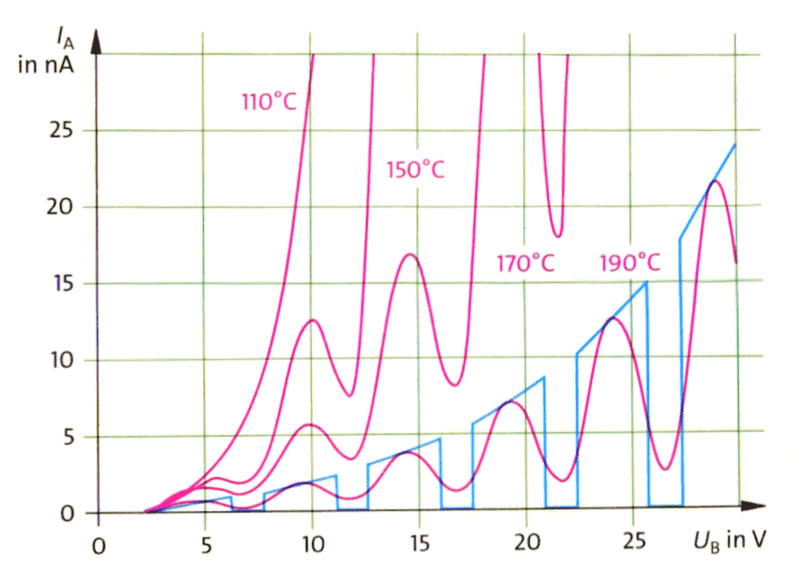
The discussion centers on the Franck-Hertz experiment, specifically analyzing the relationship between detected current and acceleration voltage. The idealized behavior of the current is quadratic, influenced by the energy required to release electrons from the hot cathode. The first drop in current occurs at 4.9 V when mercury (Hg) is used as the medium, indicating atomic transitions that absorb energy. The temperature of the cathode, noted at 190°C, is considered low for plasma arcs but may be adequate for this experiment.

PREREQUISITES
  • Understanding of the Franck-Hertz experiment
  • Knowledge of electron behavior in electric fields
  • Familiarity with atomic transitions and energy absorption
  • Basic principles of thermionic emission from cathodes
NEXT STEPS
  • Research the mathematical modeling of the Franck-Hertz experiment
  • Explore the role of different gases in the Franck-Hertz experiment
  • Learn about thermionic emission and its dependence on temperature
  • Investigate the significance of cathode temperature in plasma physics
USEFUL FOR

Physics students, experimental physicists, and educators interested in atomic physics and the Franck-Hertz experiment will benefit from this discussion.

greypilgrim
Messages
583
Reaction score
44
Hi.

The blue curve shows the idealized behaviour of the detected current vs. the acceleration voltage in a Franck-Hertz experiment:
SCAN0082.png

  1. It appears that the underlying behaviour is quadratic, why? I calculated the time for an electron to reach the grid at distance ##d## from the hot cathode to be $$t=d\cdot\sqrt\frac{2m_e}{U_B\cdot e}\enspace.$$ Now I'm not sure how to use this. How many electrons are released at the hot cathode per second? Does this depend on ##U_B## as well? I think so, otherwise there shouldn't be an overall increase of the blue curve at all.
  2. Why isn't the first drop at exactly 4.9 V? Is there still energy needed to release electrons even from a hot cathode? This would probably agree with 1., but is there a simple quantitative relation?
 

Attachments

  • SCAN0082.png
    SCAN0082.png
    64.8 KB · Views: 1,187
Physics news on Phys.org
What is the gas that was used as the medium? You can expect the current to increase with voltage. Whether it can be expected to be a quadratic dependence is something I'm not sure of. The places where the current drops considerably are where the gas has atomic transitions and absorbs energy. ## \\ ## Edit: I googled it=if mercury (Hg) is used as the medium, 4.9 volts is the place where the first dip occurs. Perhaps you had something other than mercury. ## \\ ## As for the temperatures on the graphs=is that the cathode temperature for different cases? I don't have sufficient expertise with this particular experiment to know whether T=190 C is a suitable cathode temperature. As plasma arcs go, that is a very cool cathode, but perhaps it is sufficient for the Franck-Hertz experiment.
 
Last edited:

Similar threads

  • · Replies 3 ·
Replies
3
Views
3K
Replies
4
Views
3K
  • · Replies 41 ·
2
Replies
41
Views
6K
  • · Replies 9 ·
Replies
9
Views
2K
  • · Replies 1 ·
Replies
1
Views
4K
  • · Replies 5 ·
Replies
5
Views
5K