Discussion Overview
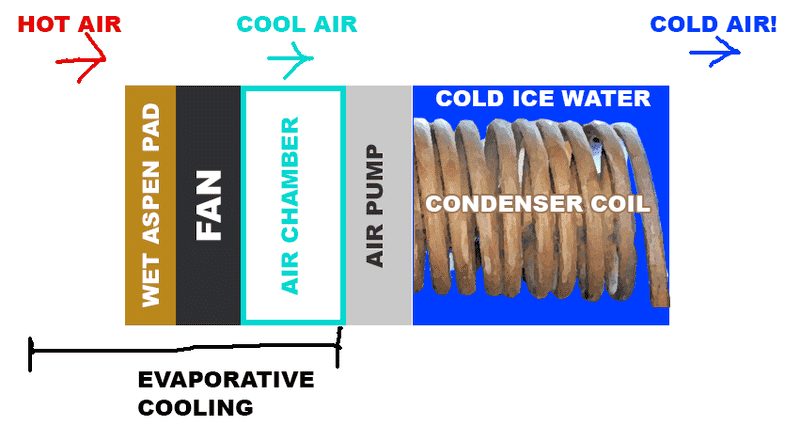
The discussion revolves around the effectiveness of further cooling air that has already been subjected to evaporative cooling. Participants explore the potential methods and implications of using ice and air pumps in conjunction with evaporative cooling systems, considering energy efficiency and humidity effects.
Discussion Character
- Exploratory
- Technical explanation
- Conceptual clarification
- Debate/contested
- Experimental/applied
Main Points Raised
- Some participants propose using ice to further cool air after it has been evaporatively cooled, questioning the effectiveness and energy efficiency of this method.
- Others seek clarification on the cooling process, specifically whether air is pumped through coils cooled by ice water.
- One participant explains that the method discussed is contrary to how traditional air conditioning operates, emphasizing the need for proper heat exchange between air and water.
- Concerns are raised about the humidity introduced by evaporative cooling, which can produce heat due to condensation, particularly in high humidity environments.
- Another participant shares their intention to experiment with different pad thicknesses and water saturation levels in a dry climate to optimize cooling effects.
- Indirect evaporative cooling methods are mentioned as being effective in certain climates, suggesting a potential model for the discussed cooling system.
- One participant notes the performance of new wood-shaving pads in evaporative coolers, indicating that they may not work effectively until they have aged through use.
- A suggestion is made to use a heat exchanger to leverage the advantages of dry air, proposing a system that could pre-cool incoming air before it is evaporatively cooled.
Areas of Agreement / Disagreement
Participants express a range of views on the effectiveness and practicality of further cooling methods, with no consensus reached on the best approach. Some agree on the challenges posed by humidity, while others propose different cooling strategies without resolving the overall effectiveness of the initial concept.
Contextual Notes
Participants highlight limitations related to energy efficiency, humidity effects, and the performance of cooling pads over time. The discussion also reflects varying environmental conditions that may influence the effectiveness of the proposed methods.
Who May Find This Useful
This discussion may be of interest to individuals exploring innovative cooling solutions, particularly in dry climates, as well as those involved in HVAC design or experimental cooling systems.