GAIA - 1 billion stars and counting

Click For Summary
SUMMARY

The GAIA telescope has successfully mapped over 1 billion stars in the Milky Way, creating the most detailed 3D map of our galaxy to date. This mapping effort, part of GAIA's first data release (DR1), suggests potential new insights into the shape of the Milky Way. Users can access the data at archives.esac.esa.int/gaia. Additionally, the open-source visualization tool Gaia Sky allows users to explore this data in a 3D environment, with a WebGL version available at wwwstaff.ari.uni-heidelberg.de/gaiasandbox/webgl.

PREREQUISITES
  • Understanding of astronomical data and mapping techniques
  • Familiarity with the GAIA telescope and its mission
  • Basic knowledge of 3D visualization tools
  • Experience with WebGL for browser-based applications
NEXT STEPS
  • Explore the GAIA data release at archives.esac.esa.int/gaia
  • Learn to use Gaia Sky for 3D visualization of stellar data
  • Investigate the Sloan Digital Sky Survey and its mapping techniques at www.sdss.org
  • Research WebGL development for creating interactive astronomical visualizations
USEFUL FOR

Astronomers, astrophysicists, data visualization developers, and anyone interested in exploring the structure of the Milky Way and utilizing advanced astronomical data.
Borg
Science Advisor
Gold Member
Messages
2,331
Reaction score
5,052
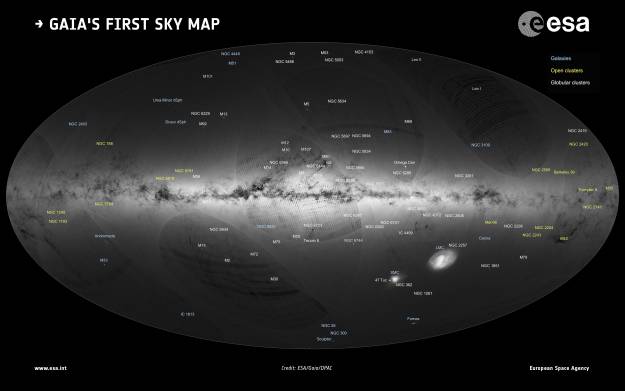
The GAIA telescope has been mapping stars in the Milky Way with unprecedented quality and quantities. It has been assembling the most detailed 3D map ever made of our Milky Way galaxy and has currently mapped over 1 billion stars. There are already hints that the Milky Way may be shaped differently from what we thought.

Gaia's billion-star map hints at treasures to come

Gaia_GDR1_Sky_Map_annotated_signature_625.jpg
The data from Gaia's first release can be accessed at http://archives.esac.esa.int/gaia
 
  • Like
Likes   Reactions: Kia Neves, CalcNerd, rootone and 7 others
Astronomy news on Phys.org
Borg said:
The GAIA telescope has been mapping stars in the Milky Way with unprecedented quality and quantities. It has been assembling the most detailed 3D map ever made of our Milky Way galaxy and has currently mapped over 1 billion stars. There are already hints that the Milky Way may be shaped differently from what we thought.

Gaia's billion-star map hints at treasures to come

The data from Gaia's first release can be accessed at http://archives.esac.esa.int/gaia
yup, this is pretty impressive :)Dave
 
Would it be possible to develop a program from this data where you could move through the galaxy in 3D or like Google Maps?
 
  • Like
Likes   Reactions: Noah Marshall and hsdrop
Greg Bernhardt said:
Would it be possible to develop a program from this data where you could move through the galaxy in 3D or like Google Maps?
My thoughts as well. Unfortunately, I'm much too busy at work or I would. :smile:
 
Where is the "you are here" sign?...lol

Joking aside, it is a cool map and a fascinating project.

Cheers,

Billy
 
AFAIU Gaia DR1 is just a 'preview' after only 14 month of operation out of five years. It does not include much more then the Hipparcos catalog - at least regarding parallax data and a few bright stars are not there yet. So right now Gaia Sky is probably not better then the mature and well established Celestia software... which will certainly incorporate the final data release when it will be available in a few years.

Note that there is a WebGL version of Gaia Sky that can run right off the net into a browser window - when it doesn't crash.
 
would you happen to have the link to the browser based vr.?
also could we do the same for whole galaxy to get a good sense of the out would shape of the cosmos?


i also wanted to thank you for the post very much:wideeyed::partytime:
 
hsdrop said:
would you happen to have the link to the browser based vr.?
also could we do the same for whole galaxy to get a good sense of the out would shape of the cosmos?

Gaia Sky WebGL:
http://wwwstaff.ari.uni-heidelberg.de/gaiasandbox/webgl

At a larger scale we have the Sloan Digital Sky Survey that has mapped distant objects and produced some remarkable maps showing 'sponge' like structures:
http://www.sdss.org

 
  • Like
Likes   Reactions: hsdrop
  • #10
patmurris said:
Gaia Sky WebGL:
http://wwwstaff.ari.uni-heidelberg.de/gaiasandbox/webgl

At a larger scale we have the Sloan Digital Sky Survey that has mapped distant objects and produced some remarkable maps showing 'sponge' like structures:
http://www.sdss.org


thank you so very much for the links
 

Similar threads

  • · Replies 1 ·
Replies
1
Views
2K
  • · Replies 4 ·
Replies
4
Views
2K
  • · Replies 5 ·
Replies
5
Views
3K
  • · Replies 6 ·
Replies
6
Views
3K
  • · Replies 19 ·
Replies
19
Views
3K
  • · Replies 6 ·
Replies
6
Views
3K
  • · Replies 2 ·
Replies
2
Views
3K
  • · Replies 1 ·
Replies
1
Views
2K
  • · Replies 24 ·
Replies
24
Views
7K
  • · Replies 6 ·
Replies
6
Views
4K